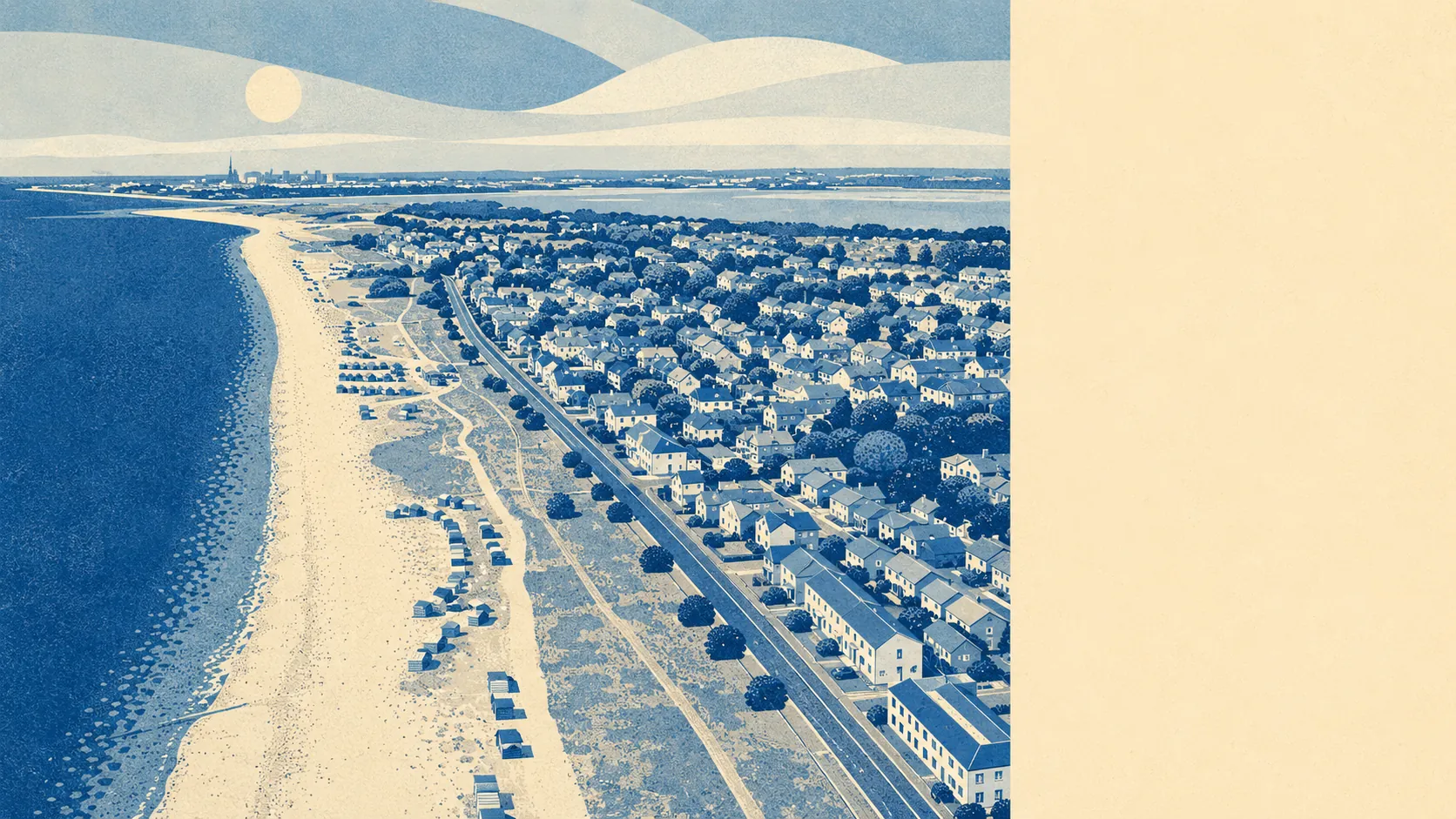
An inverted T of bungalows surrounded by tidal water. One road on, the median age fifty-seven. Three in ten work from home and most of the rest don't work at all. The windsurfer was invented here in 1958 by a twelve-year-old. The retirees who arrived after him never left.
The housing stock is what produces all the rest. Houses lead at about four in ten, flats just over three in ten, and bungalows nearly a quarter of everything standing. The bungalow share alone tells you who's buying. About four in ten homes carry a middle-of-the-road energy rating, around the same share sit in the better bands, and nearly one in five rate poorly enough that the heating bill is the second conversation after the asking price. Most of the homes went up between 1950 and 1982, which the energy ratings politely confirm.
A typical Hayling Island sale over the last twelve months landed at about £356,000, off a depth of 233 transactions. The split is more useful than the headline. Detached houses move at around £450,000, semis at about £327,000, terraced at £305,000, flats at £167,500. Council tax sits modally at band C, with roughly a quarter of homes at band A or B. None of that is Sandbanks money, and the Sandbanks crowd never came to look.
The typical private rent across the Havant area is about £1,130 a month, which is the figure that covers Hayling because the available data is reported at local-authority level. A two-bed runs about £1,070, a three-bed about £1,330. Rents have moved up about two percent over the last year. The Havant figure folds in mainland Leigh Park and Havant town itself, both of which sit below the island. Anyone quoting you a Hayling-only rent yield to a decimal place is reading you a number they don't have.
Crime runs at around sixty-five incidents per thousand residents over the last twelve months, about 23 percent below the Havant Borough average. There is one road on and one road off, which has a way of moderating the kind of crime that depends on a quick getaway.
Less than one percent of working residents commute by train, which is what happens when the line closed in 1963 and nobody rebuilt the bridge. About half drive to work, three in ten work from home, and the bus, walk and cycle shares between them come to roughly one in ten. Havant Rail Station, on the mainland, is the nearest railhead, with Portsmouth and Southsea Rail Station further west. Broadband is fine: gigabit coverage runs at three-quarters of postcodes and superfast at almost all of them. The signal arrived before the second carriageway did, and there is still no second carriageway.
The flood story is the one that earns the conveyancer's fee. Around eleven percent of the island's postcodes sit in Environment Agency Flood Zone 3, and roughly two percent record a historic flood. Surface water risk reads differently again: around seven percent of postcodes carry a high rating, around one in ten medium, and over a third low. The compensations sit close to the doorstep. Most homes are within roughly 270 metres of green space and have around ten green spaces inside a kilometre. About three percent of the island overlaps the Chichester Harbour Area of Outstanding Natural Beauty, Sinah Common is a Site of Special Scientific Interest, and tidal water is yards away in every direction. The flood map is the real conversation. The view is what got you here in the first place.
There are 49 listed buildings on the island, one Grade I, one Grade II starred, and 47 Grade II. There is one conservation area and two scheduled monuments. If you own a listed property, your window frames are a discussion you'll have with the council before you have it with the joiner. For everyone else, the heritage constraints are mild by south-coast standards.
About three-quarters of households own their home, well above the regional norm. The median household income is around £49,500. One in three households contains a single person and one in five a single pensioner. Couples with children make up about one in nine. This is not where the school-run is the dominant traffic event of the morning, and it has not been for thirty years.
Hayling Island suits the buyer whose life does not depend on a station within walking distance, a school catchment, or any evening anywhere being open past nine. The bungalow stock is what people downsize into when they have decided what kind of life they want next. The proximity to water, the green-space network, the low crime rate and the Area of Outstanding Natural Beauty designation are the actual product. If those are what you want, this is the place that already has them.
It is not for anyone who needs the train, the catchments, or the kind of restaurant scene a city has by accident. It is not for the buyer expecting Sandbanks-grade water frontage at Sandbanks prices: that frontage is here, the prices are not, and the wealthy retiree fantasy has happily gone elsewhere. And it is not for the buyer who wanted Whitstable but flinched at Kent prices and thought the south coast might do. Buy in Bognor Regis like the borough boundary tells you, or commit to Canvey Island if a flood map is the bit you're already comfortable with.
The notable residents say more about who the place attracts than the brochure ever will. Peter Chilvers built the first windsurfer here in 1958, at the age of twelve, on Hayling sand. The Court of Appeal decided in 1982 that everything that came after the board was an obvious extension, which is the kind of legal judgement only a coastal twelve-year-old with a sail could earn. Princess Catherine Yurievskaya, daughter of Alexander II of Russia, lived in North Hayling for years and is buried at St Peter's. The novelist Marjorie Bowen was born on the island. Inventors, deposed aristocrats and writers who liked the quiet. None of them needed a station.
The verdict comes in above average. The surrounding area and the green-space network do the heaviest lifting, scoring as well as the rating system goes. The connectivity pulls the average down: no station, thin bus network, and a pedestrian ferry to Eastney that spent a year out of action a decade ago and has never quite recovered the cadence. Not Sandbanks, not Whitstable, just a quieter Bognor with a Chichester Harbour view and a flood map worth reading before exchange.