Sawbridgeworth is a town of owners who moved in meaning to stay, and for most buyers that is the best reason to live here. About three in four households own their home, the typical resident is in their mid-forties, and poor health is unusual enough to be a talking point. For someone arriving, that means neighbours with a stake in the street and a very long memory for who parked across whose drive in the last decade.
The 2021 Census puts home ownership at about 74%, with 19% renting privately and 8% in social housing. The median age is 45, a third of adults hold a degree, and unemployment runs at 2%. The Office for National Statistics models gross household income at about £65,600 for the financial year to March 2023, averaged across the town's two middle-sized statistical areas. On the government's deprivation index, its neighbourhoods were in the ninth of ten bands in both 2019 and 2025, at the least-deprived end. By the Norman conquest Sawbridgeworth was already the richest village community in the county, so the current comfort is less a boom than an old habit the town never broke.
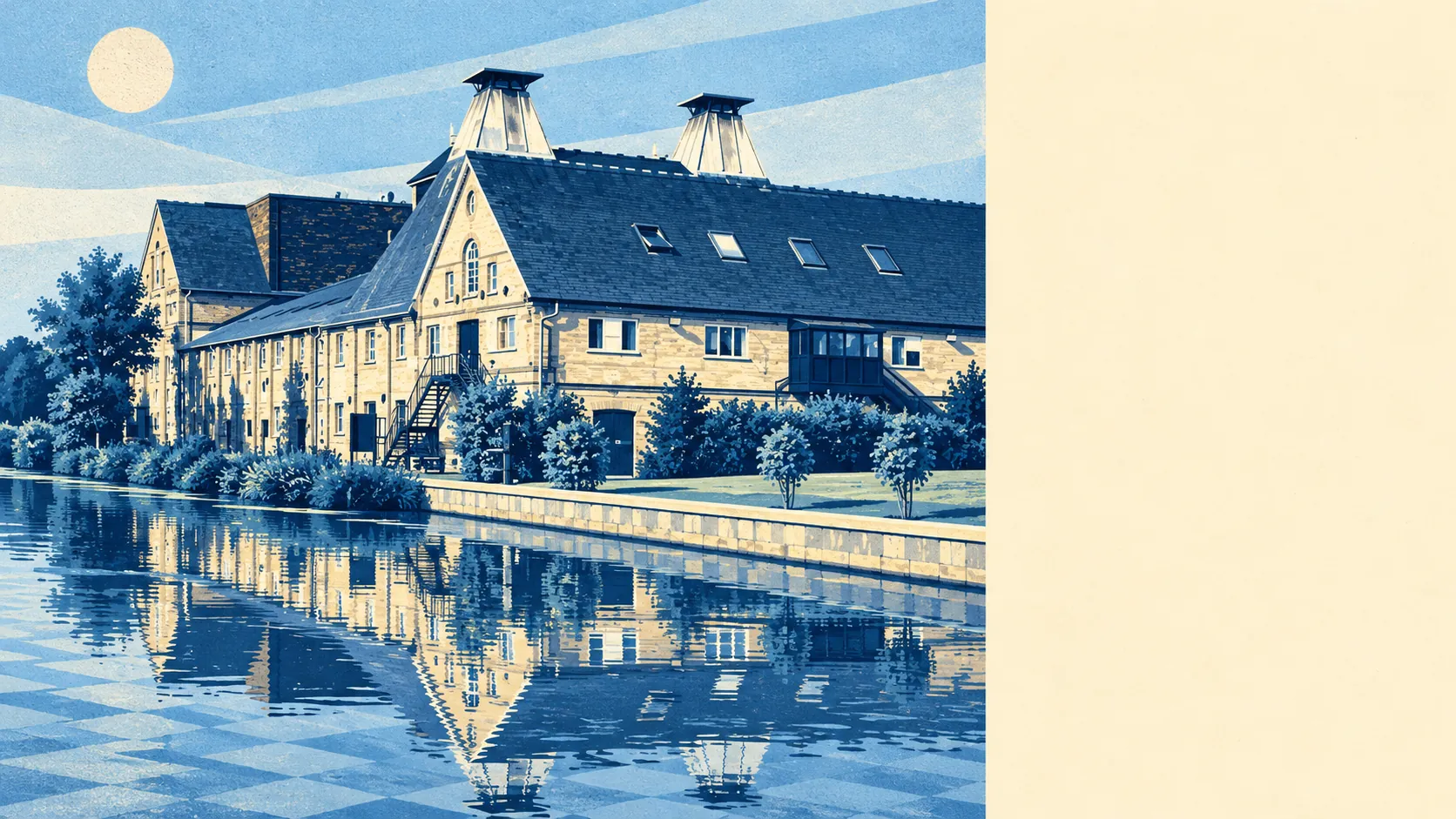
The other old habit is the buildings, and they come with paperwork. Historic England lists 162 buildings in and around the town: one at Grade I, 10 at Grade II* and 151 at Grade II. Great St Mary's Church is the Grade I. Four conservation areas cover the surrounding ground: Sawbridgeworth itself, whose town centre was designated in 1968, plus Lower Sheering across the river, High Wych, and Harlow Mill and Old Road North. Listed building consent applies inside a listed house as well as out, and conservation area status tightens the rules on demolition and on what changes facing the street. Great Hyde Hall is Grade II* and has been divided into housing, so you can live in a mansion here, as long as you accept that the window design was settled centuries before you arrived.
The River Stort runs down the eastern edge with the railway and the Stort Navigation beside it, and the flood maps follow that line closely. In the Environment Agency's river-and-sea flood zones, about 1% of the area falls in Zone 3 and 7% in Zone 2. A broader measure, the share of postcodes rated high risk on at least one flood indicator including surface water, comes to 11%, with another 13% at medium. The Environment Agency has nine recorded flood events here, the most recent in 2001, when the main river overtopped a channel with no raised defences. Most of the town is uphill of the problem. The rest lives next to a river that was the county boundary long before it was a view.
Sawbridgeworth Rail Station is on the West Anglia Main Line between London Liverpool Street and Cambridge, with Harlow Town and Bishops Stortford Rail Station close by. In the 2021 Census, though, only 4% of workers took the train to work, against 41% working from home and 44% driving. The town has 28 bus stops; those with timetable data average 59 weekday departures each, between two and three an hour at peak, and 78% have a weekend service. Ofcom's figures show gigabit broadband available to 75% of premises and superfast to 96%, and all four mobile operators reach 99% of the area. The station gets talked about a lot more than it gets used.
Hertfordshire Constabulary's published rate for the year from June 2025 to May 2026 is about 57 crimes per 1,000 residents, roughly 20% below the East Hertfordshire average of about 70.
The Land Registry recorded 126 sales in the year to late May 2026, at a median of about £418,000. By type, flats went for a median of £220,000, terraced houses £380,000, semis about £483,000 and detached houses about £615,000. The most common council tax band is C, and bands A and B together cover about 13% of homes. Band C as the norm in a town on these incomes says the houses are more modest than the people living in them. Renters are working from East Hertfordshire's typical private rent, an Office for National Statistics average for the whole district of about £1,500 a month as of April 2026, around 4% higher than a year earlier.
The housing is unusually even. On the council tax valuation list, detached houses, semis and flats each make up about 23% of homes, terraces 21% and bungalows 10%. Only 15% were built before 1930, and the energy certificates lean heavily post-war, so the Tudor and Georgian centre is a small, expensive slice of a much larger and plainer town. On those certificates 58% of homes rate A to C, 34% D and 8% E or worse. Mains gas heats 76% of homes and 11% rely on electric heating alone. A viewing list here can run from a bungalow to a detached house by way of a purpose-built flat in one afternoon, and none of them will be the town's typical home, because it doesn't really have one.
Green space is about 160 metres from the average front door, and water about 220 metres. The towpath along the Stort Navigation runs the length of town, Pishiobury Park is to the south, and Town Fields, home ground of the cricket club, is tucked behind Bell Street. Leventhorpe Academy's public pool closed at the end of 2024. The towpath has never shut.
The famous residents are a mixed bunch. Anne Boleyn held the Pishiobury estate. Robert Jocelyn, Lord Chancellor of Ireland, came from the Jocelyn family of Hyde Hall, and an earlier Ralph Jocelyn, twice Lord Mayor of London, is buried at Great St Mary's, where his family's engraved brasses still draw brass-rubbing enthusiasts. Sir Walter Lawrence, who bought Great Hyde Hall in the 1920s, founded a trophy for the fastest century in county cricket, and his joinery works in Lower Sheering built Mosquito fuselage shells during the Second World War. David and Victoria Beckham lived at Rowneybury House. Pip Pyle, drummer for bands of the Canterbury scene, also counts as a local. That makes the town the only place where a medieval Lord Mayor and a prog rock drummer turn up on the same list.
This town works for people who plan to stay for decades, work from home most days and want the train for the days they don't. It works less well for anyone who wants a frequent bus or a period house they can knock through without asking permission first.
Living among people who own their homes and expect to grow old in them means well-kept streets, low crime and neighbours who notice things, which is a comfort until the thing they notice is your planning application. Sawbridgeworth is a better-than-average choice that rewards staying put. The catch is that the history which makes the centre so appealing also limits what you can do to a house there, so buy one that already has the kitchen you want.