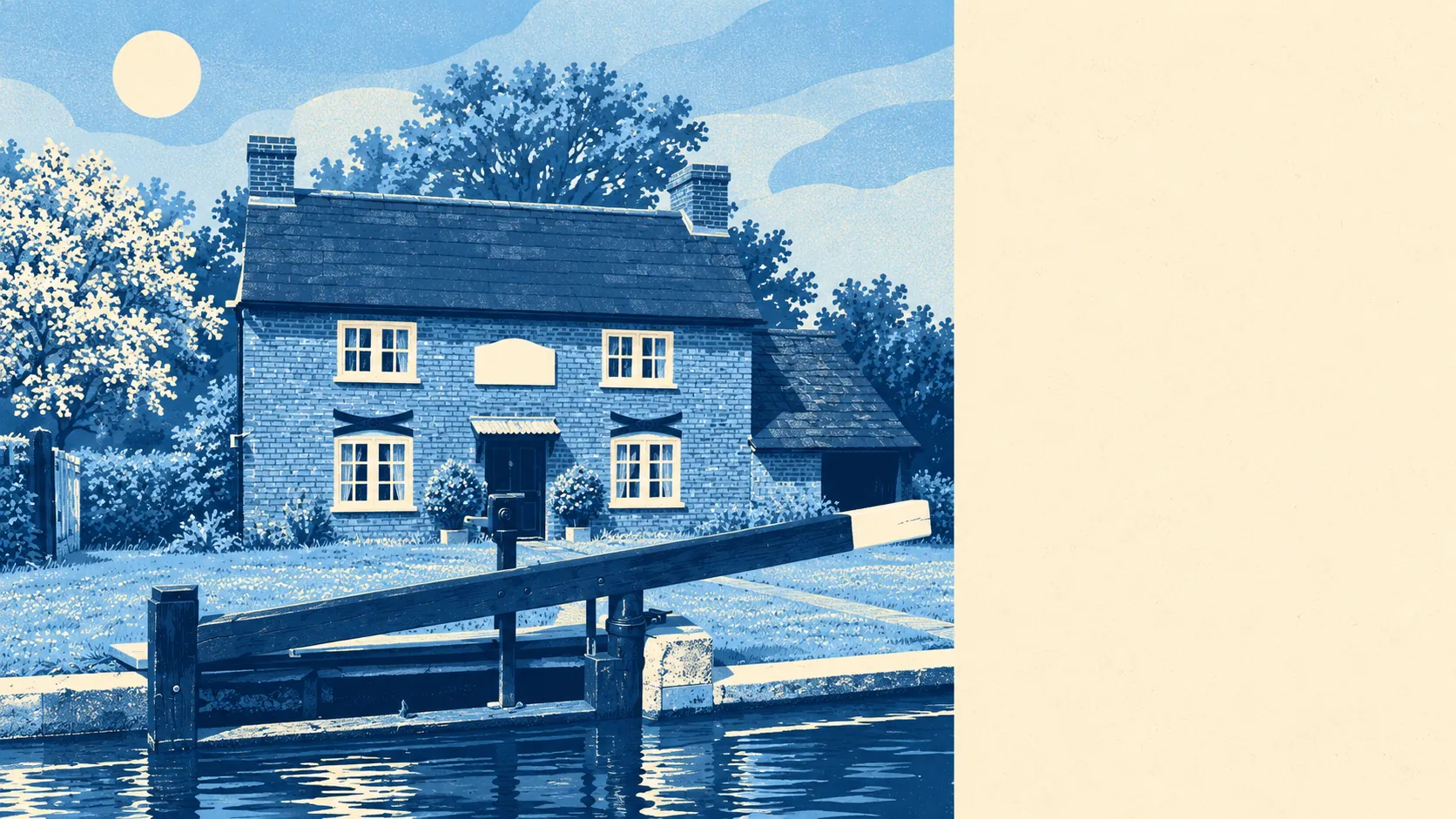
Greener and wetter than most people expect from commuter Surrey. Water is closer to most front doors than the nearest park. More than a dozen green spaces lie within a short walk. The gardens are big. New Haw is canal country that happens to be inside the commuter belt.
On average, a New Haw home has about 13 public green spaces within a kilometre, and the nearest is roughly 220 metres away. Wey Meadows and the open ground towards Addlestone Moor are close by. Few homes here are much more than a walk around the block from grass.
The water is closer. The nearest river, canal or lake is on average about 140 metres from a New Haw home, and about 56 bodies of water lie within a kilometre. The River Wey, the Wey Navigation, the start of the Basingstoke Canal and the Addlestone branch of the River Bourne all meet on the village's south-western edge. Most villages have a pond. New Haw has an entire waterway system.
The nearest stretch of the National Cycle Network is on average about a kilometre from home, and only about 2% of postcodes are close to it. For most people the towpath is the better route out, and it runs right past them.
Across the rating data for New Haw and its surroundings, there are about 154 shops, 10 pubs and 17 restaurants, along with 74 offices. The Broadway is the village's own parade, and the rest are spread through the neighbouring villages.
Fine-particle air pollution across the Runnymede council area averaged about 7.6 micrograms per cubic metre in 2024, a figure for the whole borough, so it does not separate a canal-side street from one by the motorway.
New Haw grew from a hamlet of Woking around Crockford Park farm. Most of it was built in the commuter boom of the 1950s and 1960s, which stretched the village down Woodham Lane towards West Byfleet and Woodham. Byfleet, Addlestone, Weybridge and Ottershaw all border it, so the village runs straight into its neighbours. Brooklands, the old motor-racing circuit and aerodrome, is a short drive away, and so are the Iron Age hillfort on St George's Hill and the remains of Oatlands Palace. The government's animal health laboratories occupy a semi-rural part of the village and are one of the main test centres for the H5N1 bird flu virus. Not many commuter villages have a world-class virus laboratory as one of their landmarks.
Private gardens are generous, at about 102,000 square metres per 1,000 residents across the village's neighbourhood areas. Back gardens on the post-war plots have room for a lawn, a shed and the extension most owners eventually build.
The valuation list holds 53 rateable premises within the village itself, mostly commercial and light industrial units with a few shops and offices among them. These are premises on the list, and some will not be trading at any given time. New Haw is mainly residential.
There are nine rated food outlets in the village, and about 89% of them hold the top food hygiene score, with none rated low. Nine outlets is a small enough number that one bad inspection would change the share.
No protected landscape designation covers New Haw. There is no area of outstanding natural beauty, no site of special scientific interest and no ancient woodland. Its green space is ordinary, well-used local land with no special protection, and the water does most of the work.
The area around New Haw is one of its real strengths, with water at the end of the road, parks a short walk away and gardens big enough to use.