Hounslow West is well connected, and most of the connecting is done by bus. A third of households have no car. Buses run all day and nearly every stop has a weekend service. Gigabit broadband reaches most homes. Every postcode is close to a busy road. Getting anywhere is easy, and the traffic noise is part of the price of living by the way out.
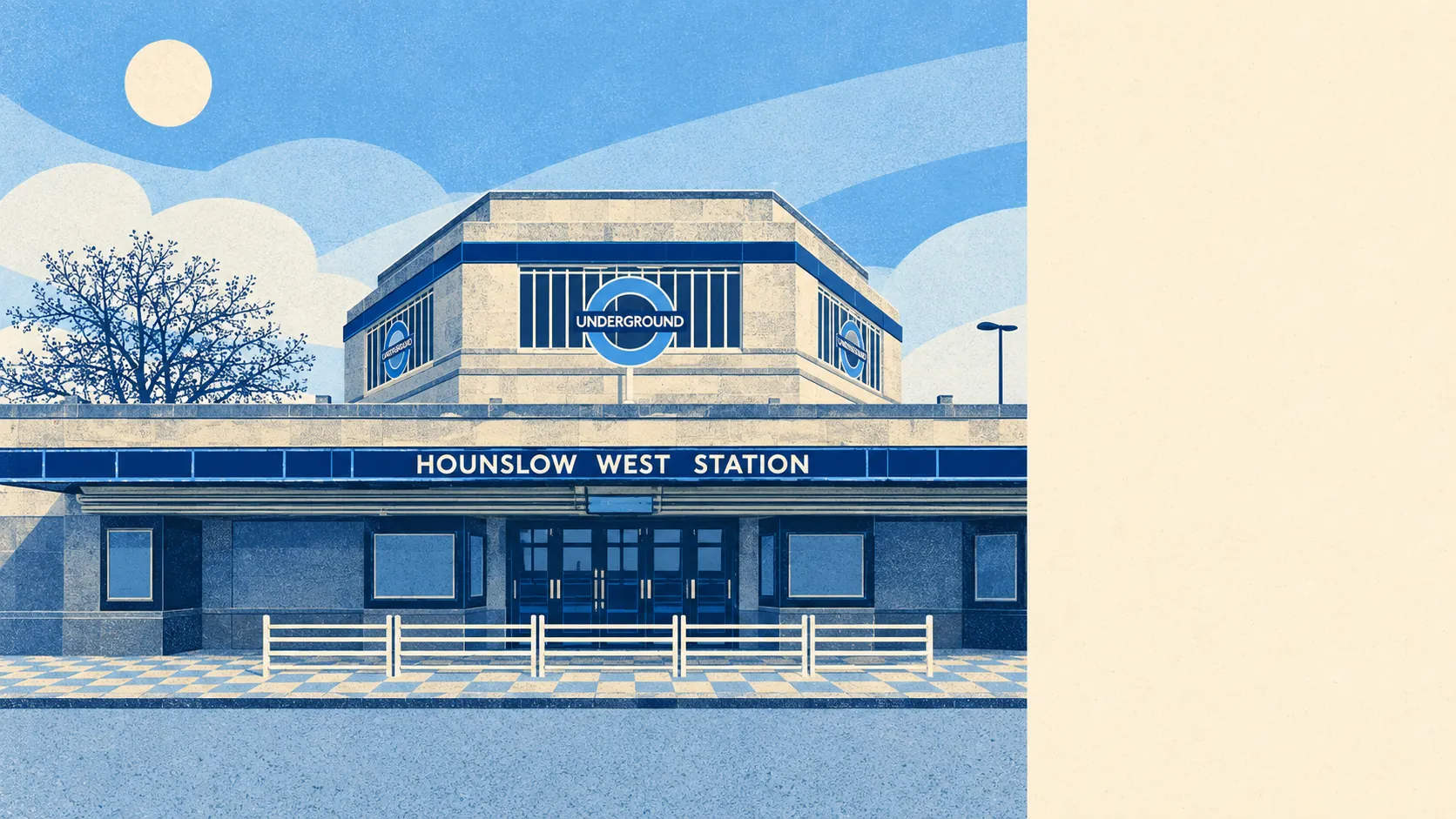
Hounslow West tube station, on the Piccadilly line, is the reason the neighbourhood exists, and the rail map around it includes Hounslow and Feltham stations plus the Heathrow stations for Terminals 2 and 3 and Terminal 4. In the 2021 census about 3% of working residents went to work by train. Buses carried about 20%, from 180 stops across the area. Hounslow West has two airport terminals with stations nearby, and more of its residents commute by bus than by train.
At that census about 33% of working residents drove to work, the biggest single share. About 21% worked from home, about 6% walked and about 3% cycled. About 34% of households have no car at all, while about 26% run two or more. Those two groups share the same streets and spend very different amounts on parking permits.
The Department for Transport's journey-time statistics are modelled averages for the area from 2019. Distances to fixed places do not change, but bus and train services have been cut since then, so the public transport times are the least reliable of the set. On those figures, the nearest town centre is about 12 minutes by car, 14 by bike, 19 by public transport and 28 on foot. A GP is about 8 minutes by car, 11 on foot and 11 by public transport, and a food shop about 7 minutes either walking or driving. The nearest hospital is about 18 minutes by car and 37 by public transport. The nearest cluster of jobs is about 9 minutes by car, 11 by public transport and 6 by bike. On the model, the bike reaches work first, and only 3% of commuters use one.
The bus figures are current. The average stop in Hounslow West gets about 389 scheduled departures on a weekday and about 21 in the busiest hour, and 165 of the 166 stops with timetable data have some weekend service. Those are departures, which tell you how often a bus comes, though they say nothing about where it goes. Even so, at about 21 departures an hour at the average stop, nobody here needs to plan their day around a timetable.
Gigabit broadband is available to about 89% of premises in Hounslow West, and superfast to about 99%. None of the area falls below the legal minimum for a decent connection. Mobile coverage is complete, with 4G or 5G from at least one operator and from every operator across all of the area. Phone signal is one thing nobody here needs to worry about.
The government's noise mapping treats 65 decibels as the level where road noise becomes significant. Every postcode in Hounslow West is near road noise at or above that level, and the loudest band recorded reaches 75 decibels. Rail noise is a separate source: about 11% of postcodes are near rail noise of 65 decibels or more, peaking at 70. The mapping gives no guide to how a particular bedroom will sound. A visit to the actual street at rush hour, with the windows open, will tell you more than any map.
The area has 39 public charge points with 60 connectors between them, and 4 of those connectors are rapid. With 4 rapid units, most electric car owners will need a charger at home or a charging routine planned around the slow ones.
Connections are one of Hounslow West's solid strengths, with frequent buses, the tube, near-universal fast broadband and short trips to the everyday essentials. The noise from the roads that carry all that traffic is the trade-off.