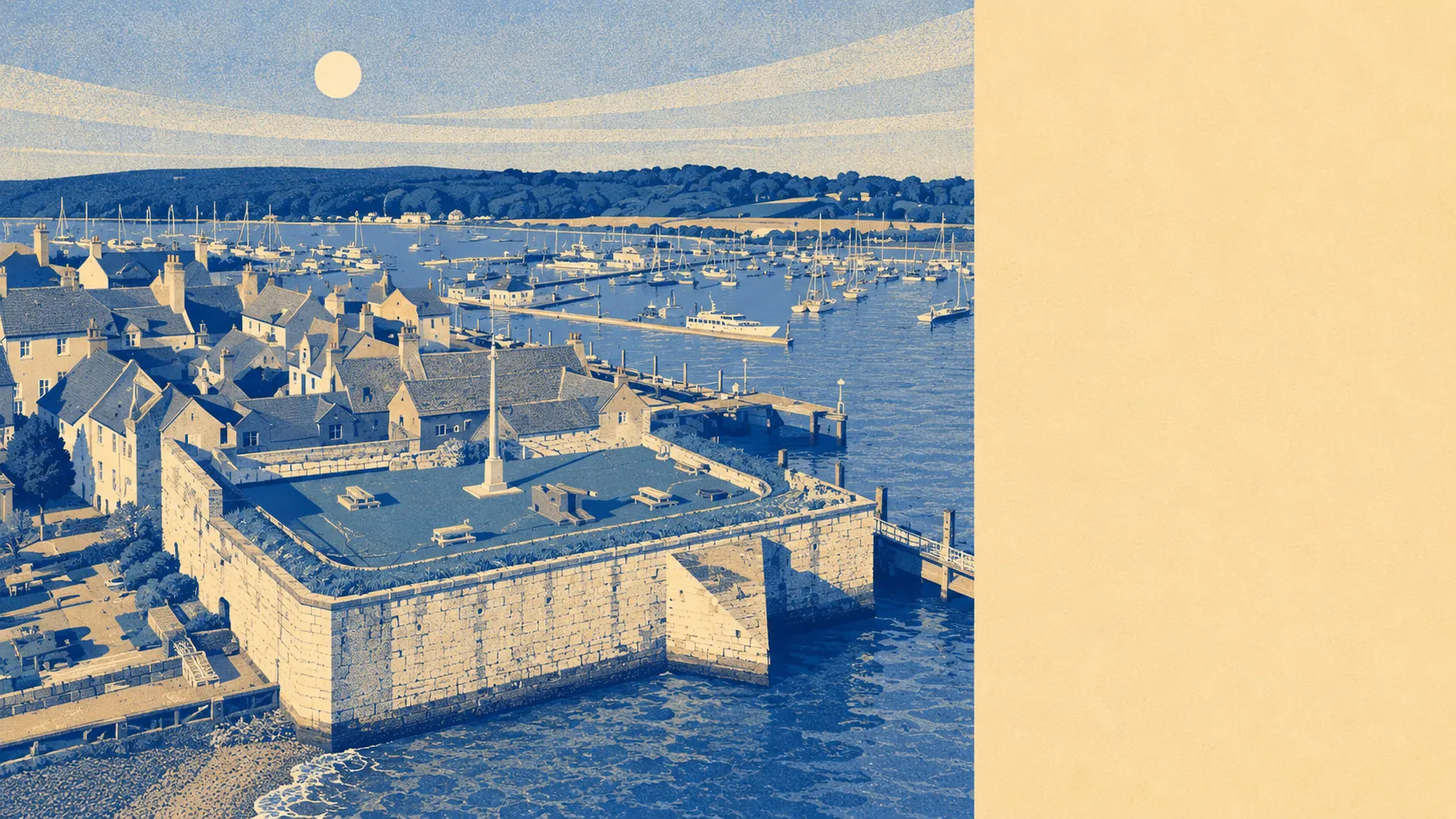
The area around Yarmouth is the best part of buying here. More than half the surrounding land sits inside the Area of Outstanding Natural Beauty that covers the Isle of Wight. Open water sits about two hundred and forty metres from the typical front door. Three greenspaces lie within a kilometre. It is the strongest thing the postcode has to offer, and the data agrees with the eye.
Green space access is genuinely good for a town this size. Roughly three greenspaces sit within a kilometre of the typical postcode, with the nearest under five hundred metres away. Open water does even better: the typical postcode counts close to forty pieces of bluespace within a kilometre, and the nearest sits about two hundred and forty metres from the front door. That ratio of water to land tells you most of what you need to know about where Yarmouth is, and what the daily walk from any given house tends to look like.
More than half the area sits inside the Area of Outstanding Natural Beauty that covers the Isle of Wight, which is the formal recognition that the surrounding landscape is unusual enough to be protected at national level. The designation does not cover the town centre itself, but it does cover most of the countryside around it, which is the bit that gives the views and the walks their character. Several Sites of Special Scientific Interest lie close to Yarmouth without crossing into the town's own boundary, including the Yar Estuary and the Bouldnor and Hamstead Cliffs, both of which are reachable on foot from much of the town. There is no ancient woodland inside the postcodes themselves, but the protected landscape does most of the work the missing woodland would have done.
The character of the area is what you get when a small Norman town with a Tudor gun platform sits at one end of a low-density rural island. Yarmouth Castle, built in 1547, still anchors the seafront. The pier, the longest timber pier in England still open to the public, runs into the Solent from the same shoreline. Inland, the road network connects to Freshwater, Freshwater Bay, Totland, Colwell, Norton, Newtown, Calbourne and a dozen other villages without any of them growing to the size that would change Yarmouth's role as the western island's gateway town. Newport, the island's administrative centre, sits about twenty-two minutes away by car. Population density across the area runs at about two hundred people per square kilometre, which is rural-village density rather than market-town density, and which explains why the dark sky and the quiet morning are still actually dark and actually quiet.
The area around Yarmouth is the cleanest five out of five in the entire buying proposition. The protected landscape carries the bigger half, the water at the door does the rest, and the village-scale road network keeps it that way.