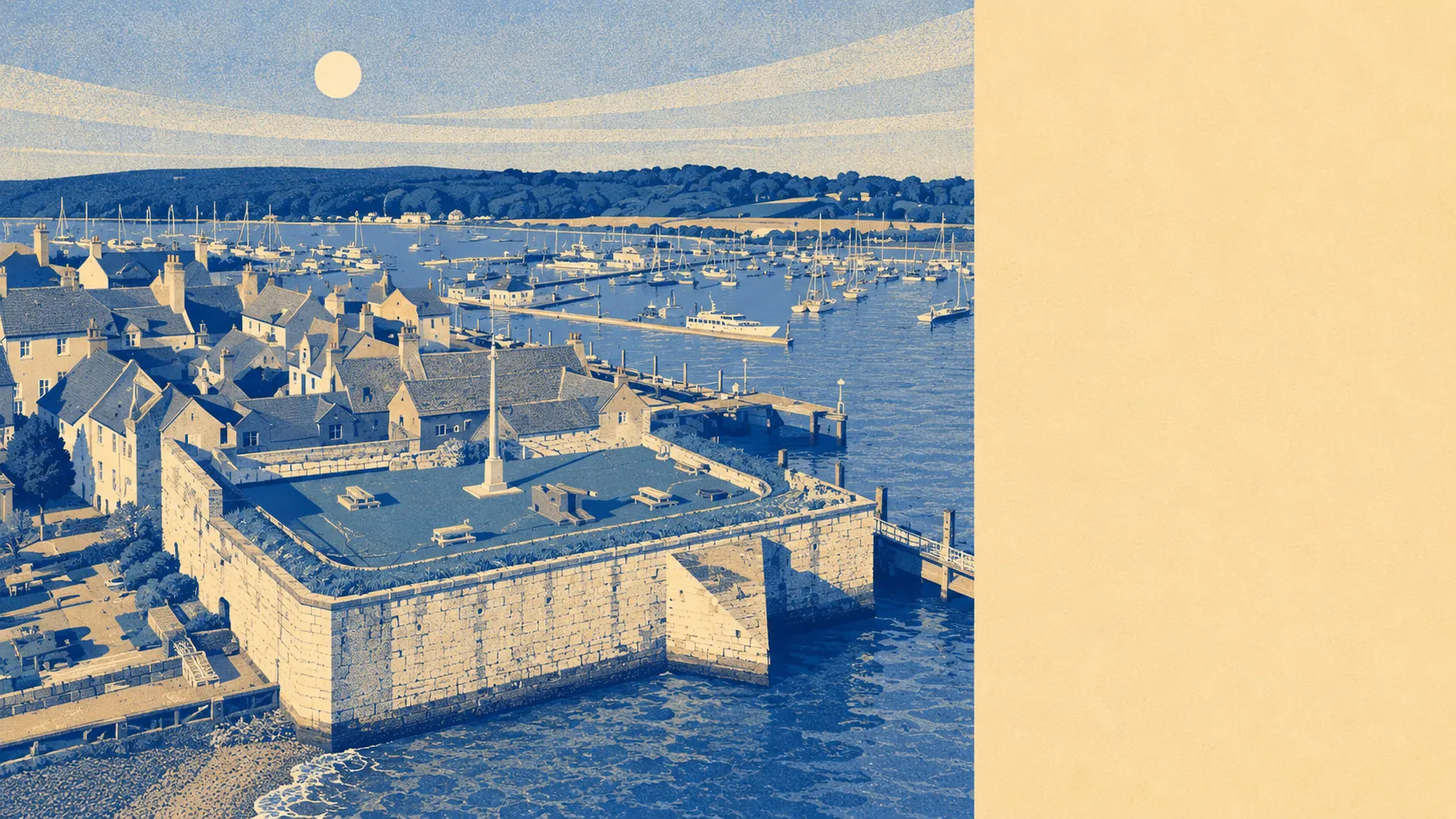
A Norman street grid wrapped around a Tudor gun platform. The longest timber pier in England, and the oldest residents to walk it. A median age of fifty-nine. About three in four households own their home. The ferry leaves twice an hour, which is the most important fact about the place and the one nobody puts in the brochure.
The housing stock is mostly houses, with bungalows doing more work than they get credit for. Roughly six in ten properties are houses, more than a quarter are bungalows, and fewer than one in ten are flats. The energy efficiency picture is what you would expect from a town where the stock predates the National Grid in places: about a third of homes manage band C or better, a third sit in band D, and nearly three in ten land in band E or worse. The post-war stock dominates, but more than a quarter of properties predate 1930, which is what gives the streets their texture and the heating bills their reputation.
The typical sale over the last year went for about £427,500 across twenty-six recorded transactions, which is a thin enough market that any single sale moves the median around. Detached houses cleared closer to half a million; flats went for around £195,000. Council tax sits at band D for the modal property, with roughly a quarter of dwellings in bands A or B and a meaningful tail above. That spread tells you the place: there is a cheap end, but not much of it, and the expensive end goes a long way.
Renting is a different conversation, and the figure available is the typical private rent across the Isle of Wight area, which sits at about £940 a month and has risen by roughly eight per cent in the last year. Yarmouth itself is at the dearer end of the island, but the published figure is the island's, not the town's.
The crime rate sits at about ninety-three incidents per thousand residents over the last year, which is roughly eleven per cent above the Isle of Wight average. That sounds worse than it is, because the island average is itself low by mainland standards, and because the figure counts incidents against the resident population in a town that doubles in size on a summer weekend when the ferry empties. The published rate is the published rate, and it sits above the local average. What it means in practice depends on whether you live near the ferry queue or three streets back from it.
Connectivity is the bit where the geography asserts itself. Trains account for almost none of how people get to work, which is what happens when the nearest station is across the Solent at Lymington Pier or Lymington Town. Roughly three in ten Yarmouth workers work from home, which is the highest single answer in the commuting picture, and nearly half drive. Around eighty-six per cent of premises can get superfast broadband and about fifty-seven per cent can get gigabit, which is better than the geography suggests and worse than a mainland market town of the same size. The bus station sits near the ferry terminal and the routes go to Newport, Freshwater and the western villages, with frequency that thins outside the main hours.
The environment is where Yarmouth quietly wins. More than half the area sits within the Isle of Wight Area of Outstanding Natural Beauty. About a tenth of postcodes carry a high surface-water flood indicator and roughly six per cent fall within the Environment Agency's flood zone three, which is what you expect from a town built on an estuary. Green space averages under five hundred metres from the front door and blue space sits closer still, at around two hundred and forty metres, because everything is closer to the water than to anything else.
Heritage constraints are the trade-off the photographs do not show. The wider area carries five hundred and forty-nine listed buildings, including eight at grade one and twenty at grade two starred, plus a conservation area and twenty-five scheduled monuments in the surrounding bounding box. Yarmouth Castle, the Bugle Hotel, the Parish Church of Saint James and the George Hotel give you the institutional spine of what is protected. What that means for a buyer is that altering the front elevation, the windows, the roofline or the boundary wall is a planning conversation, not a weekend job, and the conversation often ends with the planning officer winning.
The neighbourhood character is the third quietest fact in the brief, after the median age and the median sale price. Roughly three in four households own their home outright or with a mortgage. The median resident is fifty-nine. Around a fifth of households are single pensioners, which is more than double the share of households with dependent children. The median household income across the three local sub-areas sits at about £36,000 a year, which tells you that wealth here is held in the houses rather than earned in current salaries.
Yarmouth suits people whose working life either does not need a daily commute or accepts a ferry as the price of entry. Retirees, second-home owners, sailing-trade workers and remote-working professionals who already had their career before they arrived. People who can repair their own walls and tolerate planning officers. People for whom a Norman street grid, a Henrician castle and a timber pier are the point.
It does not suit anyone who needs trains, who has school-age children expecting a varied choice of secondary schools on the island, or who wants the next ten years of their life to involve nightlife after ten o'clock. If you want a sailing town with a railway, take the ferry to Lymington and look for a house there. If you want a yacht-trade town with a pulse and a regatta, go to Cowes and accept what it costs.
Yarmouth comes out at two and a half out of five overall, which is the right number for a place that is honestly average across most of the dimensions buyers care about. The surrounding area and green-space access pull the verdict up to a clean five out of five on environment. The freedom to extend or alter the home you buy pulls it down to one out of five on heritage constraint. Everything else sits in the middle: schools roughly average, transport roughly average, safety roughly average, flood risk roughly average. It is Cowes without the regatta crowd, Lymington without the railway, and that is either the appeal or the problem.