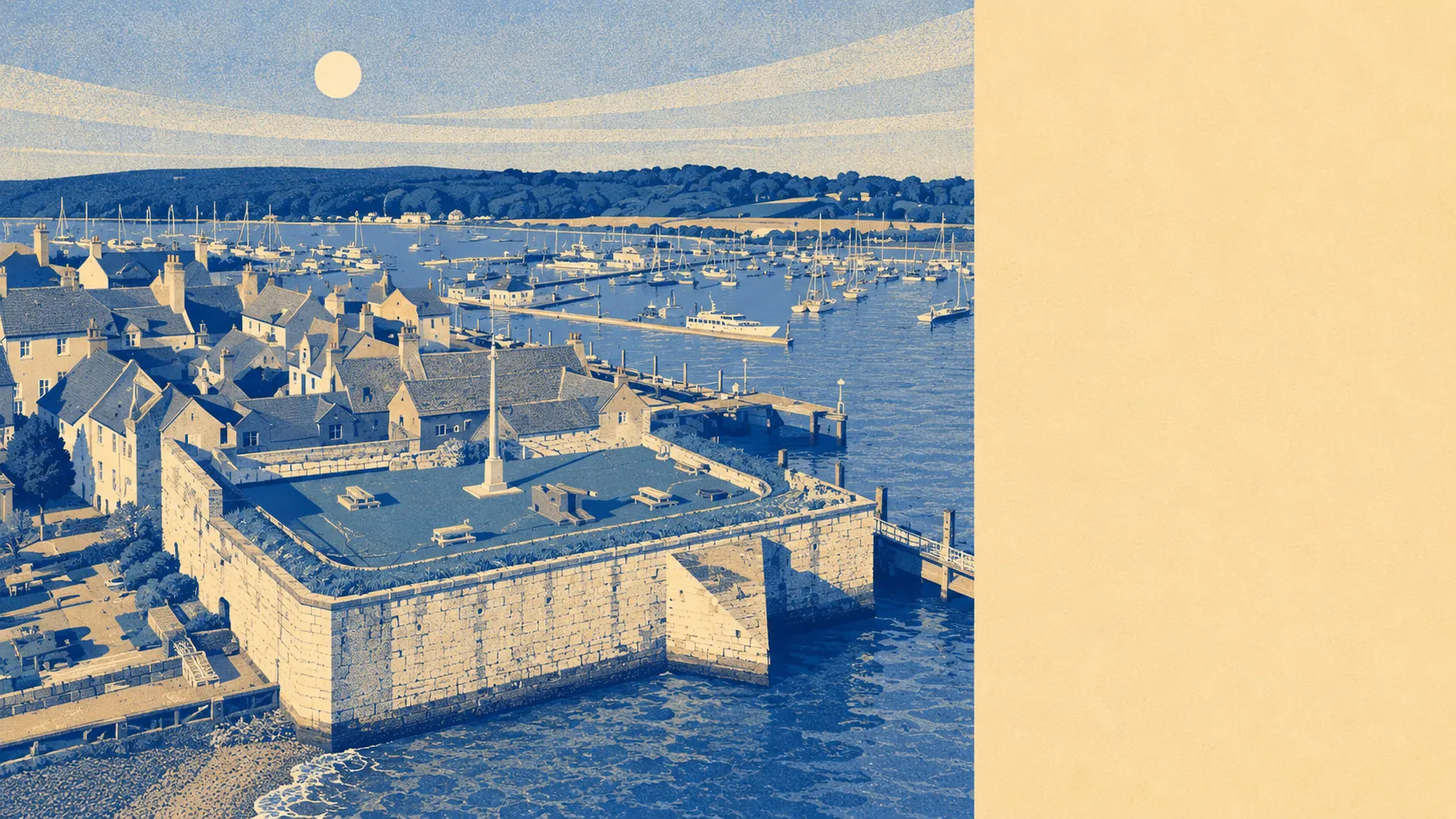
Extending a house in Yarmouth is harder than extending one almost anywhere else. The wider area carries more than five hundred listed buildings. A conservation area runs inside the town's surroundings. Twenty-five scheduled monuments sit in the wider countryside. The planning officer wins more arguments here than in most postcodes.
The listed-building inventory is the centre of the story. Five hundred and forty-nine listed buildings sit within the wider area, of which eight are grade one, twenty are grade two starred, and the remaining five hundred and twenty-one are grade two. The named entries include the obvious civic and historic anchors: Yarmouth Castle, the Bugle Hotel, the George Hotel, the Parish Church of Saint James, Golden Hill Fort, Westover, Fort Albert, and Weston Manor among many others. Listing means that any alteration to the building, its setting, its windows, its roofline, its boundary walls, or in many cases its interior, needs listed building consent before the work starts. That consent is not the same as planning permission, and it sits on top of it rather than instead of it. Doing the work without the consent is a criminal offence, and undoing the work after the event tends to cost more than not doing it at all.
One conservation area sits within the surrounding bounding box. Its name is not in the published heritage record, but its presence is, and that is the bit that matters for any buyer with a wish list. A conservation area changes the rules for the houses inside it even when those houses are not themselves listed. Permitted development rights are typically reduced. Demolition needs consent. Trees gain protection. The window frames, the rendering, the colour of the front door and the boundary treatments all become planning conversations rather than weekend choices. Twenty-five scheduled monuments sit in the wider area, mostly bowl barrows, prehistoric earthworks and the older castle sites; these constrain ground works rather than house extensions, but they are part of the heritage map any buyer should look at before they pick up a spade.
In practical terms, the rules of thumb that work in an unconstrained postcode do not work here. The rear single-storey extension that counts as permitted development across most of England may need full planning permission inside the conservation area, and if the house is also listed it needs listed building consent on top of that. The planning history shows the wider area received about a hundred and twenty-four applications over the most recent reported window and forty-eight in the last twelve months, which is the steady drip of a place where most material changes need an officer to look at the drawings. The owners who get what they want are the ones who design with the constraints rather than against them, and who appoint a planning consultant who has done a Yarmouth conservation area job before. The owners who fight the constraints lose, slowly and expensively.
The freedom to extend or alter a home in Yarmouth is the weakest part of the buying proposition. The houses come with their constraints baked in, and the price of the postcode is that the house you buy is largely the house you live with.