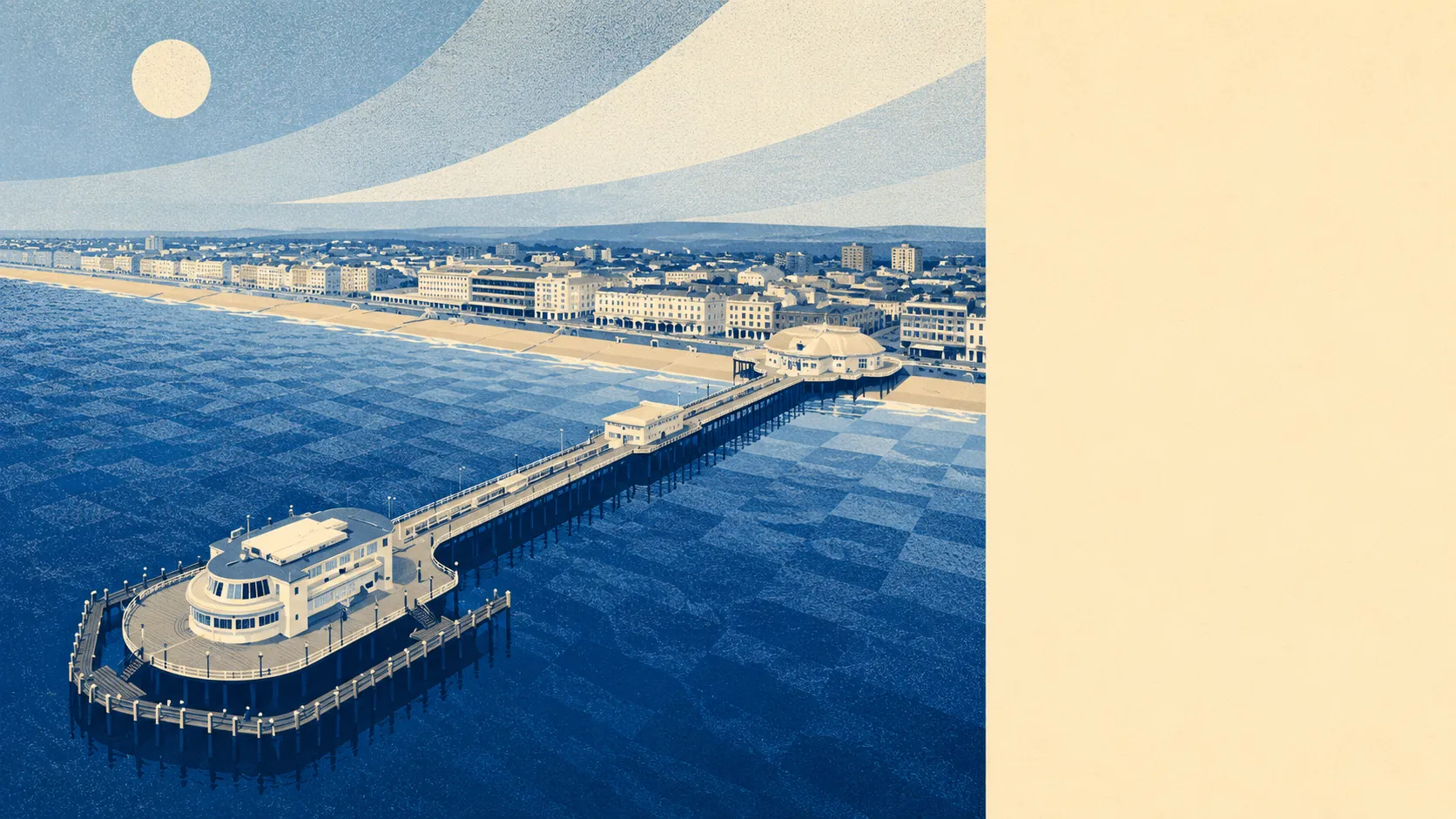
Worthing is Brighton for people who did the maths and admitted the answer. The typical sale sits at £345,000. The typical rent runs about £1,310 a month. About 112,000 people live here, the median age is forty-five, and roughly two in three own their home. Not the seaside daydream. The seaside after the maths.
The housing stock is the second surprise. Flats are the plurality at forty-four percent, houses forty-two, bungalows the remaining twelve. That's a coastal town's mix, not a village's, and it explains most of what follows about the place: the small gardens, the shared entrances, the fact that four in ten homes sit at energy band D and about a fifth are worse than that. Only about forty percent make it into the A-to-C bracket that current buyers reflexively check for. The Victorian and Edwardian terraces are the smaller slice, roughly a fifth of the stock; the bulk is post-war, built between about 1950 and the early 1980s, which is exactly when insulation standards were a suggestion rather than a policy.
The typical Worthing sale in the last twelve months went for £345,000 across 1,423 transactions, which is a busy market by any south-coast measure. Flats went for a median of £217,500. Terraced houses for £350,000. Semis for £392,750. Detached for £545,000. That's a spread wide enough that "Worthing prices" is a phrase doing very little work; the postcode you buy in and the front door type matter more than the town name. Council tax lands modally at band C, and about thirty-eight percent of homes are in the two cheapest bands, A and B, which for a seaside town is unusually kind on the bill.
Rent tells a similar story. The typical private rent across the Worthing area comes in at about £1,310 a month, and it's risen about three percent in the last year. That's the local-authority figure, not the postcode-by-postcode figure, and it covers everything from a studio to a four-bedroom house. Your specific street will do its own thing within that.
Crime runs at about ninety-eight incidents per thousand residents a year, which sits almost exactly level with the local-authority average. That's the town centre pulling in one direction and the residential streets pulling in the other, and the town-level figure is the arithmetic middle of both. Anyone picking between coastal towns on crime alone is doing it wrong; Worthing is neither the reassuring pick nor the alarming one, which is the position most towns of its size actually occupy once you strip out the reputational nonsense.
Connectivity is where the town quietly overperforms. Worthing sits on the West Coastway Line with five stations inside the borough boundary: Worthing itself, West Worthing, East Worthing, Durrington-on-Sea, and Goring-by-Sea. Direct trains reach London, Gatwick Airport, Brighton, and Portsmouth. Just over five hundred bus stops sit within the town's footprint, which is the kind of density you don't get in a village pretending to be a town. Gigabit broadband reaches ninety-seven percent of premises, which is the modern equivalent of mains water. About thirty-one percent of working residents work from home, a number that reflects the post-2020 arrivals more than any local reinvention.
The environment picture is where Worthing quietly excels and quietly worries. Green space is at your doorstep: the average home sits within two hundred metres of a park, with about eighteen separate green spaces within a kilometre. The South Downs sit directly to the north, and while the town itself contains no formal Area of Outstanding Natural Beauty designation, the National Park boundary runs through the borough's northern edge. The sea is roughly two-thirds of a kilometre away on average, close enough to be part of daily life. The worry is flooding: about fourteen percent of postcodes carry a high surface-water flood risk, and about the same fraction carry a medium risk, so a coastal-plain town does what coastal-plain towns do. If you're buying, check the specific address; the town average tells you nothing about your street.
Heritage constraints are the quiet cost of buying an older Worthing home. The borough carries 262 listed buildings, six of them Grade I, twelve at Grade II star, the rest at Grade II. Five conservation areas cover parts of the town and the surrounding villages including Ferring and Highdown, plus the outlying Castle Goring. If your future home sits inside one of those, the freedom to extend, alter, or replace windows shrinks considerably, and the planning department becomes the invisible fourth party in every renovation decision. This is the town's weakest dimension on the summary rating, at two out of five, and the reason is architectural: there's a lot of protected fabric to be careful about.
The neighbourhood character reads as classic south-coast owner-occupier. About sixty-eight percent of households own their home, roughly three in ten rent, and the median household income lands around £54,000, which puts most residents in comfortable-not-wealthy territory. The median age of forty-five sits above the England average but well below what a stereotype of the south coast would suggest. This isn't a retirement town by south-coast standards, and it hasn't been for two decades.
The neighbourhoods that make up the wider town each carry their own personality. Broadwater keeps the ancient-parish heart of the borough, with a church of Saxon origins that used to serve Worthing when Worthing was a fishing hamlet. Durrington sits inland toward the A27 and picks up the commuters. Ferring and Goring-by-Sea run west along the coast with their own conservation-area constraints and their own beach access. High Salvington climbs the lower slopes of the Downs and is where you go for a view. Patching is barely a village. West Tarring is the old market village that Worthing swallowed but which never quite gave in.
Worthing suits people who wanted Brighton and priced it honestly. It suits families who want a coastal town with actual schools and actual transport rather than a village with pretensions. It suits downsizers who want a flat within walking distance of a beach without London prices attached. It suits remote workers who need the trains for the occasional office day but not the daily grind.
It doesn't suit people who wanted a village. It doesn't suit people who need a driveway attached to a period property in the town centre, which the terraces don't provide. It doesn't suit people who confused Worthing with Chichester and expected the same demographics and price bracket. And it doesn't suit anyone who thinks a seaside town should feel like a fifteen-year-old postcard rather than a working coastal borough.
The town has a literary streak worth naming. Oscar Wilde holidayed here in 1893 and 1894 and wrote The Importance of Being Earnest during the second visit, which is the sort of local-history footnote another town would build a statue around. Harold Pinter lived here later, along with a rotation of other writers who liked being near enough to London for the theatre and far enough for the quiet. Princess Amelia stayed in 1798, and that visit is essentially why the town exists in its current form: fashionable people followed her, the town got its charter in 1803, and the terraces started going up.
Worthing rates three-and-a-half out of five for overall liveability, which sounds middling until you look at what it's good at. The surroundings and green space rate a full five out of five, which is the ceiling of that dimension and reflects both the Downs to the north and the sea to the south. The weakest dimension is freedom to alter or extend a home, at two out of five, which is the price of having 262 listed buildings and five conservation areas inside one borough boundary. If your idea of a good place to live is one where you can rip out a period feature at will, this isn't it. If your idea of a good place to live is one where the walk to the beach, the walk to the Downs, and the walk to the station are all under twenty minutes, and the price of admission is asking permission before you touch the windows, it absolutely is.