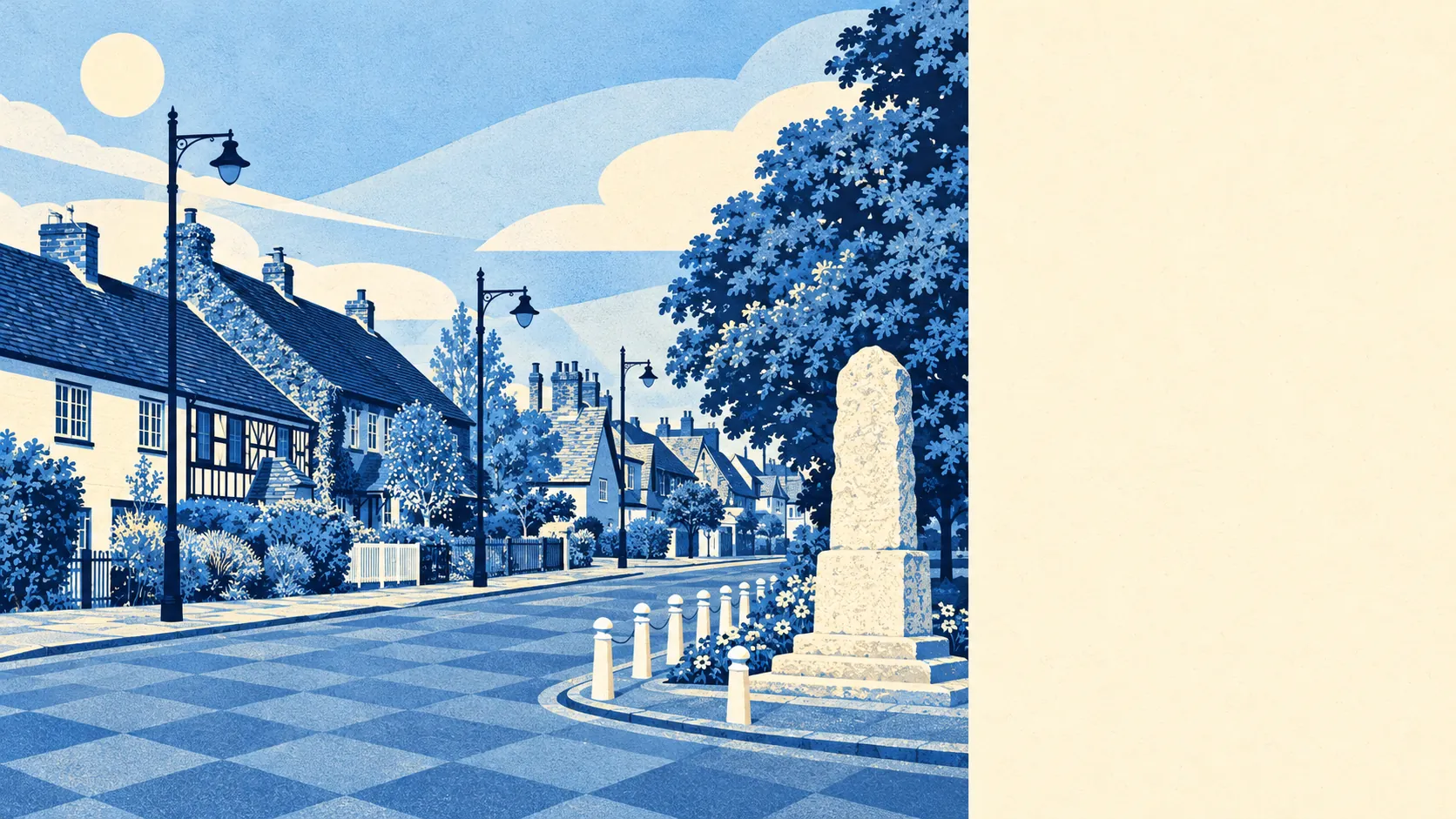
Wooburn's best asset is the people already living in it, and every one of them is sitting on the entry fee. More than eight in ten own their home. Hardly anyone is out of work. The typical house went for well over half a million, and that is the membership rate for neighbours like these.
The 2021 Census found 85% of households in Wooburn own their home, with a median resident age of 47. The Office for National Statistics models gross household income for the wider area at about £66,300 a year in the financial year to March 2023. The government's deprivation index put the village in the least deprived tenth of England in both its 2019 and 2025 rounds. In the Census, 88% of residents described their health as good or very good, and 46% of adults hold a degree. When nearly half the adults have a degree, the planning objections arrive with footnotes.
The Land Registry recorded nine sales in the year to May 2026, at a median of about £586,000. Five were semi-detached houses, with a median of about £586,000, and three were detached, with a median of £650,000. Nine sales is a handful of front doors, so the figures move a lot from one year to the next. Council tax tells the same story more slowly: the most common band is E, and only 4% of homes are in bands A or B. The bottom of the council-tax list is somewhere residents have read about.
Renting is a small corner of village life. About 12% of households rent privately, so the typical private rent across the Buckinghamshire area, about £1,470 a month, is a county-wide mean from the Office for National Statistics. It covers everywhere from town-centre flats to farmhouses. Here a county average is standing in for a rental market barely big enough to have one of its own.
The council-tax valuation list covers every dwelling. On it, 36% of Wooburn's homes are detached, 29% terraced, 19% semi-detached, 7% bungalows and 6% flats, and 17% were built before 1930. On the energy certificates, 55% of the certified homes are band D, 30% reach C or better and 15% are E or worse. Most homes, 86%, heat with mains gas. Band D is the certificate's polite way of describing a decent gas bill.
Thames Valley Police figures for the year to May 2026 put crime at about 36 offences per 1,000 residents, roughly 45% below the Buckinghamshire average of 65. The follow-up is weaker than the rate. Across the whole force area, Thames Valley Police charged someone in about 9% of cases, against 12% nationally, ranking 37th of 42 forces. In Wooburn, the low rate does more of the protecting than the follow-up does.
On the Environment Agency's river-and-sea flood zones, about 5% of Wooburn's postcodes fall in zone 2 and none in zone 3. A wider measure counts postcodes on at least one flood indicator, surface water included. On that measure 14% have a high rating and 19% a medium one. Once climate change is added to the Environment Agency's zones, 43% of postcodes come into them. The only recorded flood event came in December 1981, when a main river overflowed a channel with no raised defences, and the climate-adjusted map suggests the water hasn't dropped the idea.
There is no station in the village. Bourne End and Beaconsfield are the nearest, and the 2021 Census found only 2% of working residents commuting by train. Most stay in or drive: 47% worked from home and 43% drove. Three bus stops serve the village, each averaging 26 weekday departures, about two an hour at peak, and all three run at weekends. Department for Transport modelling from 2019 put the nearest town centre 36 minutes away by public transport and 13 by car, and the public transport time is the one more likely to have aged. Superfast broadband reaches every postcode and gigabit 82%, and every postcode gets 4G or 5G from at least one operator. Almost as many residents commute down the hallway as down the A4094.
Wooburn has 12 listed buildings, one Grade II* and eleven Grade II, and two conservation areas, Wooburn Green and Wooburn Town. Inside those boundaries, demolition, some tree work and changes to how a house faces the street need the council's say-so as well as the owner's. Extending a cottage on the green means a long conversation with the planners before any builder turns up.
The surroundings are the easy part. The average front door is about 130 metres from public green space and about the same distance from water, with nearly a dozen green spaces within a kilometre on average. That holds across Wooburn Green and the riverside hamlet of Hedsor, both covered on this page, though the walk back up from the river is the one people mention.
Wooburn works for households with a car, a home office and enough equity to clear the starting price, especially those who want neighbours who turn up, own their patch and stay. A first-time buyer on a single income, or anyone who wants a train at the end of the road, should look elsewhere.
Wooburn is a better-than-average village to live in, and the neighbours are the main reason. They are also the reason it costs so much to move in beside them.