Tetbury is a handsome, well-run town that only really works if you own a car, because fewer than one commuter in a hundred goes by train. The station closed in 1964. Nearly half of working residents drive to work. Close to four in ten work from home and skip the journey altogether. Everything else about the place makes a decent case for itself, and the car keys come with the house.
On the census travel-to-work figures, under 1% of Tetbury's commuters take the train and under 1% take the bus, against 45% who drive and 39% who work from home. The town has 41 bus stops, and the 20 with timetable data average seven departures a weekday, with half a bus per stop in the peak hour. Four in five of those stops do get a weekend service. The Department for Transport's modelled journey times, which date from 2019 and are more reliable for the car than for the bus, put the nearest GP surgery 18 minutes away by car and 35 by public transport, and a hospital 47 minutes by car and 95 by public transport. Broadband is better behaved. Superfast covers 98% of premises, nobody falls below the legal minimum, but gigabit reaches only 17%. Every postcode gets a mobile data signal from at least one network, and 96% get all of them. With that many people working from the kitchen table, the gigabit figure is the one that does the commuting.
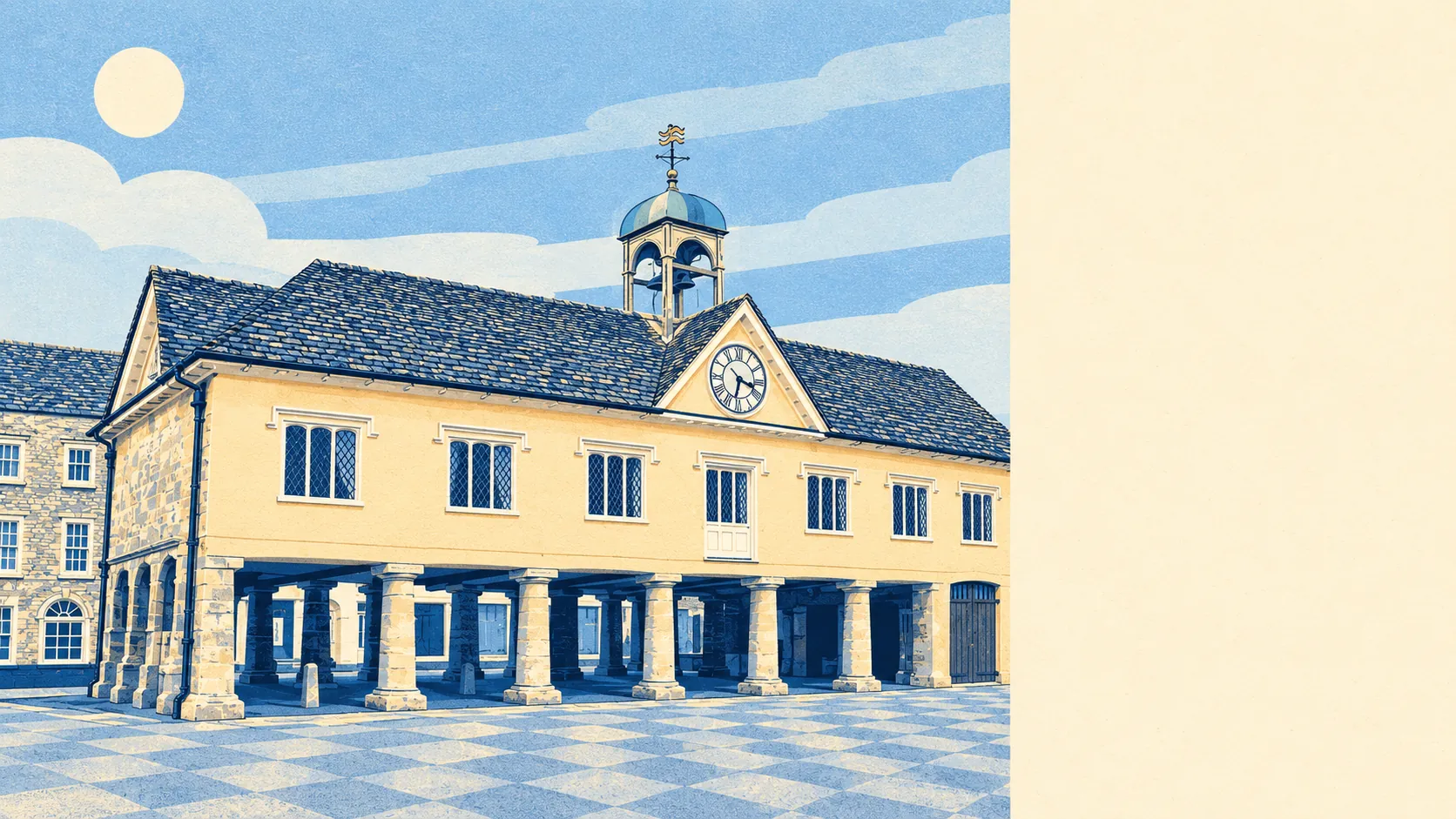
The centre was built on wool money in the 16th and 17th centuries, and it shows. Tetbury and its immediate surroundings hold 232 listed buildings, four at Grade I, four at Grade II*, and 224 at Grade II, along with two scheduled monuments and the Tetbury conservation area. The whole place falls inside the Cotswolds Area of Outstanding Natural Beauty. The Market House has stood on its pillars since 1655 and is still used for markets. For a buyer, all of this means planning consent for changes most towns would wave through, such as windows, roofing and extensions. The wool merchants built to last, and the council intends to hold every later owner to it.
Two-thirds of households own their home, and the typical resident is 47. Gross household income before tax averaged about £60,500 in the financial year to March 2023, an Office for National Statistics model averaged across the area. The neighbours have form. King Charles III keeps his private residence at Highgrove, near Doughton, and the original Highgrove Shop opened in town in 2008. Jake Meyer, the youngest British person to climb Mount Everest, is from here too, and that is one way to get a view nobody can put in for planning against.
Flood risk depends on which measure you read. In the Environment Agency's river-and-sea flood zones, none of Tetbury falls in zone 2 or zone 3. The broader postcode measure counts surface water and other indicators as well, and on that one 11% of postcodes carry a high flag on at least one indicator, 15% a medium one and 25% a low one. The Tetbury Avon rises just north of town, so the river is a small part of the story. Where water does cause trouble, it comes off the hills and down the roads.
Police.uk records 35 crimes per 1,000 residents in Tetbury for June 2025 to May 2026, about 13% below the Cotswold district average for the same year. Gloucestershire Constabulary covers the area.
The Land Registry's twelve months to mid-May 2026 recorded 100 sales at a median of £410,000. Detached houses went for about £585,000, semis £410,000, terraces £360,000 and flats £245,000, though only nine flats sold all year. The most common council tax band is C, and about one home in five falls in band A or B. Nine flats in a year tells a first-time buyer how short the bottom rung is here.
Typical private rent runs to about £1,260 a month across the Cotswold area as of April 2026, up 8% on a year earlier. That is the Office for National Statistics figure for the whole district, and Tetbury does not get one of its own.
The council-tax list splits the housing almost evenly three ways, with detached at 27%, semis at 27% and terraces at 24%. Flats make up 15% and bungalows 6%. About a quarter of homes were built before 1930, and those are mostly the stone ones around the centre. On energy certificates, 60% of rated homes reach band C or better and 11% are band E or worse. Three-quarters of homes run on mains gas. The pretty ones and the warm ones overlap less than the photographs would have you believe.
The town's state schools are St Mary's Church of England Primary School and Sir William Romney's School, with Avening Primary School and Leighterton Primary School in the villages and Westonbirt School, an independent girls' school, just outside. The three primaries in the postcode district average 105 in Key Stage 2 maths. The one secondary averages 44 on Attainment 8. Across Gloucestershire as a whole, Ofsted has graded 136 of 156 settings good or outstanding, which is a county figure and says nothing about any single school here. On the 2019 modelled times, the average home is a half-hour walk from the secondary school, and most parents drive the run instead.
Green space is where Tetbury does best. The average home is about 130 metres from the nearest park or open space, with 16 of them within a kilometre, and water of some kind is about 290 metres away. Westonbirt Arboretum, Chavenage House and Beverston Castle are all within easy reach. The page also covers the villages around the town, among them Tetbury Upton, which wraps around it on three sides, Westonbirt, Long Newnton, Ashley, Avening, Cherington and Leighterton. Each has more fields than residents, which is the whole idea.
Tetbury is right for people who work from home or drive everywhere anyway, want stone houses and footpaths on the doorstep, and can live with a conservation officer having a say. Anyone who needs a train every morning, or expects to reach hospital appointments without a car, should look at a town with a working station. Here the station shut more than sixty years ago and the buses run like a courtesy. If transport is no problem for you, Tetbury is better than most market towns at nearly everything else. If it is a problem, nothing else in town can make up for it.