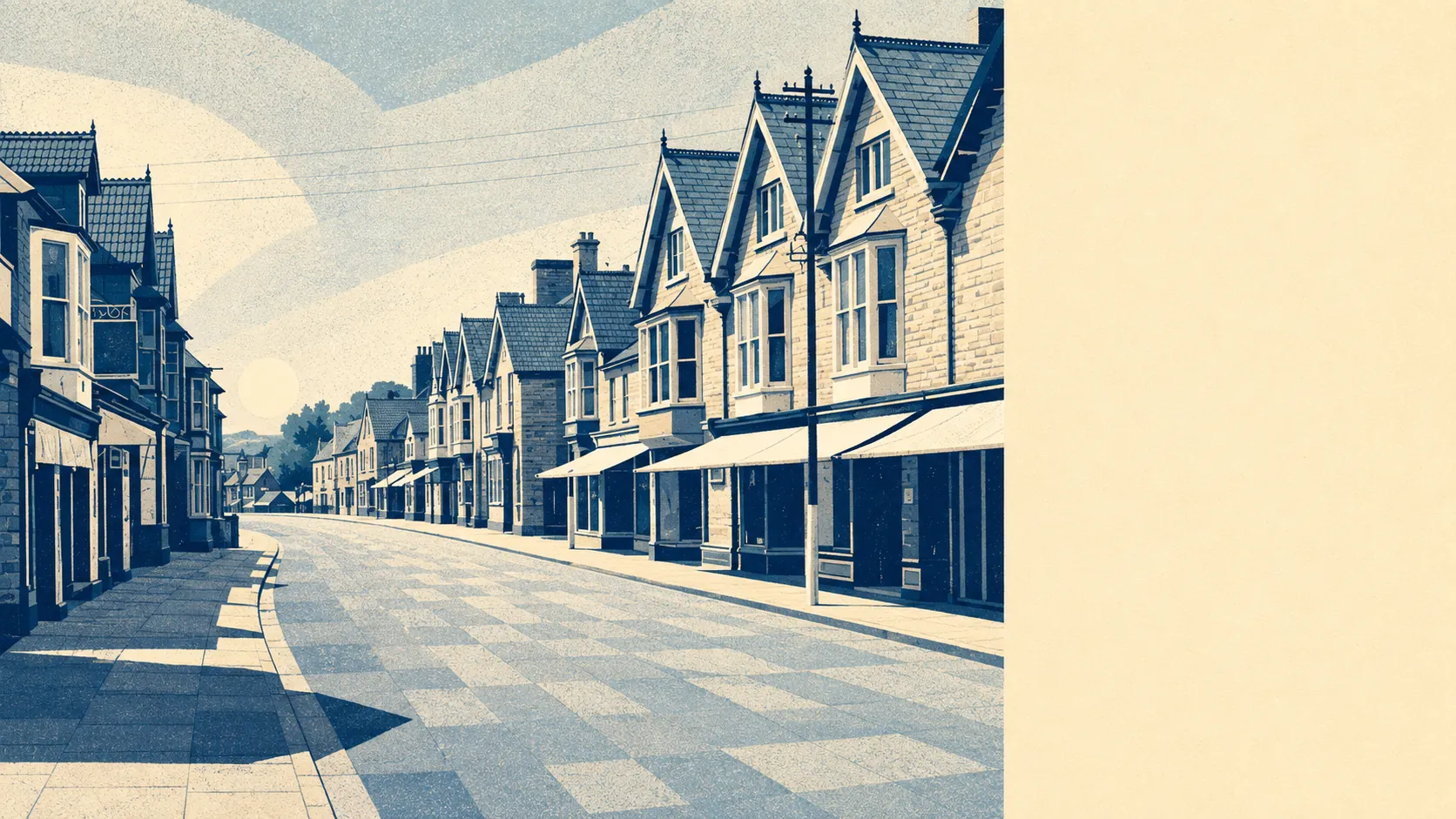
Street is a factory town that lost its factory and kept the discipline. The nearest railway station is nine miles away and there hasn't been one here since Beeching. The green space starts about 130 metres from the average front door. Crime runs a third below the county rate. It is a place that works quietly, which is a compliment and a warning in the same breath.
The housing stock is exactly what you would expect from a town built to house people who worked here. Semi-detached homes are the largest single type at around 32% of every dwelling on the council-tax list, with terraces at around 25%, detached at around 16%, flats at around 14% and bungalows at around 12%. Only around 17% of dwellings predate 1930, so the Victorian frontages near the old centre are a minority carrying a majority of the character. Energy certificates put around 57% of certificated property in bands A to C, with around 35% sitting at band D and around 9% at band E or worse. Around 78% of homes run on mains gas and around 8% are heated by electricity alone, which is the number to check before you fall in love with something older, because electric-only heating in a poorly insulated house is a bill you inherit rather than a quirk you tolerate.
On price, the Land Registry's last twelve months put the typical sale at around £266,000 across 144 transactions. The spread by type is wide enough to matter: detached houses came in around £422,500, semi-detached around £280,000, terraces around £254,000 and flats around £126,250. Council tax lands lower than most of the south west, with band B the most common and around 46% of dwellings sitting in bands A or B. That combination, a mid-range median with a low-band tax base, is the honest shape of the place. It was built for working households and the valuation list still says so.
Renting is harder to pin down at street level. Typical private rent across the Somerset area runs at about £990 a month, which is a local-authority average covering everywhere from Minehead to Yeovil rather than a Street figure. Treat it as the shape of the market and not the price of a specific two-bed off the High Street.
Safety is where Street quietly outperforms. The published rate is around 63 crimes per thousand residents over the twelve months to May 2026, against a Somerset figure of around 93, putting the town roughly 32% below the local-authority average. That gap is real and it holds. What it does not mean is that every road behaves identically, because a town with a retail park and a busy centre concentrates its incidents where the footfall is, the way every town with shops does.
Connectivity is the weak link and pretending otherwise would be a disservice. There is no station: Glastonbury and Street closed in 1966 and the nearest platforms are around nine miles off at Castle Cary and Bridgwater. Around 0.1% of residents commute by train, which is not a preference so much as an absence of options. Around 52% drive to work and around 23% work from home. The bus network does more than the rail figure suggests, with 76 stops in the area, an average of about 109 scheduled weekday departures per stop and weekend service at around 89% of stops with data. Broadband is the compensation: gigabit capability reaches around 91% of premises, superfast around 99%, and no premises fall below the universal service obligation. You can work here comfortably. Commuting to a city daily by public transport is a different proposition.
Flood risk needs its labels. On the postcode indicators, which include surface water and count a postcode as at risk if any single indicator fires, around 14% of Street's postcodes show a high reading and around 21% a medium one. On the Environment Agency's river-and-sea flood zones, which is the measure conveyancers and insurers work from, the picture is far tighter: around 1% of the area sits in zone 2 and under 1% in zone 3. Two recorded flood events appear in the record, the most recent in February 2014 from overtopping of defences on a main river. Set against that, green space is genuinely excellent. The average postcode sits around 130 metres from open green space with roughly 23 separate green spaces within a kilometre, and water is around 300 metres away on average. The Polden Hills end here, the Somerset Levels begin, and Walton and Ivythorn Hills sit just south as a Site of Special Scientific Interest managed by the National Trust, with Street Heath nature reserve to the north.
Heritage is light-touch by Somerset standards. There are 31 listed buildings, one of them Grade I, and a single conservation area covering the old core. Compared with Glastonbury two miles up the road, that is a modest constraint burden. It still bites if you buy inside the designated core, where window replacements and extensions become a conversation with the planning department rather than a trip to a builders' merchant. Everywhere else, the post-war and later stock carries no such conditions.
Character-wise, around 64% of homes are owner-occupied, the median resident is 42, and the typical household income in the financial year to March 2023 was around £48,400. That is a settled town of people who bought here and stayed, not a churn market. This page also covers Walton, the village on the Polden ridge to the west, which shares the postcode and almost none of the density.
Street suits a family who want space, a proper walk from the door, primary schools within a few minutes and a mortgage that leaves room to live. It suits anyone who works from home or drives to work locally. It suits people who like knowing their neighbours.
It does not suit a buyer who needs a train. That is not a small caveat, and anyone who thinks they will adapt should try the drive to Castle Cary in February before they exchange. It also will not suit someone who wants a night-time economy, because Street's evening ambition tops out at a decent pub.
The town has produced more interesting people than its size suggests. Alice Clark, the historian and suffragist who wrote Working Life of Women, was born and died here. Clemence Housman, the author, illustrator and suffragette, lived here with her brother Laurence. John Hinde was born here before going on to define an entire era of postcard photography. Catherine Impey, John X. Merriman and the television presenter Helen Chamberlain all belong to the place too. For a town of this scale, that is a strong hand.
Street is a good place to live and its real strength is what surrounds it: the green space, the hills, the Levels, the fact that a decent walk starts at the end of your road rather than at the end of a drive. The weak spot is transport, and it is a genuine weak spot rather than a quibble, because no amount of good broadband replaces a railway station. Buy here if your life fits inside a car and a fibre connection. Buy elsewhere if it requires a platform.