St Albans is full of people who did well, bought in, and now look after the place like shareholders, and for a buyer that crowd is the main reason to pay the entry fee. Two-thirds own their homes. More than half the adults have a degree. Nearly everyone says their health is good. The same shareholders turn up to object when anyone touches a sash window, their own included.
The neighbourhood figures read like a bank's idea of a safe borrower. About 67% of households own their home, the typical resident is 40, and the Office for National Statistics models median household income across the area at about £79,700 before tax in the financial year to March 2023. Deprivation is low and has held steady between the 2019 and 2025 national indices. Unemployment at the 2021 census was about 2%. On the estates of Marshalswick and Jersey Farm that means school-run traffic and well-kept hedges. In Frogmore and Park Street to the south the incomes are much the same, with a bit more distance from the cathedral crowd. The thing St Albans produces most reliably is people who can afford to stay in St Albans.
The commuter-city reputation has a hole in it. At the 2021 census about 55% of working residents worked from home, about 28% drove, and only about 4% took the train, even with St Albans City and St Albans Abbey stations both inside the city. Buses are steady. The 303 stops average about 59 weekday departures each, and about 97% have a weekend service. Broadband is strong, with gigabit-capable connections available to about 92% of premises, so the people who stopped catching the train have at least kept a fast line home.
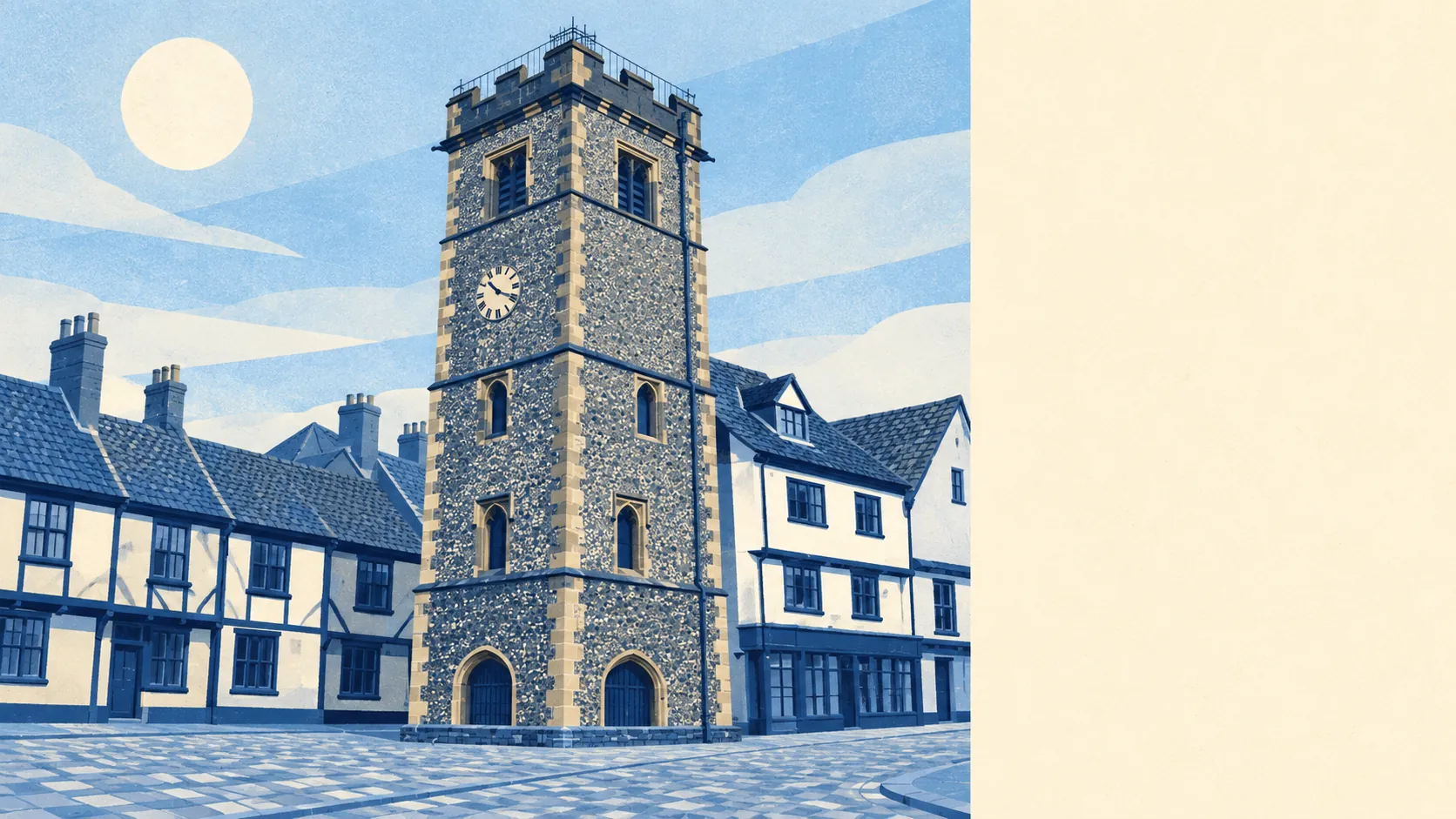
Heritage is the price of the postcard. Historic England lists 322 buildings across the area, five of them Grade I and 17 Grade II*, and there are four conservation areas, among them the St Albans city centre, Sopwell, Cunningham Avenue and Shafford Mill. Add nine scheduled monuments, from the Clock Tower to the Abbey Gatehouse and the Roman walls of Verulamium. If your house is listed or inside one of those boundaries, new windows, extensions and even some paint colours need permission first, and the permission is slow. Boudica levelled Verulamium in AD 61 without asking anyone, and nobody has altered anything round here that freely since.
Crime is the one number that refuses to go with the brochure. Over the year to May 2026 police.uk records about 91 crimes per 1,000 residents, roughly 12% above the St Albans district average of about 81. The mix is telling. Shoplifting makes up about 12% of incidents against 8% nationally, and vehicle crime 8% against 5%, while violence and sexual offences are a smaller share than the England and Wales norm. Hertfordshire Constabulary, which covers the whole county, charged in about 11% of cases over the same year, close to the national 12%. The thieves here go after the tills and the car parks, which is what a city full of shops and nice cars invites.
Flood risk is mostly a rain problem. On the Environment Agency's river-and-sea flood zones almost nothing is exposed, with about 0.3% of postcodes in zone 2 and none in zone 3. A wider measure tells a different story. About 10% of postcodes carry high risk on at least one flood indicator, surface water included. Only one flood event is on the agency's record, in June 2020, when a main river ran past its capacity. The River Ver is a trickle for most of the year. It is the heavy downpours on the hills that do the damage.
Buying in costs London-fringe money. The Land Registry's 732 sales in the year to May 2026 had a median of about £591,000. Detached houses went for about £910,000, semis for about £794,000, terraces for about £615,000 and flats for about £330,000. Council tax follows the money. Band D is the most common band, and only about 6% of homes are in bands A or B, so the cheap end of the tax list is close to empty.
Across the St Albans district, private tenants pay about £1,920 a month for a typical home, according to the Office for National Statistics rent index. Renting is no cheaper way into the same streets, just a monthly way to pay for them.
The housing stock is a fairly even split. The council-tax valuation list puts about 28% of homes as flats, 26% terraced, 25% semi-detached, 17% detached and 3% bungalows, with about 23% built before 1930. Most of the rest is post-war. About 54% of certificated homes are rated C or better for energy, and about 11% E or worse. Mains gas heats about 80% of homes and about 10% rely on electric-only heating. In a city this proud of its old brick, the draughty Victorian terrace is a status symbol with a heating bill attached.
The schools justify a good part of the price. The 41 primaries in these postcode districts average 108 in the end-of-primary maths test, above the expected standard, and the 12 secondaries average about 58 on the Attainment 8 measure at sixteen. Familiar names include Verulam School, Beaumont School, Sandringham School and St Albans Girls' School, with St Albans School and St Albans High School for Girls among the independents. Ofsted's grades are county-wide, 203 of 227 graded Hertfordshire settings good or outstanding, so they say little about any one catchment. Parents here learn the admissions map faster than the bus routes.
Green space is close to almost every front door. The nearest park or open space is about 130 metres away on average, with around 30 within a kilometre, and Verulamium Park, Clarence Park and the hamlet edges round Potters Crouch give the city real fields at its rim. Water is about 750 metres away on average, usually the Ver or the lake in Verulamium Park. The Romans built their city in the valley, and the residents walk their dogs over what is left of it.
St Albans is right for families and couples on good incomes who want history, strong schools and a crowd that cares, and who have no plans to remodel. Anyone who dreams of a bold extension, a cheap first flat or a neighbourhood that leaves you alone should look further out.
The people are the real draw. A buyer gets neighbours who are invested, financially and otherwise, in keeping the place good, and that care holds up everything from the schools to the high street. The same care is what holds up the planning application for the extension. St Albans is a better-than-average place to live for people who want to keep their home the way it is.