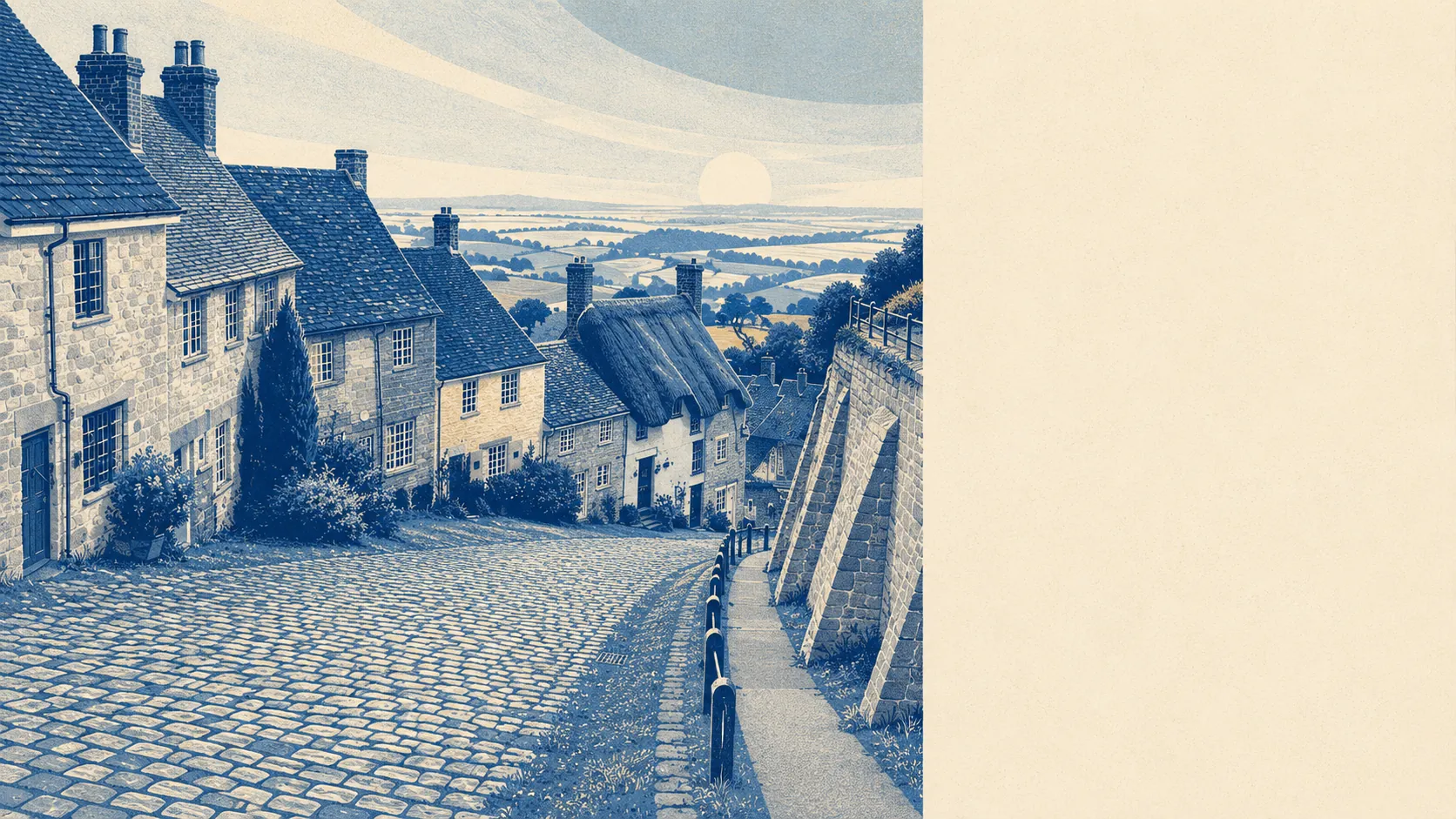
Shaftesbury is owned, middle-aged and considerably quieter than its market-town billing suggests. Around two-thirds of households own their home. A third of households contain exactly one person. The middle resident is in their mid-forties. Whoever the brochure photograph is aimed at, they are not who answers the doors here.
The 2021 census, which is the source for the population figures on this page, puts owner-occupation at about 64% of households, with about 19% renting privately and about 15% in social housing. Most front doors here belong to the people behind them, and the private rented share is thin enough that anyone arriving without a purchase in hand is competing for a small pool.
The median age is 45. About 23% of residents fall between 25 and 44, the band that generally supplies young families, first mortgages and most of the noise on a Friday night. That share is modest, and almost everything about the rhythm of the place follows from it.
Modelled household income came to about £54,800 before tax for the financial year to March 2023. Two caveats sit on that number and both matter: it describes 2023 rather than now, and gross means the figure before anything at all is deducted, not the sum that turns up in the account at the end of the month.
Households with children are the minority report. About 18% are couples with children and about 10% are lone-parent households, so the school run is a real part of local life without being the organising principle of the town.
The dominant household type is one person living alone, at about 33%. About 17% of all households are a pensioner living alone, which sits inside that third rather than alongside it, so the two shares should never be stacked on top of each other. A town of one-person households is not automatically a lonely one, but it does change what the housing stock is being asked to do, and it explains why so much of the market is two and three bedrooms rather than four.
On qualifications, about 29% hold a degree-level qualification and about 15% hold none, with full-time students at about 1%. That last figure is the honest one. Nobody comes here to study, and nobody who grew up here stays for that reason either.
Health reads well. About 83% describe their own health as good or very good, and about 4% report it as bad or very bad. Two broader measures come from the Dorset local authority rather than the town: preventable mortality across Dorset is better than the England average, and smoking prevalence, at about 10% of adults, is similar to England. Both describe the council area, not this particular hill.
159 residents live in communal establishments rather than private households, a small enough number that the household shares above describe the town as a whole rather than a slice of it.
Who lives here sits squarely in the middle of the national range: comfortable rather than wealthy, older than the country as a whole, and weighted hard towards households of one or two. Anyone buying on the assumption that a market town means a town full of young families should read those household shares twice before committing to the four-bedroom place near the school.