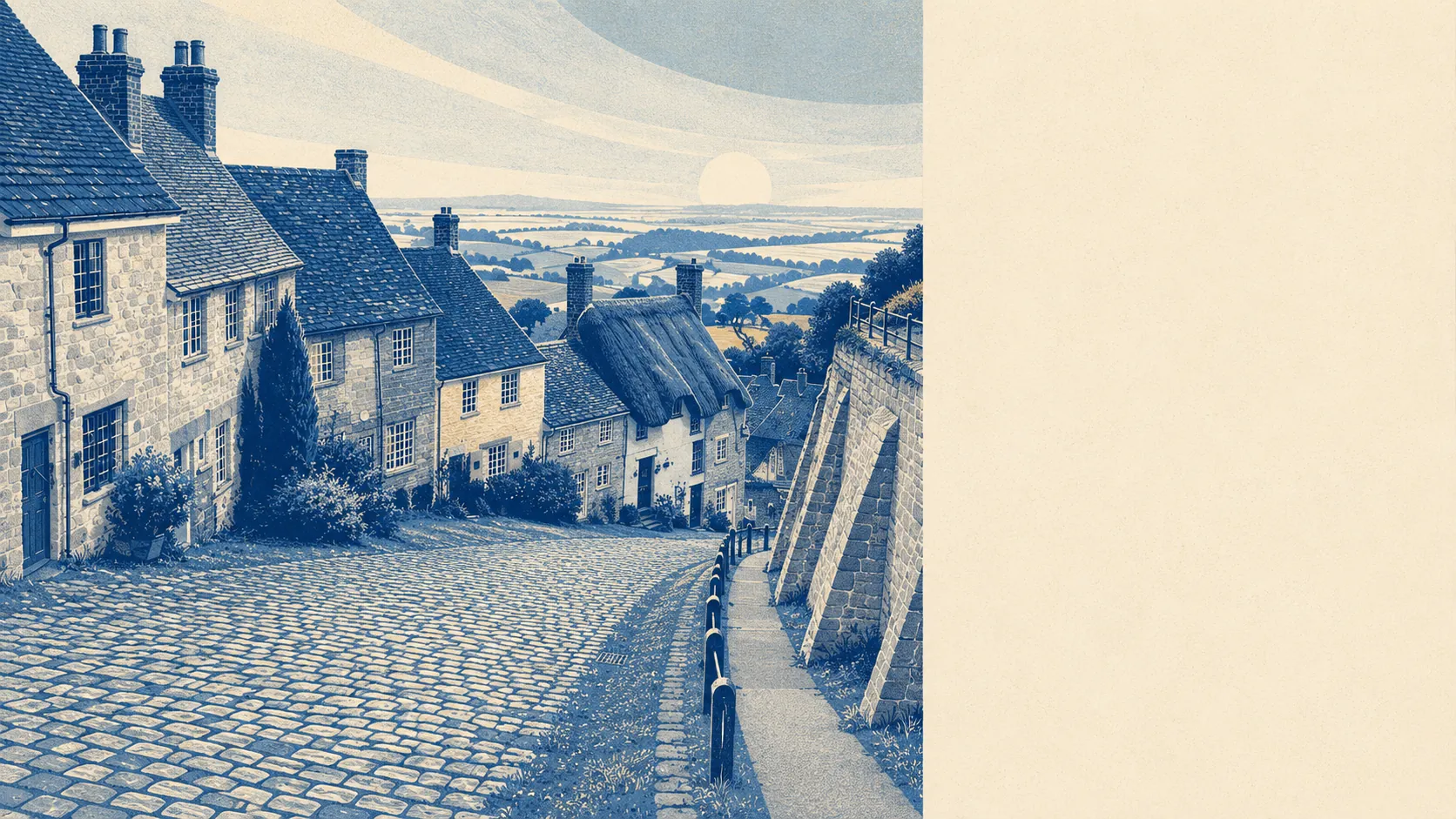
Shaftesbury is a good place to live, and the hill does the vetting. About two-thirds of households own their homes. One in five works from home. Nearly everyone else drives, because the alternative barely exists. It suits people who have already stopped commuting, and charges everyone else a daily toll for the view.
The housing is broader than a hilltop market town suggests. On the council tax valuation list, which covers every dwelling rather than only recent sales, about 29% are detached, 25% terraced, 20% semi-detached, and roughly 12% each are flats and bungalows. Around 28% went up before 1930, so the old stock is a real slice of the town rather than a heritage frontage on a modern one. Energy certificates follow the same split: about two-thirds sit in bands A to C, a quarter in band D, and about 9% in band E or worse. Roughly 68% run on mains gas and about 11% on electricity alone, which in a stone house on an exposed greensand hill is the difference between a warm winter and an educational one.
The Land Registry recorded 146 sales in the twelve months to May 2026, at a median of about £272,000. The spread by type is wide: detached homes around £418,000, semi-detached around £267,000, terraces around £233,000, flats around £157,000. Council tax lands most often in band D, with about 29% of dwellings in bands A or B, so the cheaper end of the town is genuine rather than theoretical.
Renting is measured at county level rather than street level. Typical private rent across the Dorset area was about £1,040 a month as of April 2026, up about 3.5% over the year, with one-bedroom homes around £720 and three-bedroom homes around £1,170 on the same measure. Treat that as the shape of the market, not a quote for a specific address.
Recorded crime ran at about 61 offences per 1,000 residents in the twelve months to May 2026, roughly 11% above the Dorset average. The mix is the ordinary small-town one, with violence and sexual offences at about 35% of records, close to the England and Wales share, and anti-social behaviour at about 19%. Burglary is the outlier at about 7% against roughly 4% nationally, which is the number worth a second lock rather than a second thought. Dorset Police charge or summons about 14% of cases against about 12% nationally.
Key stage 2 maths across the five primaries in these postcodes averages about 102. The town's single secondary, Shaftesbury School, records an Attainment 8 score of about 39. Ofsted has graded 86 settings across Dorset, of which 68 are good or better and two outstanding, with 17 requiring improvement and one inadequate. Shaftesbury Church of England Primary School and Motcombe Church of England Primary School cover the town and the village north of it, Port Regis Preparatory School takes the fee-paying end, and the modelled walk to a primary is about 21 minutes against about 49 minutes to a secondary. The secondary walk is why the school run exists here.
About 58% drive to work, about 22% work from home, about 13% walk, and fewer than one in a hundred use a bus or a train. There is no station in the town; the nearest is Gillingham in Dorset. Of the 52 bus stops, the 28 with published timetables average about 30 weekday departures each, and about 79% keep a weekend service, which is more than most towns this size hold on to. Broadband is the quiet advantage: superfast reaches every premise, gigabit about 88%, nothing sits below the universal service obligation, and about 97% get a signal from every mobile operator. The people working from their spare rooms up here are not roughing it.
None of Shaftesbury sits in the river-and-sea flood zones as the Environment Agency maps them, and no historic flooding is recorded. On the broader postcode indicators, which include surface water, about 10% of postcodes carry a high rating on at least one measure, about 11% medium and about 29% low, and on a hill that water arrives from the sky rather than from a river. Green space is the strong suit: the average postcode sits roughly 110 metres from open space, with about 25 green spaces inside a kilometre and water about 550 metres away. The Cranborne Chase and West Wiltshire Downs Area of Outstanding Natural Beauty covers about 3% of the area and rather more of the view. The ground itself is worth a survey, since every postcode falls in radon band 3 or above with the local maximum classed as Elevated, landslide susceptibility is class 3 across the whole area, and shrink-swell clay risk reaches class 3 across about 88% of it.
There are 276 listed buildings here, two of them Grade I and four Grade II*, along with a conservation area covering the old town and six scheduled monuments including the remains of Shaftesbury Abbey and the precinct wall on Gold Hill. In practice that means windows, extensions, solar panels and anything visible from the street become a negotiation with the planning department rather than a decision you make on a Sunday. That is the bill for living somewhere that looks like this, and it arrives every time you have an idea.
About 64% own their homes, the median age is 45, and typical household income before tax was about £54,800 in the financial year to March 2023. Settled, middle-aged and moderately comfortable, and the town behaves accordingly. This page also covers the parishes around it: Motcombe and Compton Abbas, Fontmell Magna and Ashmore, both Donheads, Berwick St John and Tollard Royal, all of which share the schools, the shopping and the roads down off the hill.
It suits people who work from home or have finished with the office, who want a detached house with a garden for the price of a modest terrace in a city, and who use the countryside rather than photographing it from the car. Families do well on the primary side and accept the drive to the secondary.
It is wrong for anyone who needs a train, anyone who wants a Saturday night that outlasts the pub, and anyone whose offer letter is really a plan for a rear extension and three new windows. Buyers at the older end should read the heating type before falling for the beams.
The town has been important for far longer than it has been quiet. Alfred the Great founded the burgh in 880 and the abbey in 888 with his daughter Ethelgifu as first abbess, and it grew into the wealthiest Benedictine nunnery in England, rich enough that people said if the abbot of Glastonbury married the abbess of Shaftesbury their heir would hold more land than the king of England. Cnut died here in 1035 and was buried in Winchester. The 3rd Earl of Shaftesbury took the family name off into eighteenth-century arguments about beauty and taste, and Charles Fox Bennett, born here in 1793, left to become premier of Newfoundland, which remains the longest commute anyone from this town has managed.
Shaftesbury lands above average, and its real strength is everything around it: open space at the doorstep, downland in every direction, and a position that hands the town a view most places pay a premium for. The weak spot is the freedom to alter what you buy, because between the listings and the conservation area the house you view is largely the house you keep. Buy it for the outlook and the walking, not for the plans in your loft.