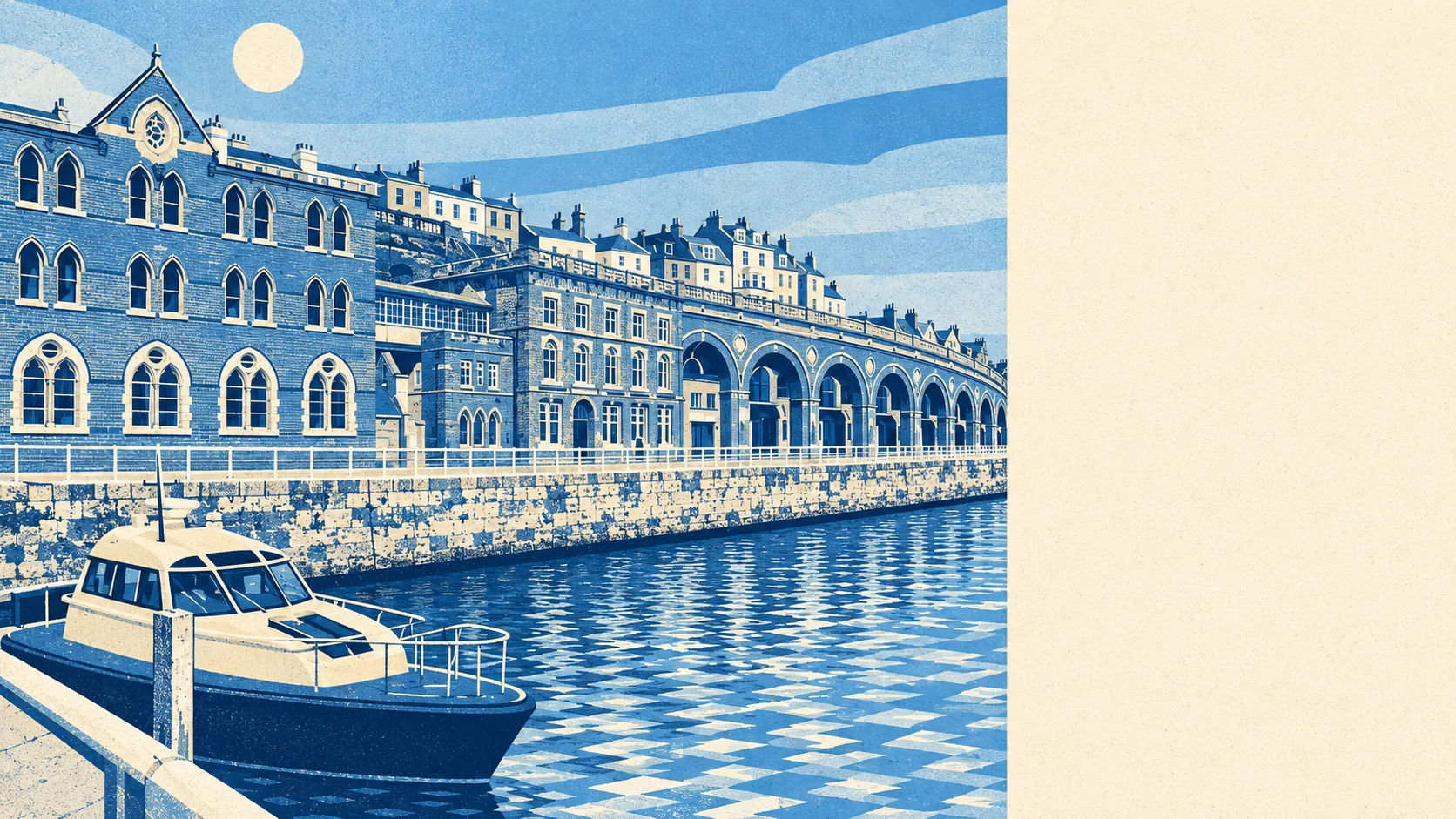
Ramsgate is a grand harbour town running on a sensible budget. Four in ten homes were built before 1930. Just over half the households own their place. Half of commuters still get in the car. The bones are Victorian ambition; the wallet is firmly present-day.
The housing is older and more mixed than a seaside town usually gets away with. On the council-tax valuation list, which covers every dwelling rather than only the ones that have changed hands lately, terraces lead at 32%, flats follow at 28%, semis make up 20%, bungalows 12% and detached houses a thin 8%. Some 40% of the stock was built before 1930, which is why so many of the streets near the Royal Harbour look like they were designed for someone arriving with a trunk and a fortnight's plans. Energy certificates reflect that age. About 48% of certificated homes sit in bands A to C, 39% in band D and 13% in band E or worse, so the handsome terrace with original sash windows tends to show up in the heating bill before it shows up in the survey. Around 79% of homes run on mains gas and about 9% rely on electric-only heating. In an older flat that second group is the one to ask about at the viewing, before the agent gets to the view from the bay window.
Prices are where Ramsgate stops pretending to be the grand resort it once was, in a way buyers tend to like. The Land Registry's last twelve months of sales, to the end of May 2026, give a median of £255,000 across 407 transactions. Terraces went for a median of £245,000, semis £280,000 and detached houses about £384,000, while flats sat at £160,000. The detached figure comes from 44 sales, which tells you how rarely anyone gets to buy a house with space down both sides here. Council tax follows the same modest line: band B is the most common, and 63% of homes sit in bands A or B. The Georgian and Victorian frontages suggest money. The valuation list suggests otherwise.
Renting costs about £1,110 a month, which is the typical private rent across the Thanet area as of April 2026 rather than Ramsgate's own figure. By size, the district-wide averages run from £765 for a one-bed to £1,216 for a three-bed. The harbour-view flat and the back-street two-bed are both in that number, and a landlord will be happy to remind you which one you're looking at.
Crime is the part that sits closest to the town's reputation. Ramsgate records a published rate of about 137 crimes per 1,000 people over the year from June 2025 to May 2026, roughly 15% above the Thanet average. Violence and sexual offences, a broad legal category that includes common assault without injury, account for about 41% of recorded crime, against 35% across England and Wales. Anti-social behaviour makes up about 17%. None of that is a reason to cross Ramsgate off, but it is a reason to walk the street at eleven on a Saturday as well as eleven on a Sunday. The listing photos are always taken on the Sunday.
Getting about depends on what you're getting to. Ramsgate Rail Station sits at the top of the town, Dumpton Park Rail Station serves the Broadstairs side, and Thanet Parkway and Minster Rail Station are close by for the western edge. Only about 3% of working residents take the train to work, around 50% drive and about 22% work from home, which says the London commute is a thing people talk about more than they do. There are 211 bus stops, with an average of 86 weekday departures per stop, and 94% of the stops with timetable data get a weekend service. Broadband is solid: gigabit connections reach about 79% of premises and superfast about 99%. The old Manston airport site, just west of town, is not operating. If it ever did, the town would sit under the flight path, which is the sort of detail worth knowing before you fall for a loft conversion with a skylight.
Flood risk is narrower than a coastal town might lead you to expect. Only about 0.4% of the area falls in the Environment Agency's highest river-and-sea flood zone, and around 1% of postcodes sit inside the zone modelled for climate change. The wider postcode indicators, which include surface water, are less comfortable: about 12% of postcodes carry a high rating on at least one flood indicator and 16% a medium one. Most of that is rain with nowhere to go rather than the sea coming over the wall. The shoreline management plan's long-term approach for this coast is to hold the line. Green space is the genuine win. The average home is about 135 metres from the nearest green space, with roughly 25 within a kilometre, and water is about 770 metres away on average. The cliff-top promenades with parks at either end are what people mean when they say Ramsgate grew on them.
Heritage is where the town gets less relaxed. There are 462 listed buildings, including five at Grade I and 12 at Grade II*, from the Royal Harbour itself to Pugin's Church of St Augustine and The Grange. Four entries sit on Historic England's Heritage at Risk register. No conservation area appears in the published heritage data for the area, but a listed building brings its own consent requirements, and a lot of Ramsgate's best-looking streets are listed ones. Buy a listed terrace and plastic windows are not a decision you get to make on your own. Pugin designed the house, and the council holds his proxy.
The people are neither retirees nor weekenders. About 56% of households own their home, the median age is 42, and median gross household income was about £48,600 in the financial year to March 2023, an Office for National Statistics estimate averaged across the area. Out towards Cliffs End, also written Cliffsend, and Manston, the town thins into village edges and farmland, which is where the buyers who wanted a driveway usually end up.
Ramsgate suits people who want period architecture and a working harbour without paying resort prices for either, and who treat the sea as the place they walk the dog rather than a backdrop for a second home. It suits remote workers with decent broadband, people who drive, and anyone who likes a town with a past and a price tag that hasn't caught up with it.
It suits less well if you need a fast daily train to London and plan to take it every morning, if you want a new-build with low bills, or if the idea of asking permission to change your front door makes you tense. It also won't suit buyers who read a crime rate as a crime rate without walking the streets that produce it.
Ramsgate is a good place to live for the right buyer, and better than its reputation for most of them. Its real strength is the surroundings: green space on the doorstep, cliff-top parks, and a harbour that most towns would build a brand around. The weak spot is freedom to change the house you buy, because the handsome old stock comes with rules attached. Ramsgate will sell you history at a discount. It just won't let you redecorate it.