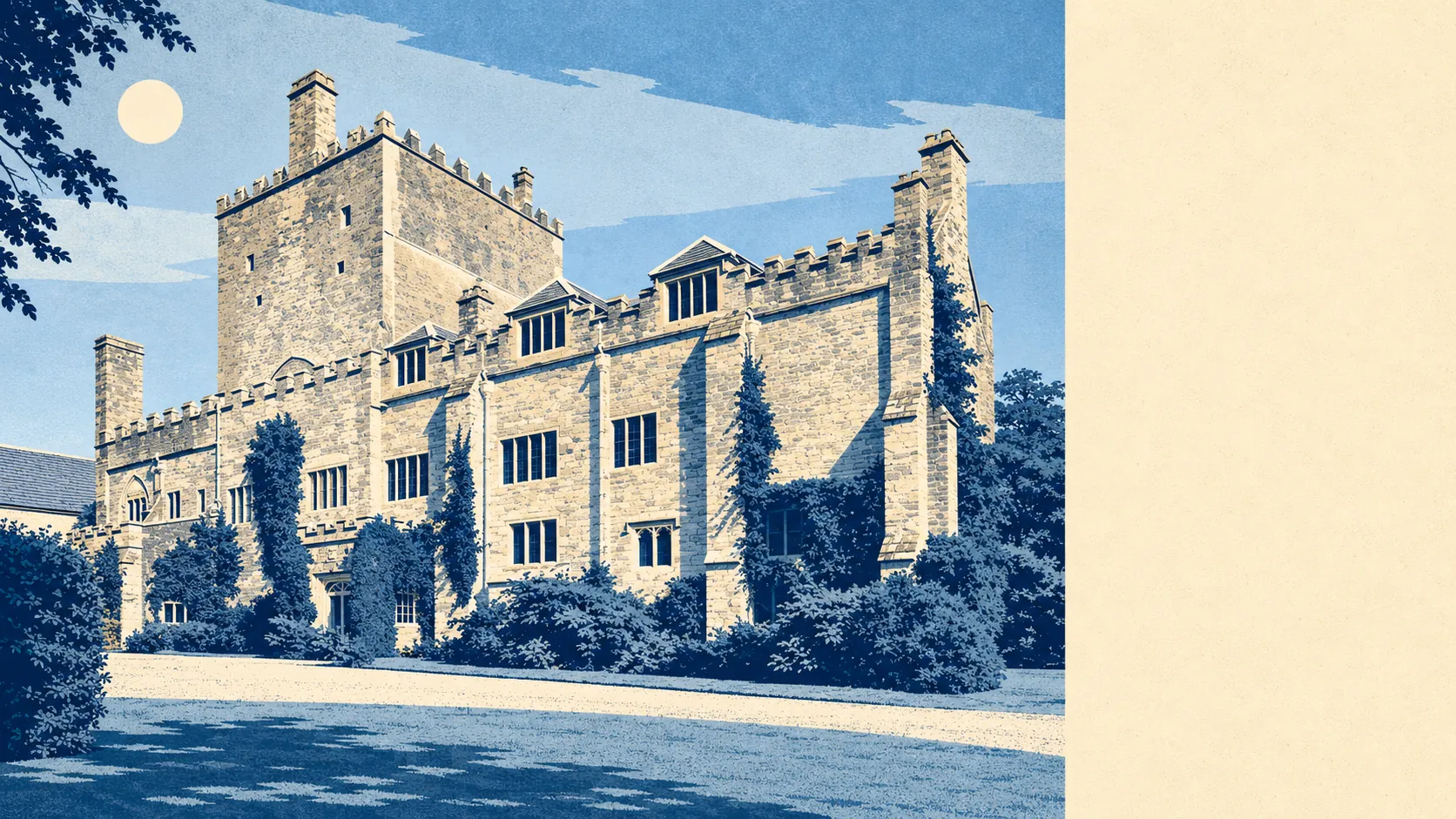
Yelverton is where Plymouth exhales. More than eight in ten households own their home. The median resident is 58. Half the households keep two cars or more, and a third of the working population never leaves the house to do it. This is not a commuter village. It is where people land once the commuting is behind them.
The dwelling mix is roomy in a way most villages are not. On the council tax valuation list, which covers every home rather than only the recently certificated ones, about 40% are detached, 19% bungalows, 15% semi-detached, 15% terraced and 8% flats. Roughly 35% went up before 1930, and 46% of households have four bedrooms or more, which tells you what kind of buyer the place has spent a century catering for. Energy certificates put about 41% of assessed homes in bands A to C, 36% in band D and 23% in band E or worse. About 57% are on mains gas, which this close to Dartmoor counts as an amenity rather than an assumption, and about 4% run on electricity alone. An electric-only house built before the war is a January problem, and it is cheaper to find that out at the viewing than on the first bill.
The Land Registry recorded 31 sales in the twelve months to mid-May 2026, at a median of £375,000. The type split is where the money actually sits: a median of £587,500 across eleven detached sales, £385,000 across seven terraced, £285,000 across seven semi-detached and £123,500 across six flats. Terraces landing above semis is the sort of inversion a small sample produces, so read the type medians as a sketch rather than a rule. The most common council tax band is F, and only about 20% of dwellings sit in band A or B. The valuation office had a look at Yelverton and did not find many bargains either.
Renting is a minority activity here, and the honest figure is a wide one. Typical private rent across the West Devon area runs at about £840 a month as of April 2026, up about 2% over the year, taken from the national statistics office's rent index rather than a count of advertised listings. Two bedrooms across the same area sit at about £760 and three bedrooms at about £940. Those cover the whole district rather than this village, which matters in a place where the council tax bands run as high as they do.
Recorded crime runs at about 30 offences per 1,000 residents over the twelve months to May 2026, against about 47 per 1,000 across West Devon as a whole, on the published neighbourhood-level police figures. That is the number a buyer wants. The one nobody puts in the window is the force-wide charge rate: Devon and Cornwall Police charged about 8% of recorded offences over the same period against about 12% across England and Wales, which puts the force 42nd of 42. Low crime and low clear-up rates are not the same comfort.
Getting anywhere is the soft spot, and it is not marginal. The railway station closed along with the line to Tavistock and Plymouth, so everything now moves on the A386, north to Tavistock and Okehampton, south to Plymouth. Stagecoach service 1 runs the Tavistock to Plymouth route and Plymouth Citybus adds a rural service towards the moor. There are 15 bus stops averaging 41 scheduled weekday departures each, and every one of them has a weekend service, which is more than most villages this size manage. It barely dents behaviour: about 52% drive to work, about 2% take the bus, and the train share rounds to zero. About 11% of households have no car at all. Transport department modelling from 2019 puts the nearest town centre at about 19 minutes by car and about 45 by public transport, and the nearest hospital at about 23 minutes by car. The public transport half of that is the half that ages badly. Broadband is the consolation prize and a good one: gigabit-capable service at about 78% of premises, superfast at about 99%, nothing below the minimum universal service standard, and mobile signal from at least one operator everywhere, with about 91% covered by all of them. The internet reached Yelverton in better shape than the railway ever left it.
On flooding, the good news needs its label attached. No part of Yelverton sits in the Environment Agency's river-and-sea flood zones, and none of it falls inside a recorded historic flood extent. On the broader postcode indicators, which include surface water, about 4% of postcodes carry a high flag, 3% medium and 29% low. Surface water on the edge of a moor is a drainage question, not a river one. Green space is the opposite of a worry: the average postcode is about 210 metres from open green space with about nine within a kilometre, and about 390 metres from water. Roughly 13% of the area falls inside the Tamar Valley area of outstanding natural beauty, and the wider ground covered here runs out to Lopwell at the tidal limit of the Tavy and up to Two Bridges in the middle of the moor. Two things come with the granite. Every postcode sits in the higher radon bands, with the highest local reading at the top of the published scale, so a radon test belongs on the checklist rather than in the reassurance pile. And every postcode sits within reach of road noise mapped at 65 decibels or above, which is what a village organised around a main road looks like on a noise map.
Heritage constraint is light. Three listed buildings inside the boundary, all Grade II, with no conservation area and no scheduled monument. Compared with the parish around it, where Buckland Abbey and a scatter of wayside crosses are protected, altering a house in Yelverton is a normal planning conversation rather than a heritage negotiation. That freedom stops at the National Park boundary: Horrabridge and Princetown, both covered here, sit inside Dartmoor National Park, where the same extension takes longer and comes back with more conditions.
The character follows from the ownership. About 82% of households own, the median age is 58, one household in five is a pensioner living alone, and typical gross household income sits at about £52,000 for the financial year to March 2023, modelled by the statistics office across middle-layer areas rather than measured door to door. Nearly half of adults hold a degree. Crapstone sits about a mile away in the same parish and behaves accordingly.
It suits the buyer who wants the moor out of the kitchen window and a hospital inside half an hour by car: people trading down from somewhere expensive, families who would rather have a detached house and green space at the end of the road than a station, and anyone who works from home and treats the office as an occasional inconvenience.
It does not suit anyone who needs a train, anyone whose budget runs out where the flats run out, or anyone expecting a village with this age profile to supply a social life on demand. The moor is the social life, and it does not do last orders.
The roll call is stranger than the place looks. Seth Lakeman, nominated for the Mercury Music Prize, comes from here. Maureen Bruce, formerly of Sadler's Wells Ballet, lives here. General Sir Frank Kitson retired here. And Ravenscroft was built as a private house, became a school in the 1930s, served as the officers' mess for the Royal Air Force station at Harrowbeer during the Second World War, and is now a care home, which is a better career than most buildings manage.
Yelverton is a good place to live and reasonably honest about the trade. Its real strength is the ground it stands on: the moor, the water, the green space within a few minutes of the front door, and the fact that most of it is protected by rules somebody else has to enforce. The weak spot is leaving, and no amount of gigabit fibre compensates for a village that lost its railway and kept the road. Buy here for the view out and the quiet in. Buy the car first.