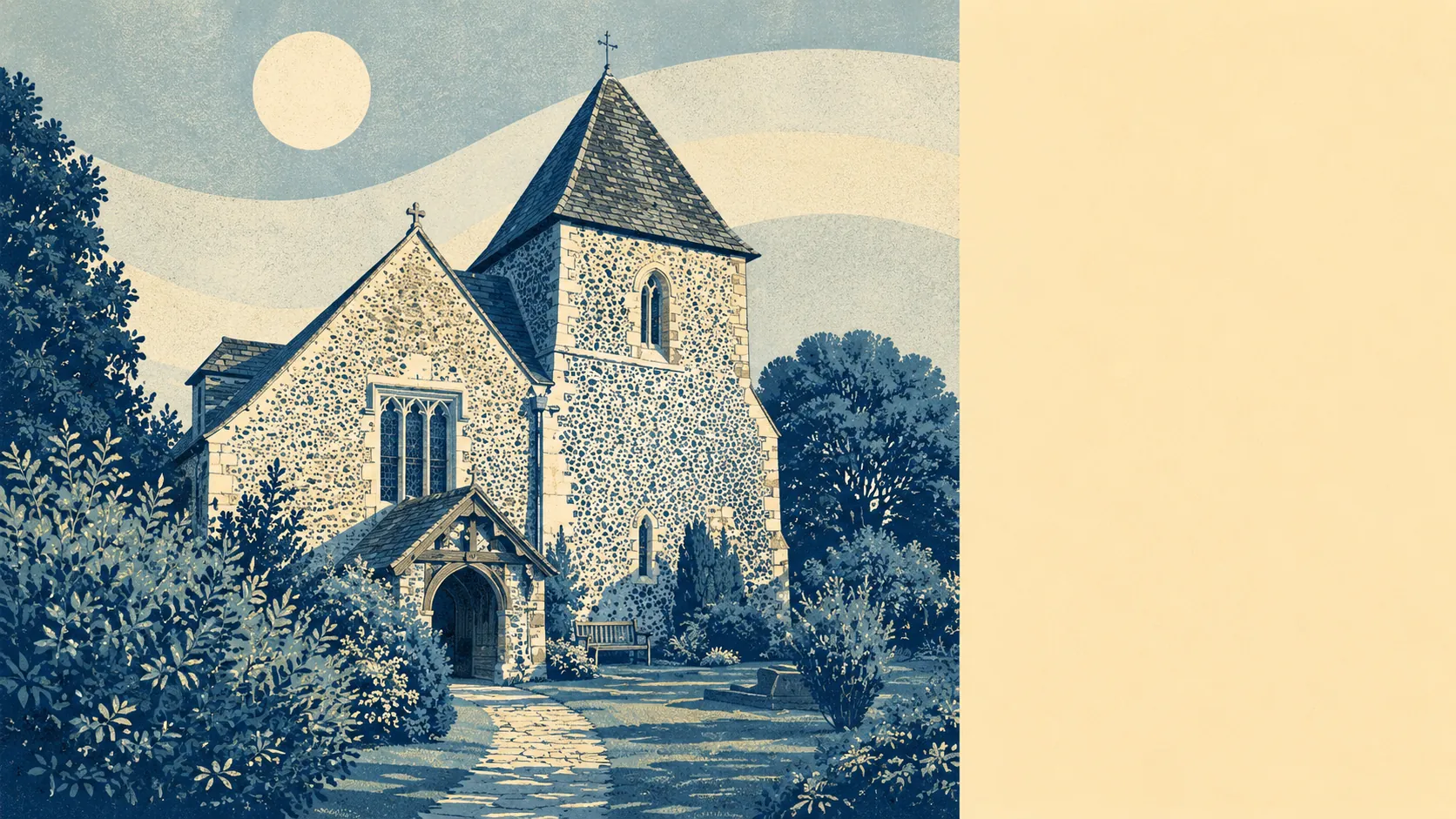
Yapton is what people mean when they say "a village on the road to somewhere else." It sits three miles north-east of Bognor Regis at the crossroads of two B-roads, with about 6,900 people and 2,700 households. Three-quarters of them own their homes. The median age is 45. It is not, and does not pretend to be, an extension of Arundel.
The housing stock is the first thing to understand. Roughly four in five homes are houses, only about one in twelve is a flat, and the rest are bungalows. That ratio does a lot of work: it tells you the streets are not packed with converted terraces, the gardens exist, and the density is village-scale rather than town-scale. The energy picture is decent for a village that grew mostly between the war and the early eighties. About two thirds of the rated stock is in bands A to C, another quarter sits in band D, and only around one in twelve is band E or worse. The post-war ratio is doing the lifting there. Older listed cottages have their own problems, but they are the minority of the stock, not the norm.
Buying costs are the reason people who wanted Arundel end up looking here. The typical sale price over the last twelve months was about £350,000, across roughly a hundred transactions, so the market has depth. The split by type is the usual village pattern with sharper gaps than you might expect: detached houses ran to about £440,000, semis to around £345,000, terraces to about £257,000, and the handful of flats that sold went for around £192,500. Council tax lands mostly in band C, and about a quarter of the stock sits in bands A or B, which is the affordability marker that most Arun villages would like to be able to claim and can't.
Renting is a different market and the honest figure is not Yapton-specific. The typical private rent across the Arun area is about £1,220 a month, up around 3.5% on the year. That is the local-authority average, not the village's own, and Yapton being an inland village rather than a Bognor postcode probably shades it slightly cheaper in practice. Treat the figure as the ballpark, not the offer.
Safety is where the honesty gets uncomfortable. The published crime rate is about 112 per thousand residents a year, which is roughly 25% above the Arun average of about 90. It is a village-scale rate on a village-scale population, and the arithmetic magnifies small numbers of incidents into a rate that reads worse than it feels on the street. But the number is the number, and Yapton runs higher than its parent district, not lower. Buyers who assume every rural West Sussex village runs quieter than the towns need to look at the data before they commit.
Connectivity is genuinely good for a village of this size. Broadband is the standout: gigabit is available at 83% of postcodes, ultrafast at the same 83%, and superfast at 98%. Nothing sits below the universal service floor. Rail is not in the village itself, but Barnham station is the near neighbour and connects to Bognor, Littlehampton, Ford and Arundel, and about one in fifty residents commutes by train. The car does the heavy lifting: nearly six in ten drive to work, another quarter work from home, and only about one in ten households has no car. Bus stops sit at 33 across the built-up area, which is roughly one per 200 people. Not urban service levels, but a working village network.
Environmentally the surroundings are the strongest thing on the report card, rated five out of five. Green space is on the doorstep, at an average of 157 metres from a postcode centroid, with about sixteen green spaces within a kilometre of the typical address. Water is close too, at an average of about 500 metres. No Site of Special Scientific Interest, no Area of Outstanding Natural Beauty, no ancient woodland inside the boundary. Flood risk is the qualifier: about 8% of postcodes carry some high risk, about 11% carry medium, and roughly a third carry some low risk. Under climate projections about one postcode in ten sits inside a projected zone. That is a check-your-specific-street issue rather than a stay-away issue.
Heritage constraints are light. Thirty-five listed buildings in the wider area, three of them Grade I, and a single conservation area covering Yapton Main Road and Church Lane. If you buy inside that conservation area or in a listed cottage, the usual planning conversation applies before you touch the windows or the roof. If you buy anywhere else, and most buyers will, you can install what you like within normal permitted development.
Neighbourhood character is settled and older than the national median. Three quarters of households are owner-occupied, the median age is 45, and the typical household income is about £54,700. That last number is comfortable-provincial rather than commuter-belt, and it explains the housing market: prices that professionals can reach and retirees can afford to downsize into, without the London-money distortions of the coast further east.
Who it's for. Buyers who want a house rather than a flat, garden rather than balcony, and a village rather than a commuter suburb. Buyers who drive to work or work from home. Buyers whose priority is a settled community with good broadband, decent schools within a short drive, and green space out of the front door. Buyers who understand that Barnham is the station and Bognor is the town.
Who it's not for. Buyers who want to walk out of the door onto a busy high street with three coffee shops. Buyers who need daily rail commuting and refuse to drive to a station. Buyers who assume rural means low crime and won't do the postcode check on flood risk before they exchange.
The Portsmouth and Arundel Canal ran through here between 1823 and 1855, part of a route that carried agricultural goods and munitions between London and Portsmouth when the Channel was too dangerous for shipping. The village produced Duncan Goodhew, the Olympic swimming maestro, who was brought up here and has a residential road named after him. The sculptor Ginger Gilmour works from a fifteenth-century farmhouse nearby. The poet Andrew Young lived in the area. None of it is on the tourist trail. All of it is real.
The verdict is three out of five, which is the honest average of what the data actually says. The strongest dimension by some distance is the environment and surroundings, at the top of the scale. The weakest is safety, where the rate runs above the Arun average and needs to be looked at with clear eyes rather than village romanticism. Everything else lands close to average, which for a village on the road between Bognor and Arundel is exactly what it should be. If Barnham is the compromise that mostly works and Arundel is the dream, Yapton is the compromise for buyers who never wanted the dream in the first place.