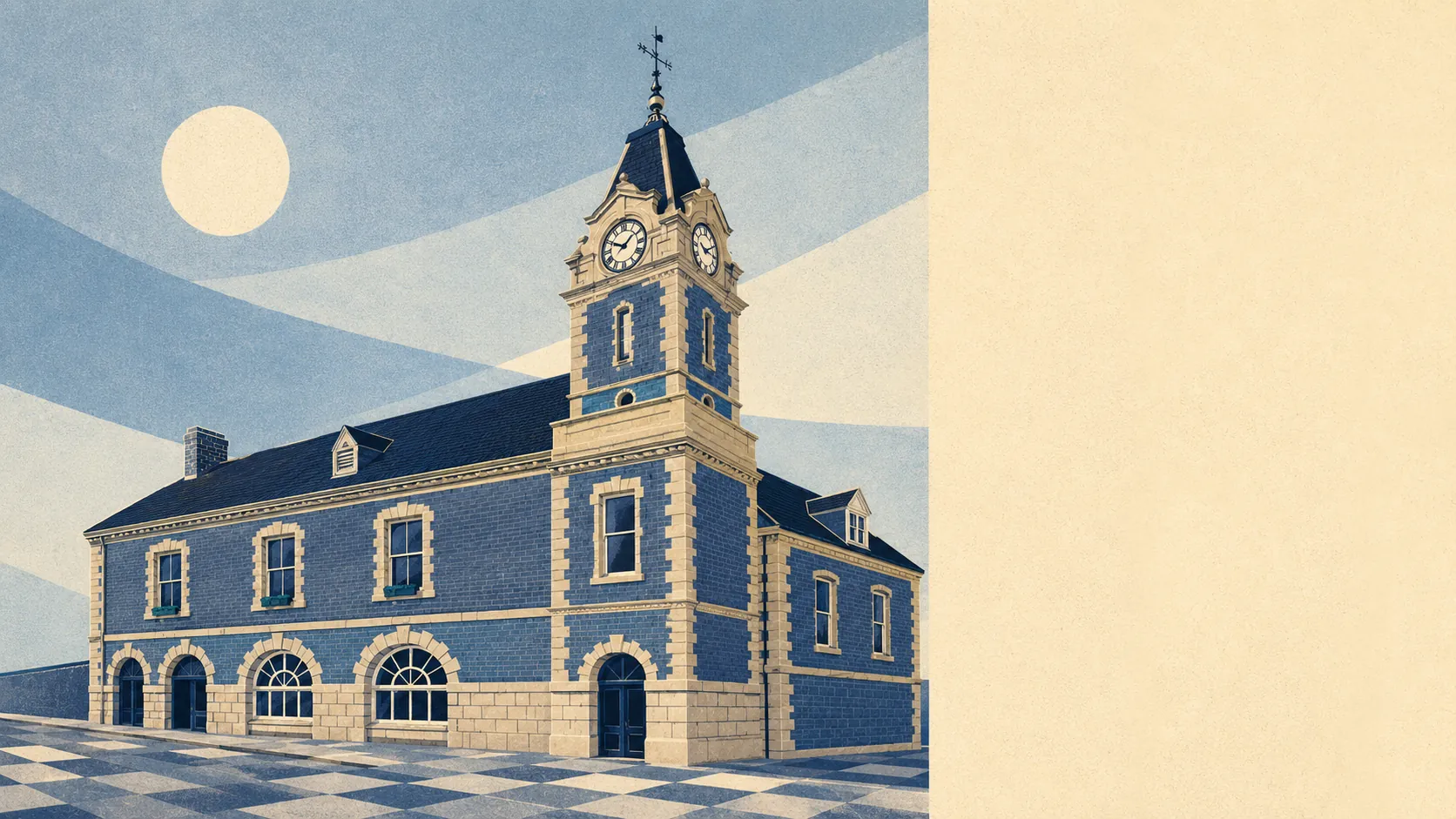
Yes, if you can live somewhere that has never once asked to be admired. Wincanton made its money turning milk into baby food. The railway left in 1966 and did not come back. Three in five people drive to work, most households own outright or on a mortgage, and the place keeps the hours of a town with things to do in the morning. This is a working town in a county that now sells itself as a lifestyle, and it has quietly declined to join in.
The housing surprises people who arrive expecting thatch. Taking every dwelling on the council tax valuation list rather than only the ones certificated in recent years, 31% are detached, 23% semi-detached, 16% terraced, 15% bungalows and 11% flats. About 27% were built before 1930, which leaves most of the town post-war or later, on plots with room around them. Energy certificates put roughly 62% of certificated homes in bands A to C, 28% in band D and 10% in band E or worse. Around 62% of households run on mains gas. Roughly 13% heat with electricity alone, and that is the thing to establish before the viewing rather than after the first winter bill.
The Land Registry's last twelve months, to May 2026, record 96 sales at a median of £270,000. The spread by type is wide: flats at a median of £125,000 across 13 sales, terraces at £225,000 across 17, semis at £270,000 across 35, detached houses at £350,000 across 31. That gap is the whole town's price ladder in two numbers. Band B is the most common council tax band and about 32% of dwellings sit in band A or B, which is not the profile of a place trading on prettiness.
For renting, the typical private rent across the Somerset area is about £990 a month as of April 2026, with the same county-wide series putting two-bedroom homes near £890 and three-bedroom homes near £1,100. Those are area figures rather than the town's own, so read them as the shape of the market, not as an asking price.
Recorded crime runs at about 73 offences per 1,000 residents over the twelve months to May 2026, roughly 21% below the Somerset average. The mix repays a closer look. Violence and sexual offences account for about 42% of recorded crime against 35% across England and Wales, while antisocial behaviour sits at 11% against 16% nationally. That violence category is a broad statutory grouping taking in assault without injury, and it is the largest category almost everywhere, so a high share is not the same thing as a high rate.
Five primaries serve these postcodes, Wincanton Primary School and Our Lady of Mount Carmel Catholic Primary among them, averaging a Key Stage 2 maths scaled score of 104. Secondary means King Arthur's School, the county's first specialist sports college, with an Attainment 8 score of 41. Ofsted has graded 140 settings across Somerset, of which 101 are good or better and five outstanding, against 32 requiring improvement and seven inadequate, so the county figure hides real variation and the individual report is the document that matters. Primary is about a twenty-minute walk, secondary nearer thirty-five, or ten minutes in the car alongside everyone else doing the same run.
No station. The line went in 1966 and the nearest platforms are at Templecombe and Bruton, which is why about two people in every thousand commute by train. Three in five drive, roughly 23% work from home and 11% walk. There are 32 bus stops in the area; the 23 with published timetables average 15 weekday departures each, about two in the peak hour, and 14 of them see any weekend service. Broadband is the quiet strength: superfast reaches every premise, gigabit around 83%, and nothing falls below the universal service minimum. By car the town centre is about nine minutes, the nearest hospital about half an hour, the main employment centre roughly 25. The public transport times behind those comparisons date from 2019 and have aged less well than the driving ones.
On flooding, about 19% of postcodes carry a high rating on at least one indicator, surface water included, with 20% medium and 43% low. On the narrower river-and-sea flood zones, about 3% of the area sits in zone 2 and 1% in zone 3, rising to 7% once the Environment Agency's climate allowance is applied. The two measures answer different questions and both appear on this site. No historic flood outlines are recorded. Green space is where the town wins without effort: the nearest averages about 180 metres, with around 11 within a kilometre, and water about 320 metres. There is no national landscape designation and no site of special scientific interest, which means the countryside here is ordinary, close and walkable rather than protected and photographed.
There are 114 listed buildings, one of them grade one: The Dogs, built around 1650 and reworked inside by Nathaniel Ireson in the 1740s. Five are grade two star and 108 grade two, one conservation area covers the town, and one listed building sits on the Heritage at Risk register. The practical translation is short. On the list or inside the boundary, windows, doors, roofs and extensions become a conversation with the planners before they become a quote from a builder.
About 63% of households own their home, the median age is 43, and household income runs at roughly £54,400 gross before tax, modelled for the financial year to March 2023. Close to 30% of households are one person living alone. This page also covers the parishes around the town: Holton a couple of miles to the south west, Cucklington out towards the Dorset border, Penselwood to the north east, and Yarlington. Those are villages rather than suburbs, and the difference announces itself on the drive to a supermarket.
It suits people who want a garden, a driveway and a mortgage that leaves something over, who are content to drive to most things and who would rather spend the difference on the house than the postcode. It suits people working from home, and families who are happy with one secondary and will read its report properly.
It does not suit anyone who needs a train, anyone who wants a cheap central flat with something happening outside it after nine, or anyone buying an address to say out loud. The bus will not rescue a carless household here.
The notable residents make an odd pub quiz round. John Ring, an eighteenth-century surgeon who spent his life arguing for vaccination. Tony Weare, who drew comic strips. Sir Robert Burgess, who went to school locally and finished up running the University of Leicester. And Diana Hoddinott, who played Annie Hacker, giving the town a stronger claim on British political satire than most places with an actual political history.
Wincanton is a good place to live for people who like their towns useful. Its real strength is the ground it stands on: green space at the end of most streets, countryside that is close and unfenced by designation, and villages a few minutes out that would cost a fortune with a smarter address. The weak spot is water, and it is a genuine one, with enough postcodes carrying a high flood indicator that the individual address matters far more than the town does. Check that first, not at the survey. Get it right and you have bought a town that works, which is a duller sentence than the estate agent will write and a truer one.