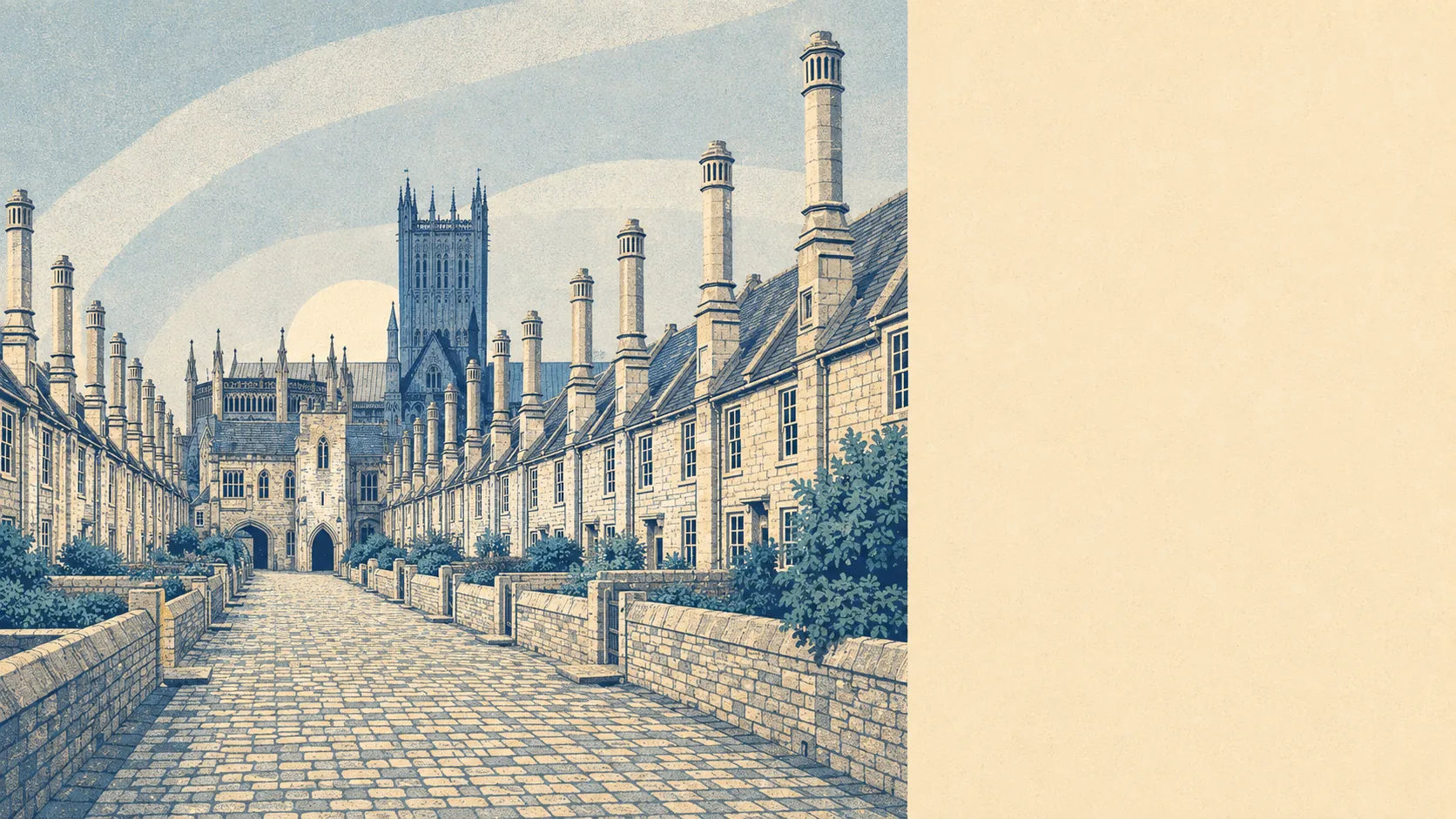
Yes, if you can live with a city that closes. Wells is a cathedral city where the cathedral is genuinely the biggest thing that happens. The countryside starts almost at the end of your road. Crime sits well below the county average, and the housing is quietly expensive rather than loudly so. It is one of the calmest places in Somerset to own a house, and one of the most bureaucratic places in Somerset to change one.
The stock is houses, and it is mostly not old. Across every dwelling on the council-tax valuation list, terraces make up about 25%, semis about 23%, detached about 20%, bungalows about 17%, and flats only about 13%, which is a suburban mix rather than a medieval one. Only about 22% predates 1930, so for all the Gothic frontage in the middle, most people in Wells live in something built after the war on a plot with a driveway. About 76% of homes run on mains gas, and roughly 8% are on electric-only heating, which is the number to check before you fall in love with a cottage in a conservation area. On energy performance, the Energy Performance Certificate register puts about 59% of certificated stock in bands A to C, with roughly 32% sitting in band D and about 10% in E or worse. Houses dominate that register too, at around 65%, with flats at about 18%.
Buying here costs a comfortable amount of money for a small city. The Land Registry's last twelve months, to May 2026, records 161 sales at a median of £333,000. Split by type, the pattern is orderly: flats at a median of £199,000, terraces at £315,000, semis at £320,000, and detached houses at £530,000, which is where the professional Wells money goes and stays. Price per square metre across sales that could be matched to a certificate's floor area runs to about £3,760, on a median floor area of roughly 91 square metres. Council tax lands mostly in the middle: band C is the most common band, and about 27% of dwellings sit in band A or B, so the cheap end of the tax list exists but is not where the city's character lives. Band D costs around £2,560 a year.
Renting is harder to pin to Wells itself, because the published figure is the wider one. Typical private rent across the Somerset area is about £990 a month, up around 4% over the year to April 2026. Treat that as the regional temperature rather than the reading on your own street, because Wells is not the cheapest corner of Somerset and the number covers the whole county.
Safety is one of the better arguments for the place. The published crime rate for Wells over the twelve months to May 2026 is about 76 recorded crimes per thousand residents, against roughly 93 for Somerset as a whole, which puts the city about 18% below the county average. Within the mix, violence and sexual offences account for around 39% of recorded crime against about 35% nationally, and shoplifting about 12% against roughly 8%, which is what a compact market centre with a concentrated shopping core produces. Avon and Somerset Constabulary charges in about 11% of cases, close to the England and Wales figure of roughly 12%, so the force is neither a standout nor an embarrassment.
Schools are a genuine draw, and the reason a fair number of families accept the commute. Ofsted has graded 140 settings across Somerset, of which 101 are good or better and five outstanding, though 32 sit at requires improvement, so the county average hides real variation. Locally, Key Stage 2 maths scores across the six primaries in the postcode district average about 101, and Key Stage 4 attainment at the single secondary comes in at about 50. The Blue School, founded in 1641, is the state comprehensive, and Wells Cathedral School, founded in 909, is the private option with the music specialism. Primary choice includes Stoberry Park School, St Cuthbert's Church of England Junior School, St Cuthbert's Church of England Academy Infants and Pre-School, and St Joseph and St Teresa Catholic Primary School, with Coxley Primary School, Horrington Primary School and Wookey Primary School in the villages. Driving time to a primary is around eight minutes; a secondary is closer to ten.
Connectivity is where the enthusiasm stops. Wells has no railway station, and about 0.1% of working residents commute by train, which is another way of saying nobody does. Around 47% drive to work, roughly 31% work from home, about 14% walk, and roughly 2% take the bus. There are 70 bus stops in the area, 58 with service data, averaging around 121 weekday departures and about eight in the peak hour, and roughly 97% of stops have a weekend service, which is better than most rural Somerset manages. A hospital is about 51 minutes away by car, which is the single figure most likely to make an older buyer pause. Broadband compensates: gigabit service reaches about 70% of premises, superfast about 98%, and no premises fall below the universal service obligation. At least one mobile operator covers effectively every premise.
Water is a live consideration in a city built where the Mendip springs meet the Levels. On the postcode indicators, which include surface water, about 10% of postcodes carry a high rating on at least one measure and roughly 29% a medium one. In the river-and-sea flood zones specifically, about 9% of the area sits in zone 3 and roughly 15% in zone 2, rising to around 44% under the Environment Agency's climate-change mapping. About 10% of postcodes sit within the Axe Brue Internal Drainage Board area. Geologically, around 86% of the area is classed at compressible-ground class 3 or above and about 14% at soluble-rocks class 3 or above, which is limestone country doing what limestone does. Radon reaches the High band, with about 44% of the area at band 3 or higher, so budget for a test. Against that, green space is exceptional: roughly 138 metres to the nearest patch, about 20 within a kilometre, water about 260 metres away, and the Mendip Hills protected landscape clipping the edge of the area.
Heritage is the tax you pay for the view. The area holds 343 listed buildings, 25 of them Grade I and 36 Grade II star, along with two conservation areas covering Wells and Mendip Hospital, and three scheduled monuments. If your house is on that list or inside those boundaries, window replacements, solar panels, extensions and external insulation all become conversations with the planning department rather than decisions. Planning volume tells its own story: 633 applications since April 2024, 267 of them in the last twelve months.
Character-wise, this is a settled, older, comfortable city. Around 68% own their homes, the median age is about 51, and modelled household income runs to roughly £54,000 gross. About 37% of households are single-person and roughly 21% are single pensioners, while couples with children make up about 15%. Around 38% hold a degree. Nearly 81% report good or very good health. The page also covers the surrounding villages of Westbury-sub-Mendip and Wookey, which are quieter again, and where the balance tips further toward the car.
Wells suits people whose lives are built around a house, a garden and a car, and who genuinely want an evening that ends early. It works for families using the school choice, for people working from home on a good connection, and for retirees who want walkable shops and countryside without a city's noise.
It does not suit anyone who needs a train, anyone who needs a hospital nearby, or anyone whose plan involves ripping the back off a period house and glazing it. The freedom to alter your own home is the thing Wells asks you to give up, and it asks quietly, through committee.
The city has form for people passing through and finding it inconvenient. William Penn was briefly arrested here for addressing a crowd in the market place, released only when the Bishop of Bath and Wells intervened, which is a Wells story in miniature: the trouble was minor and the man who fixed it lived up the road in a palace. Jocelin of Wells, born here, helped create Magna Carta and built most of the cathedral. Herbert Balch went underground and founded the museum. Mary Bignall-Rand took Olympic gold in the long jump in 1964, which remains the fastest anyone has left Wells.
So: yes, a good place to live, with the usual asterisk. Its real strength is the setting, the green space that starts almost immediately and the protected hills behind it, backed by low crime and strong school choice. The weak spot is the freedom to change your own house, followed closely by the absence of a train. Buy something already extended, and you get the best deal in the city.