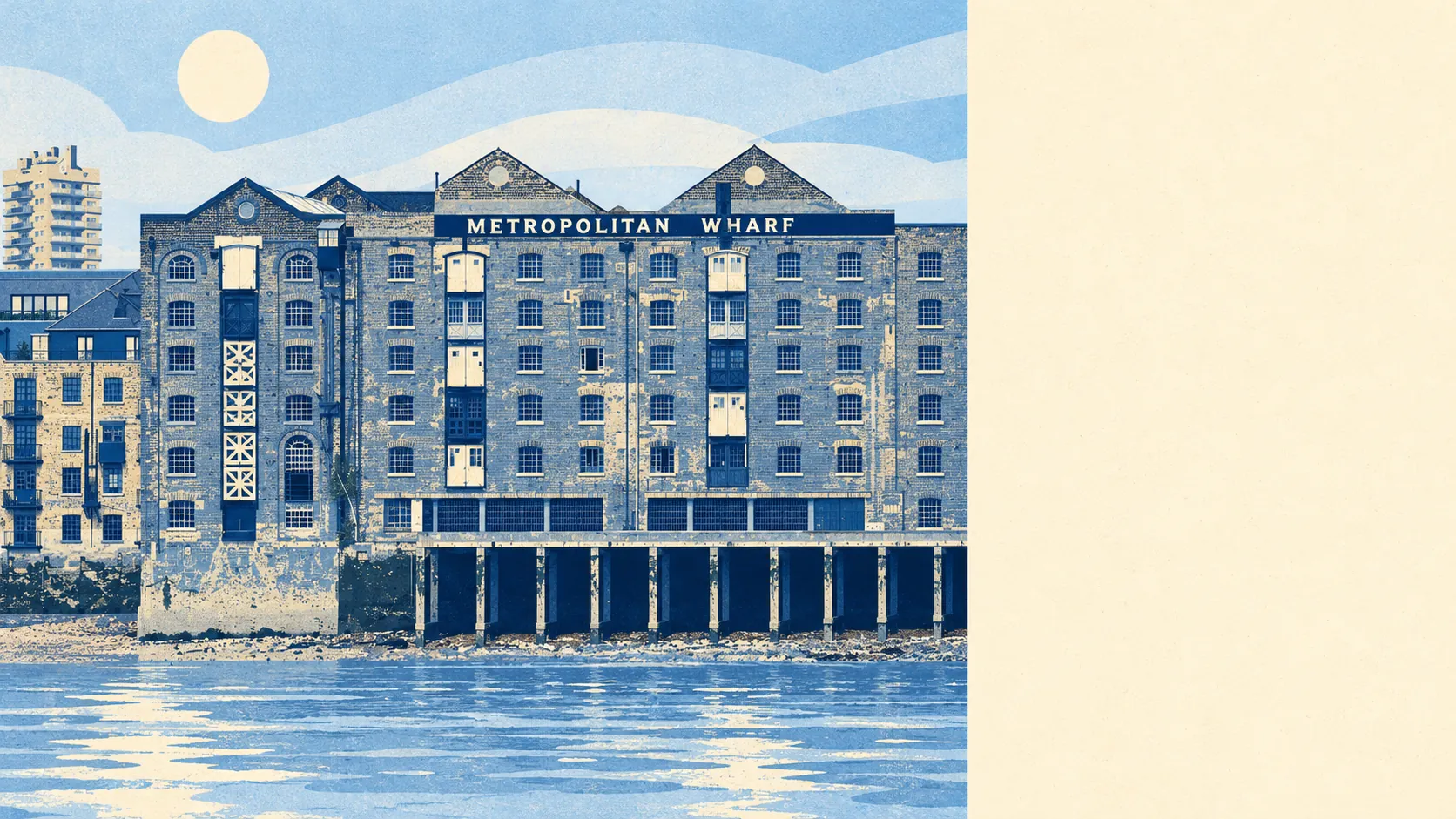
The area around Wapping is excellent, and the river is only the most obvious part of it. A small park is a short walk from almost every front door. Water is everywhere. Pubs on the foreshore keep a riverside drink within reach. The only things missing are fields and private gardens.
Wapping homes are on average about 94 metres from the nearest public green space, with about 77 green spaces within a kilometre. St George's Gardens, behind the Hawksmoor church on Cannon Street Road, was the church's cemetery before it became a public park in mid-Victorian times. The former churchyard of St John's, Wapping's oldest church, is a park too. Several of the area's best-used open spaces started life as burial grounds.
The nearest water is about 260 metres away on average, and about 128 stretches of water lie within a kilometre. The Thames forms the whole southern edge. The Ornamental Canal runs through the middle to Shadwell Basin. Watermen's stairs such as Wapping Old Stairs and Pelican Stairs, beside the Prospect of Whitby, lead down to the foreshore. Wapping was built along a river wall, and almost every street still ends at water.
The National Cycle Network is about 360 metres from the average home, and about 81% of postcodes are close to it. The Thames Path crosses the area from west to east for walkers and cyclists. There is no ancient woodland anywhere in the area, which is about what you would expect from drained marsh in Zone 2.
Rated premises in Wapping include 57 shops, 8 pubs and 23 restaurants. That is a small high street, and the pubs make up for its size with their location.
Tower Hamlets recorded fine-particle pollution of about 10 micrograms per cubic metre in 2024, a figure for the whole borough. A breeze off the river does not change that number, so a riverside flat breathes the same air as the rest of the borough.
The character comes from a long, narrow strip pressed between the Thames and the old marsh line. Wapping High Street runs down the middle, with side streets leading off to the river. The Wapping Pierhead and Wapping Wall conservation areas keep the riverside looking as it did. Shadwell, on the eastern side, brings its basin and its own station. Wapping has the feel of a fishing village that London grew around, though the fishing is long gone.
Private outdoor space is scarce. Census-area figures put private garden at about 5,300 square metres for every 1,000 residents, and most of it belongs to the few houses. For most people, the outdoor space they have is a balcony or the park down the road.
The council's valuation list counts 1,095 rateable premises in Wapping, and offices make up the largest group at 485. These are premises on the list, which says nothing about whether each one is open or occupied. Wapping has more desks than shop counters.
Of the 81 food premises given a hygiene rating, about 79% hold the top score and about 3% sit at the bottom of the scale. With 81 premises the numbers cover every café, pub kitchen and takeaway in the area.
No protected landscape overlaps Wapping. There is no area of outstanding natural beauty, no site of special scientific interest and no ancient woodland. The scenery is a river, a canal and some old churchyards, and none of it needs a designation to be worth having.
The surroundings are Wapping's strongest feature: green space and water within a few minutes of almost every home, with the Thames Path joining them up. The trade-off is that the outdoor space is shared, and very few homes have a garden of their own.