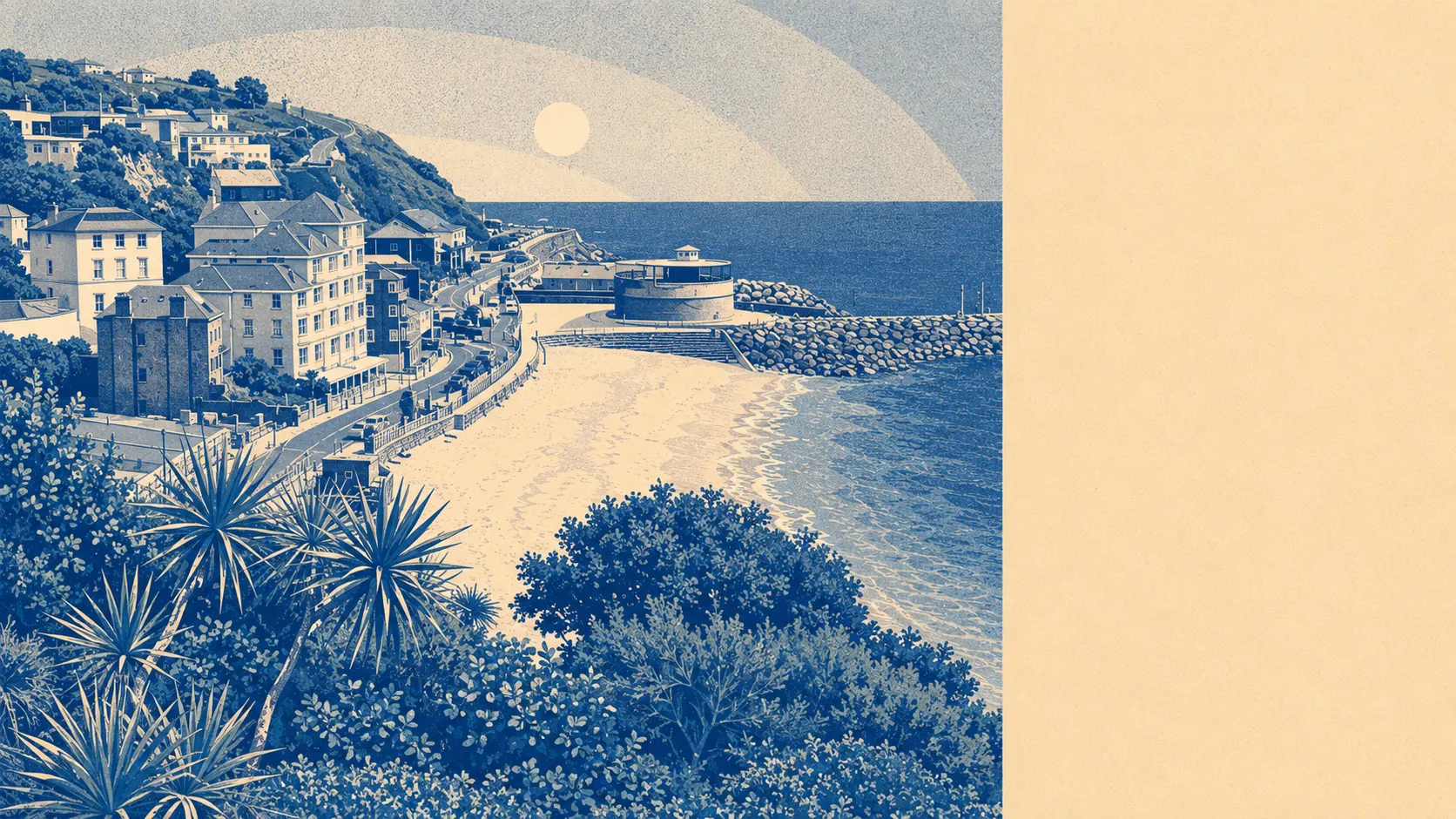
Built on a cliff for the dying, now sold to the retired. The median age is fifty-six. About a quarter of households don't have a car. The railway shut in 1966 and never came back. Not Brighton with a microclimate. A Victorian sanatorium town that's mostly Victorian and mostly retired.
The stock is what Doctor James Clark's 1830 book caused to be built. Houses make up about forty-four percent of the homes, flats forty percent, and the rest are bungalows. Two in five were put up before 1930 and they're still standing because the Victorians built things to last and the Luftwaffe missed most of them. The energy ratings tell the story bluntly. About a third of the stock sits at C or better. Just over a third sits at D. Nearly a third sits at E, F or G, which is the band you reach for the woollens in and accept that part of the heating bill will be staring through the windows. Old houses on a south-facing cliff are full of charm and full of draughts, and the energy certificate is the place where charm goes to die.
Eighty-three properties have changed hands in the last twelve months at a median of two hundred and forty-five thousand pounds. The median hides the spread the way it always does. A flat goes for around a hundred and forty-six thousand, a terrace for two hundred thousand, a semi for two hundred and fifty thousand, and a detached for nearly half a million. Council tax tells the same story from a different angle. The modal band is B and over half the dwellings sit in Band A or B, which is a working-island tax base bolted onto a market that occasionally pretends it's not. People arriving with London money buy the detached. People living on island wages buy the flat.
Rents aren't published for the town on its own. The typical private rent across the Isle of Wight area is about £940 a month, up about eight percent over the year. Ventnor's specific rent isn't separately reported, but a place where about two-thirds of households own and the rental pool is small enough to wave at isn't where cheap stock is hiding. Anyone arriving to rent should expect to pay island-typical for less-than-island-typical access to anything that isn't the sea.
The crime rate is about ninety-three per thousand residents per year, which sits roughly eleven percent above the Isle of Wight average. That figure is published on a population base wider than the resident headcount, which is why dividing the incident count by the residents produces a different number and isn't the comparable one. Eleven percent above an island average is what a Victorian town centre with a seafront strip and a Friday night looks like in its crime data.
The railway closed in 1966 and the most recent question in Parliament about extending the line from Shanklin hasn't produced a station. About half of working residents drive to work. Bus services run on routes three and six through Southern Vectis to Newport, Ryde, Sandown and Shanklin. The cycle-share to work is barely one in a hundred, which is what happens when commuting involves a 241-metre hill. About a quarter work from home, which is the closest thing the town has to a transport strategy. The broadband is the one piece of good news. Gigabit is available to more than three in four premises and superfast covers almost everyone. The internet arrived even if the train didn't.
Eight percent of postcodes have at least one address with a high flood-risk indicator and another six percent have a medium one. The high-risk pockets aren't the whole town. The coast here needs active shoreline management because it erodes whether anyone manages it or not. The flip side is the green space, which is what saves the verdict. The Isle of Wight Area of Outstanding Natural Beauty laps about nine percent of the boundary. Greenspace is on average a hundred and twenty metres from anyone's front door. The sea is just under three hundred. The Botanic Garden is in town. Ventnor Park took a gardening award in 2016 and the seafront has a paddling pool with a concrete model of the island on it. Whatever else Ventnor is, it isn't somewhere you have to drive to a park.
There are 132 listed buildings inside the place, including nine at Grade two-star and one hundred and twenty-three at Grade two. The Victorian fabric does most of the work that conservation areas would do somewhere else. Replacing windows on a listed terrace involves English Heritage and a quote explaining why plastic isn't on the table. Most of the alterations residents want are alterations the planners would prefer they didn't make. The houses are now worth more than they ever were when used as designed.
About sixty-three percent of homes are owner-occupied. The median age is fifty-six. The median household income is just over forty-one thousand pounds, below the English average and roughly Isle-of-Wight-typical. Four in ten households are single-person, one in five are pensioners living alone, and couples-with-kids account for less than one in ten. This is not a young town. Three primaries in the surrounding area have closed recently, which is what demographic decline looks like on a balance sheet.
Ventnor suits people who arrive with capital and a view of life that includes Sunday-afternoon bandstand music in Ventnor Park, terraced gardens facing south into the Channel, and the Ventnor Fringe Festival being roughly as much culture as anyone needs. Retirees with London equity, downsizers, and people who liked the idea of the south coast but found Salcombe priced like Mayfair.
Ventnor isn't for people whose mortgage depends on a commute that gets them to a station in under an hour. The nearest direct train is at Shanklin, which has the calmer market and the bus route that connects to it. If you want a Victorian seaside town that does exactly what it says on the tin, with the bucket-and-spade energy and the budget that comes with both, you want Sandown.
Sir James Clark's 1830 book sent half of consumptive London here in the 1840s, which is the founding act of the town and most of its architecture. Doctor Arthur Hill Hassall opened the Royal National Hospital for Diseases of the Chest in St Lawrence in 1869. Charles Dickens visited. Ivan Turgenev visited. Algernon Charles Swinburne lived nearby at East Dene. Queen Victoria came across from East Cowes and the place started calling itself Mayfair by the sea, a phrase that aged badly. The Russian novelist, the English poet, the consumptive Londoners and the railway tourists from Bournemouth all arrived through the same iron pier the storms eventually took back.
The headline rating is three out of five, which is the average answer to a question that isn't quite average. The strongest dimension is the surrounding area and green space, which scores five out of five and would score higher if the scale went higher. Everything that makes Ventnor look good in a brochure is true. The weakest dimension is the local community, which scores one and a half because the population is old, ageing, declining, and the deprivation indices put it in the more-deprived third of England. The arithmetic produces an average score by adding a magnificent setting to a thinning community and dividing by two.
Salcombe prices, Sandown wages, Shanklin transport. Pick the two you can live with.