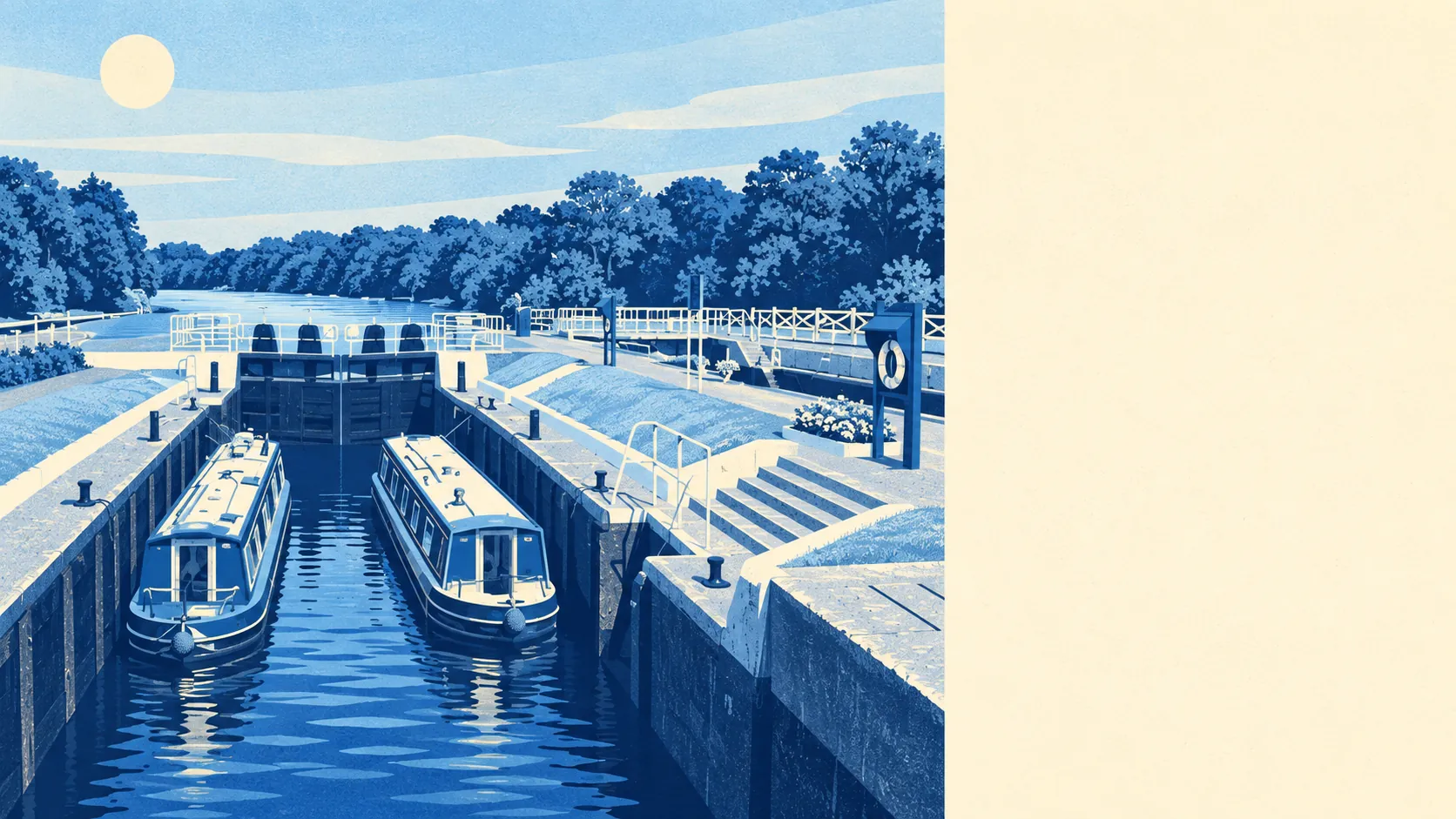
It's green and wet, in a good way. There's a park or open space a few minutes' walk from almost every front door. Water is never far away. The gardens are generous for a town this close to London. Sunbury is suburban, but the river gives it plenty of room around the edges.
Green space is one of the best things about Sunbury. On average, the nearest park or open space is about 170 metres from a home, and there are about 21 within a kilometre. In most of the town, walking the dog doesn't involve getting in the car.
Water is almost as close. The nearest river, lake or reservoir is about 380 metres away on average, and there are about 26 bodies of water within a kilometre. Along the Thames there are islands as well as banks. Sunbury Court Island is reached by a narrow arched footbridge, and Sunbury Lock Ait, almost uninhabited, is home to a yacht and motorboat club. Hamhaugh Island, Lock Island and Pharaoh's Island are further along the same stretch.
The National Cycle Network is further off, about 1.4 kilometres from the average home, and only about 20% of homes are close to it. The surrounding area has no ancient woodland. For most people, getting out into the countryside here means the towpath.
The rated premises across the wider postcode area include 572 shops, 35 pubs and 31 restaurants. Sunbury has pubs, cafés, takeaways and local shops, and residents tend to go further afield for anything larger.
Fine-particle air pollution across Spelthorne as a whole averaged about 8 micrograms per cubic metre in 2024. That's a figure for the whole council area, and it doesn't show any difference between a riverside street and a house near a busy road.
Sunbury's character comes from what's next to it. Kempton Park is to the north-east, Hampton to the east, Shepperton and Lower Halliford to the south-west, and Walton-on-Thames across the river. The post-war streets are inland, while Lower Sunbury has the river frontage and the older buildings. For the millennium, local volunteers stitched an embroidery of the town's landmarks, including St Mary's, Hawke House and the river, and the Queen came to see it in 2001. A town that spends years embroidering a picture of itself is clearly fond of the place.
Private gardens are the part of Sunbury most comparisons miss. The town has about 81,000 square metres of garden for every 1,000 residents, a lot of private outdoor space for somewhere this built-up and this close to London. The post-war semis inland have most of it. The riverside cottages tend to have water at the end of the garden and less lawn.
The business-rates list for the town has 460 premises. The biggest group is 102 shop premises, followed by 69 warehouse and storage premises and 65 offices. That mix reflects a working suburb with some industrial units on its edges. These are rated premises on the valuation list, not a count of businesses currently trading.
Of the 105 food businesses inspected for hygiene, about 78% hold the top score of five, and about 1% are rated at the bottom of the scale. Eating out in Sunbury carries very little hygiene risk.
None of Sunbury falls inside an area of outstanding natural beauty, a site of special scientific interest or ancient woodland. No national body has designated any of this landscape as protected, so it's the parks, the river and the islands that make the surroundings worth having.
The surroundings are one of Sunbury's real strengths. Few places this close to London have this much grass and water within a short walk of home.