Yes, if your commute is the stairs. Nearly half the working residents work from home. Almost all the rest drive. The train and the bus barely register. Rudgwick is a lovely village for people who have already arranged not to need anywhere else.
The housing is big, detached and built for families who own at least two cars. On the council-tax valuation list, which covers every home rather than the ones that happen to have sold recently, about 34% of dwellings are detached, 21% semi-detached, 15% bungalows and 16% flats, with terraces down at 6%. Around 26% were built before 1930, which is where the village's older character comes from, and the rest is mostly post-war. The energy certificates split roughly down the middle: about 48% rated A to C, 37% on D and 15% on E or worse. Only about 60% of homes are on mains gas, and around 5% heat with electricity alone. Before you fall for the inglenook, ask what heats the rest of the house.
Prices match the square footage. The Land Registry recorded a typical sale price of about £505,000 in the year to late April 2026, from only 12 sales, which tells you how rarely anyone leaves. Detached homes went for around £580,000 across seven sales, and terraces for about £500,000 across three. That's a sample small enough that one nice cottage can move the whole average, but the message is still clear: there's no cheap end of Rudgwick, only a less expensive one. Council tax points the same way. The most common band is E, and only about 11% of homes sit in bands A or B.
Renting here means paying Horsham-area money for village-level supply. The typical private rent across the Horsham area was about £1,450 a month as of April 2026, according to the Office for National Statistics' rental index. That's a district-wide figure, not a Rudgwick one, and with around 11% of households renting privately, the local stock you can pick from is thin. Renters here tend to be people waiting to buy, and they can wait a while.
Rudgwick is not a crime story. Police figures for the year to May 2026 put the rate at about 54 crimes per 1,000 residents, roughly 6% below the average for Horsham district. At that level a handful of incidents moves the mix, so the headline rate means more than any single category. The biggest risk to your peace is probably the planning notice on the lamppost.
Getting around is where the village starts charging. About 43% of working residents drive to work and fewer than 1% take the train or the bus. There are 15 bus stops, with around 16 weekday departures per stop on average and roughly one an hour at peak. Every stop with timetable data has a weekend service, which is decent, as long as you don't mind organising your Saturday around it. The Department for Transport's modelled journey times, which date from 2019 and age worst for public transport, put Horsham town centre about 16 minutes away by car or 25 by public transport. A secondary school is about 18 minutes by car or 33 by bus, and a hospital is about 36 minutes by car or around an hour and a half by public transport. Broadband is where the home workers live: superfast speeds reach about 93% of premises, but gigabit reaches only about 20%. Mobile coverage from all operators reaches about 99% of the area. Video calls work fine. Uploading a film in a hurry is another matter.
The surroundings are the best reason to be here. Green space sits about 250 metres from the average home, with around five spaces within a kilometre, and water is about 280 metres away. On the Environment Agency's river-and-sea flood zones, none of Rudgwick's postcodes fall in zones 2 or 3. On the wider postcode indicators, which include surface water, about 8% of postcodes carry a high flag on at least one measure and about 14% a medium one. That's rain with nowhere to go rather than a river coming over its banks, and it's worth checking street by street. Radon is in the lowest band throughout.
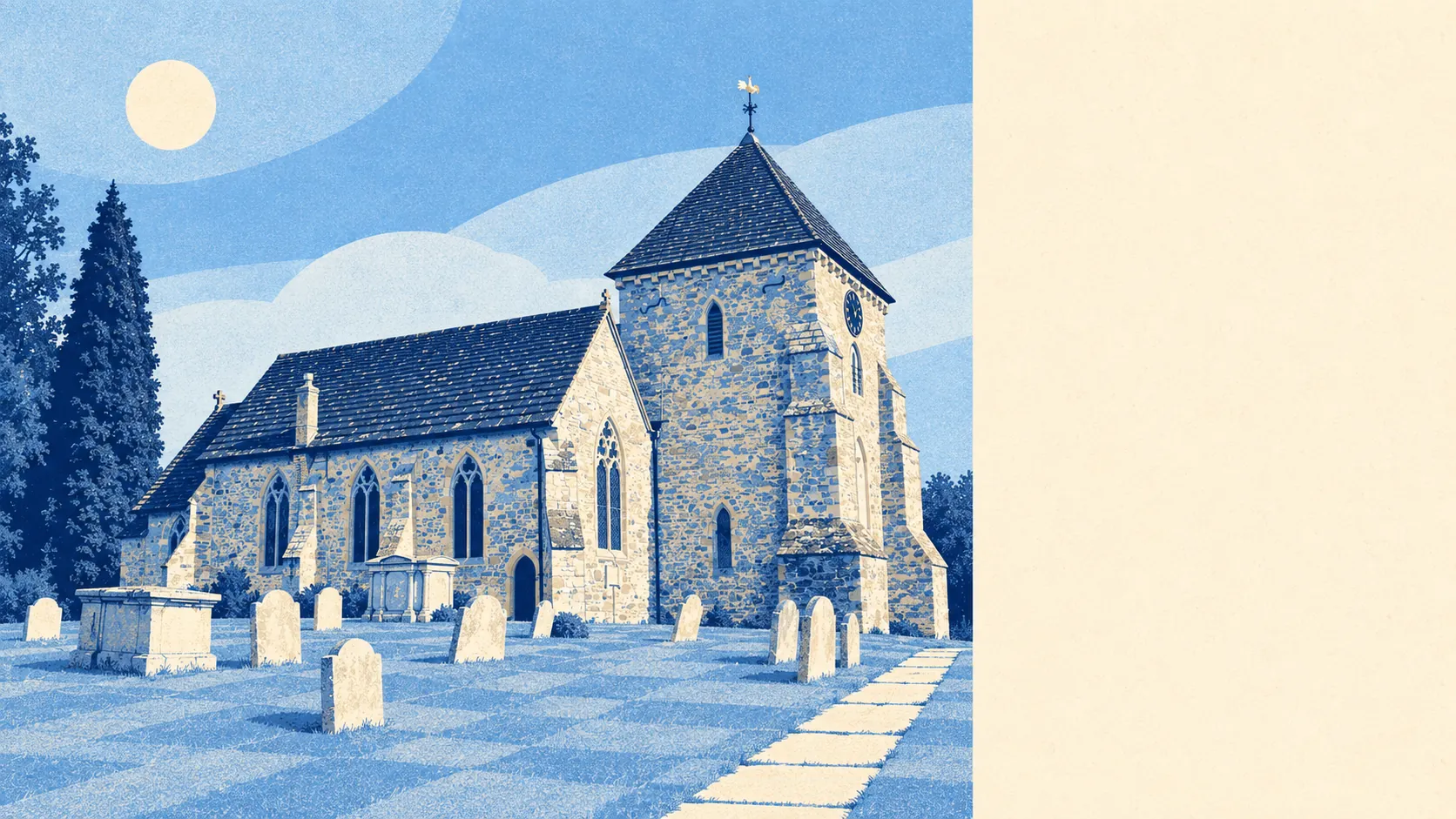
Heritage is a real constraint here, not a sales gimmick. There are 48 listed buildings, one of them Grade I and 47 Grade II, and one conservation area covering the village. The parish church of the Holy Trinity has a Norman font of Sussex marble and a belltower from the early thirteenth century, and Garlands, a seventeenth-century farmhouse, is on the list too. If you're buying inside the conservation area or near a listed neighbour, the uPVC brochure goes in the recycling. Planning officers here have longer memories than most residents.
The people fit the houses. About 81% of households own their home and the median age is 50. The Office for National Statistics' modelled average household income, before tax, was about £67,000 in the financial year to March 2023. About 42% of homes have four or more bedrooms, and roughly 22% of households are couples with children. It's a settled, comfortable village where the kids' bedrooms outlast the kids by years.
Rudgwick suits a household with two cars, one or two jobs that can be done from a spare bedroom, and children at Rudgwick Primary School or happy to be driven to secondary. It suits people who want fields close enough to walk to after work and don't mind a planning application taking longer than the building work. West Sussex's wider school picture helps too: Ofsted has graded 103 of the county's 122 graded settings good or better.
It doesn't suit anyone who needs to commute by train, a teenager with a social life and no licence, or a first-time buyer hoping the village has a starter flat hidden somewhere. If a bus once an hour sounds like a joke rather than a timetable, Horsham gives you the station and the shops and asks you to trade away the quiet. That's a fair trade for some buyers and a bad one for others.
The village has a quieter cast of notable residents than you might expect. Bertram Prance, the artist and illustrator, lived here. Margaret Peterson, the novelist, died here. Eric Thompson grew up here and went on to create The Magic Roundabout, which suggests a childhood with plenty of room to think. The history also has a darker note: during the Second World War two RAF B-25s collided over the village, killing eight airmen, and the crash sites now lie in the grounds of Rikkyo School. In 1985 a new dinosaur turned up in Rudgwick Brick Yard and was named after the place, making Rudgwick one of the few villages with its own species.
Rudgwick is a good place to live if the rest of your life is already sorted. Its real strength is the surrounding countryside, with green space and water a few minutes' walk from most front doors. The weak spot is transport: without a car, and ideally a job that doesn't need one, the village turns from a retreat into a waiting room. Get the home office and the second car sorted, and the rest takes care of itself.