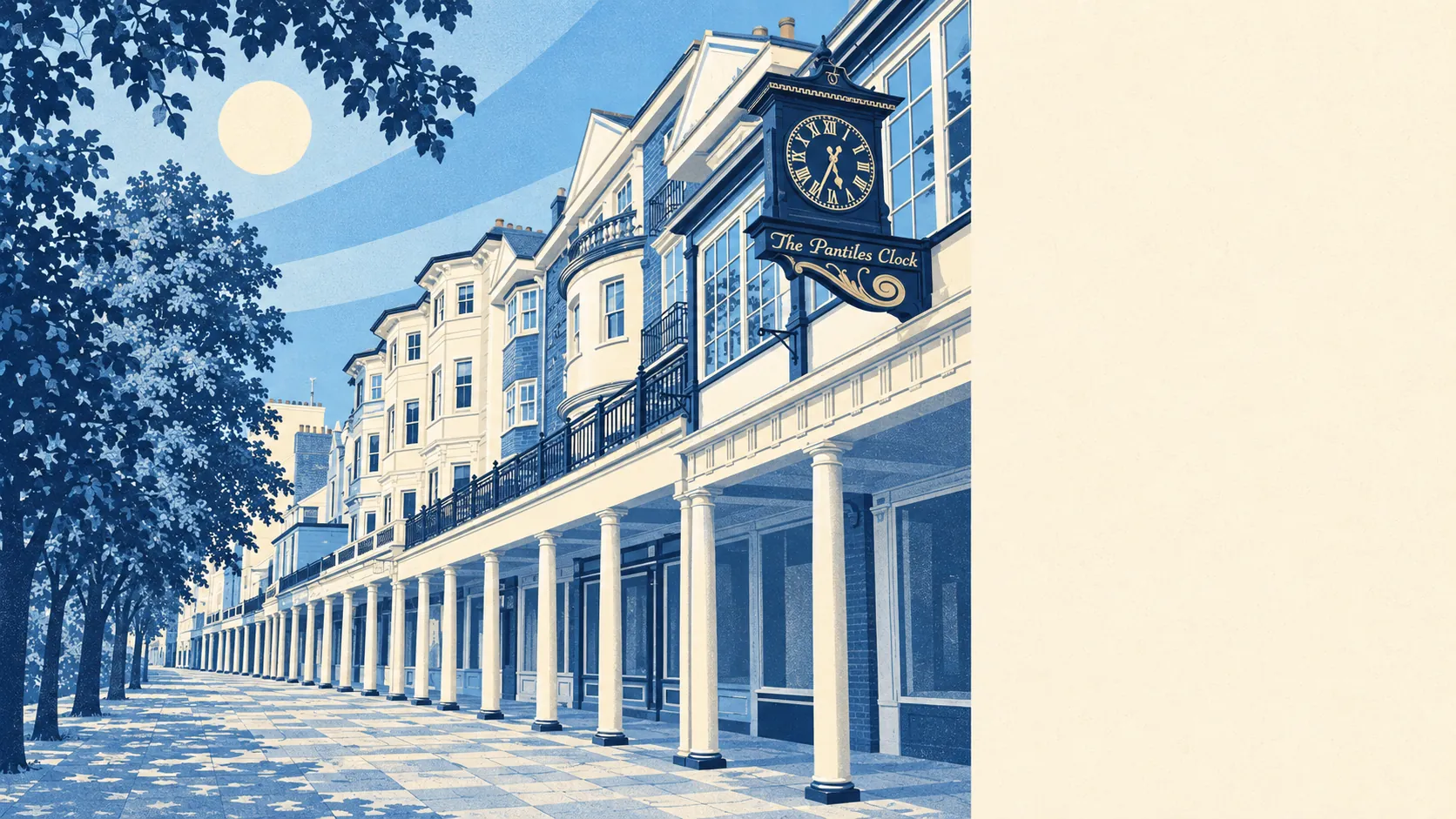
Yes, and it's a commuter town where half the commuters stopped commuting. Six in ten own their homes. More than four in ten work from home. There's a patch of green round most corners. It's a commuter-belt price tag on a town that mostly stays in.
The housing stock splits into two towns sharing a postcode. On the council-tax valuation list, about 38% of dwellings are flats, 24% semi-detached, 20% terraced, 15% detached and 3% bungalows, and 43% were built before 1930. The Calverley Park villas and the Pantiles fronts get the photographs, while a lot of people live in a converted upper floor with a view of a chimney stack. Energy certificates reflect that age. About 52% of certificated homes sit in bands A to C, 36% in band D and 13% in E or worse. Three quarters of homes are on mains gas, and about 13% are heated by electricity alone. If that 13% includes the Victorian conversion you're viewing, ask for the bills before you admire the cornicing.
The Land Registry recorded 648 sales in the year to late May 2026, with a median of about £415,000. Flats went for around £255,000, terraces for about £400,000, semis for roughly £520,000 and detached houses for about £911,000. That last figure is where the town's reputation sits. The house price index shows prices flat over the twelve months to May 2026, with flats down about 3%, so the market has stopped rewarding people for simply owning something here. Band C is the most common council-tax band, and only about 21% of homes are in bands A or B. Band D costs about £2,450 a year. Cheap is not a setting the town has.
Renting runs at about £1,510 a month, which is the typical private rent across the Tunbridge Wells area as a whole rather than the town on its own, as of April 2026, and up about 5% on a year earlier. By bedroom count that's roughly £1,040 for a one-bed and £1,380 for a two-bed. The landlords know exactly who's coming down the A26 with a London salary.
Crime is the bit that doesn't fit the brochure. Police figures for June 2025 to May 2026 put the town at about 78 recorded crimes per 1,000 people, roughly 12% above the Tunbridge Wells borough average. The mix explains it. Anti-social behaviour makes up about 20% of recorded crime against 16% nationally, and shoplifting about 12% against 8%. That's the signature of a busy shopping centre, which is what the town is: Royal Victoria Place and the high street pull in the whole district, and so do the people who help themselves. Kent Police charges about 16% of cases, against about 12% nationally, which puts it sixth of 42 forces. The residential streets and the shopping streets are different conversations.
Schools are where the town earns its money back. Across the 16 primary schools in the local postcode districts, the average end-of-primary maths score is about 106, and the six secondaries average an Attainment 8 score of about 56. Kent still runs the eleven plus, so Tunbridge Wells Girls' Grammar School, Tunbridge Wells Grammar School for Boys and The Skinners' School sit alongside Bennett Memorial Diocesan School, St Gregory's Catholic School and Skinners' Kent Academy. Across Kent as a whole, Ofsted has graded 221 of 245 settings good or outstanding. The selective system rewards the parents who read the admissions rules in Year 4, and quietly surprises the ones who read them in Year 6.
Getting about works for the people who still leave. Tunbridge Wells and High Brooms stations sit on the Hastings Line, though only about 4% of workers took the train at the last census and 34% drove, against 44% working from home. There are 278 bus stops, averaging 39 weekday departures each and about two an hour at peak, with weekend service at about 80% of them. Gigabit broadband reaches about 80% of premises and superfast about 98%, and all four mobile operators cover about 98% of the area. The broadband is the real commuter line now.
Flood risk is the weak point, and it's the kind people don't expect on a sandstone ridge. About 16% of postcodes are flagged high on at least one flood indicator, surface water included, 14% medium and 31% low. The Environment Agency's river-and-sea flood zones barely touch the town: about 1% of postcodes sit in zone 2 and fewer than one in a hundred in zone 3, and its property count lists 16 homes and businesses at high risk from rivers and the sea. So the flag comes from water running downhill, not from a river. Check the specific street, not the town. Green space is the opposite story. The nearest park is on average about 140 metres away, with about 24 green spaces within a kilometre, from Dunorlan Park and Calverley Grounds to Wellington Rocks and the High Weald Area of Outstanding Natural Beauty on the town's edge.
Heritage comes with paperwork. There are 327 listed buildings, one at Grade I, 36 at Grade II* and 290 at Grade II, from the Church of King Charles the Martyr to the terraces of Calverley Park Crescent. The mapping used here records no conservation areas inside the town's own boundary, but that isn't licence: if the house is listed, new windows become a planning application, and the planning officer has seen every trick.
The people are settled rather than young. About 60% own their homes, the typical resident is 40, and modelled household income averaged about £67,000 before tax in the financial year to March 2023. Nearly half of adults hold a degree. Frant, just over the county line in East Sussex, is covered here too and plays the village to the town's high street.
It suits a family working from home who want grammar schools, parks at the end of the road and a train to London they'll use twice a week. It suits downsizers who want a proper town centre within walking distance, and don't mind that everybody else in it had the same idea.
It doesn't suit a first-time buyer hoping the town will be cheap somewhere, because it isn't. It doesn't suit anyone who wants a quiet flat above the shops, because the shops are where the trouble is.
Royal Tunbridge Wells is a good place to live if you can pay to join. Its real strength is the green space: parks, rocks and open Weald at the end of the street. The weak spot is flood risk from surface water, and it catches the buyer who assumed a hilltop town must be dry. Check the street's drainage before you check the grammar school's league position.