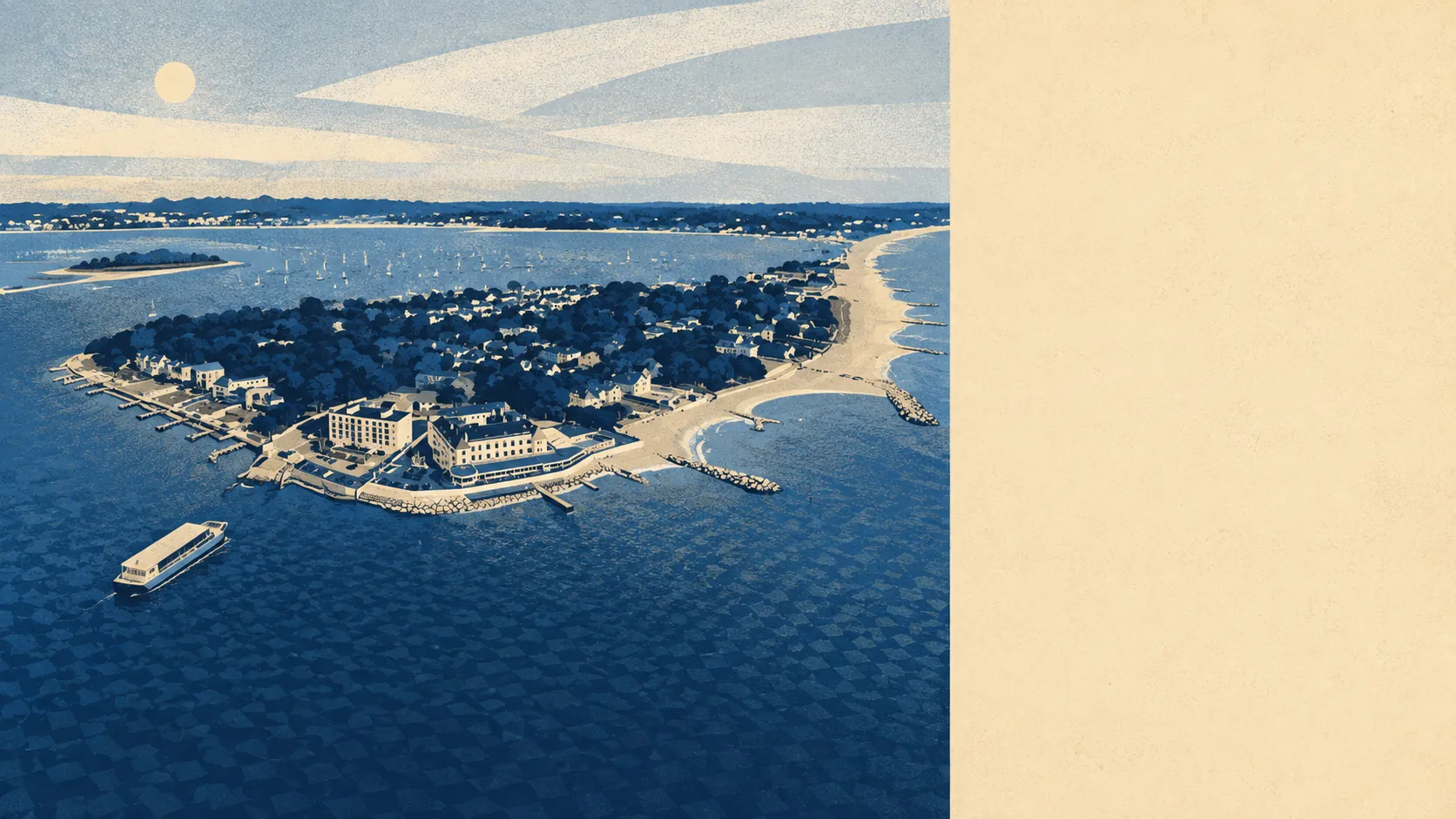
Yes, if you can live with a town that cannot decide whether it is a port or a postcode. Most homes here are owned outright by the people in them. The typical resident is comfortably into middle age. Crime sits below what the wider council area records. Green space is nearly always at the end of the road, and the water is rarely much further. Poole works well for people who want the coast without the performance, and less well for anyone who arrives expecting to reshape the house they just bought.
The housing stock is the first thing to understand, because it explains most of what follows. On the council tax valuation list, which covers every dwelling rather than only those with a recent energy certificate, flats make up about 31% of homes, detached houses about 22%, semis about 17%, bungalows about 16% and terraces about 13%. That bungalow share is not an accident of the spreadsheet: this is a town that has been receiving retirees for decades and built accordingly. Only about 17% of dwellings predate 1930, so the Georgian merchant houses of the Old Town are the exception rather than the texture. The bulk went up after the war. On energy performance, roughly 55% of certificated stock sits in bands A to C, about 35% is band D, and around 10% is band E or worse. Heating is mains gas in about 80% of households, with about 9% on electricity alone. That last figure is the one to check before you fall in love with a flat conversion, because electric-only heating in a poorly insulated older building is a running cost you inherit on completion day.
On price, the Land Registry's last twelve months of sales put the typical Poole home at around £340,000, across roughly 1,580 transactions. The spread by type is wide enough to matter. Detached houses came in at a median around £450,000, semis around £330,000, terraces around £290,000 and flats around £232,000. Council tax is a further clue to the shape of the place: band C is the most common band, and about 26% of dwellings sit in bands A or B, which tells you that for all the yacht photography, a quarter of the town is in the cheapest two bands.
Renting is a different arithmetic. Across the Bournemouth, Christchurch and Poole area, typical private rent is about £1,400 a month as of April 2026. That is an area figure rather than a Poole-specific one, and the local authority it covers includes Bournemouth and Christchurch, so treat it as the register you are entering rather than a quote for a specific street.
Safety reads better than the town's reputation for a busy quayside might suggest. The published crime rate for Poole is about 73 offences per thousand residents over the twelve months to May 2026, and that sits roughly 16% below the average for the wider Bournemouth, Christchurch and Poole authority. It is a genuinely reassuring number for a place with a working port, a nightlife strip and a summer visitor surge attached to it.
Connectivity is the quiet strength. Poole, Parkstone, Branksome and Hamworthy stations all sit on the main line, though only about 1% of residents commute by train and around half drive to work. Another 29% work from home, which for a coastal town is a substantial slice of the working week never leaving the postcode. Buses are dense rather than glamorous: roughly 1,110 stops in the area, an average of about 52 scheduled weekday services per stop, and about 93% of stops carrying a weekend service. Broadband is the standout. Gigabit-capable service reaches about 87% of premises, superfast reaches about 99%, and no premises fall below the universal service obligation. Every premises has coverage from at least one mobile operator on fourth or fifth generation networks.
The environment is where Poole genuinely earns its keep. Green space averages about 190 metres from a Poole postcode, with roughly 14 green spaces within a kilometre, and water averages about 510 metres away with over 20 blue spaces within the same radius. That is not a marketing line, that is a town built around a harbour and a heath. Flood risk needs stating carefully, because two different measures circulate. On the postcode indicators, which include surface water, about 11% of postcodes carry a high rating on at least one measure and about 13% a medium one. On the Environment Agency's river-and-sea flood zones, the picture is much narrower: about 2% of the area sits in flood zone three and under 1% in zone two. Four flood events are on the recorded register, the most recent in December 1989, caused by overtopping of sea defences.
Heritage is where the town gets restrictive. There are 270 listed buildings in Poole, three of them Grade One and 21 Grade Two star, and 16 conservation areas including Poole Park, Sandbanks, Canford Cliffs Village, Ashley Cross, The Avenue, Brunstead Road, Westbourne and the Town Centre Heritage area. If your house sits inside one of those boundaries, the window you want to replace, the render you want to remove and the extension you sketched on the back of the viewing brochure all become conversations with the planning department rather than decisions. This is the single biggest constraint on living here, and it is the one buyers consistently discover late.
The character of the place follows from all of it. About 68% of homes are owner-occupied, the median age is around 45, and median household income across the area runs to roughly £53,700 before tax. That is a settled town rather than a churning one. The page covers the full spread of neighbourhoods, and they are not remotely alike: Sandbanks, Canford Cliffs and Lilliput on the water, Broadstone and Canford Heath inland and suburban, Parkstone and Longfleet doing the ordinary daily work of the town, Hamworthy carrying the port, and Alderney, Branksome and Lytchett Minster filling in the rest.
Poole suits people who want coast and harbour without needing to be seen having them, who value a fifteen-minute walk to green space over a fifteen-minute walk to a nightclub, and who are content buying a post-war house rather than reinventing a Georgian one. It suits remote workers particularly well, given the broadband.
It suits you less if your plan involves knocking things about. Buy inside a conservation area with a loft conversion in mind and you will spend the first year meeting people whose job is to say no. It also suits you less if you need the train, because the line is there but almost nobody uses it, which tells you something about where the jobs actually are.
The town has form for attracting people who wanted somewhere to sit still. Tony Blackburn, the painter Augustus John, and Mimi Smith, the aunt who raised John Lennon, all lived here. So did Alfred Russel Wallace, who worked out natural selection independently of Darwin and then retired to the south coast, which is either the greatest anticlimax in British science or exactly the right instinct. Freddie Mills, the world light-heavyweight boxing champion, came from here too. It is a decent roll call for a town that never bothered turning itself into a resort while Bournemouth did exactly that next door.
The verdict is above average, and the shape of it is clear. The real strength is the surroundings: green space and water are closer here than in most of the country, and the harbour is a genuine amenity rather than a view. The weak spot is the freedom to alter your own home, because between 270 listed buildings and 16 conservation areas, a large slice of the most desirable streets come with a planning officer attached. Buy the house you want rather than the house you intend to change, and Poole will do very nicely.