Moreton-in-Marsh gets most things right, and its name was upfront about the one thing it gets wrong. Daily life runs along a medieval High Street built wide enough for a wool market, with the Fosse Way rumbling down the middle and a station at the end that still goes to London. It is a working town in Cotswold stone, with a GP, a supermarket and a train, and that combination is rarer round here than the postcards let on.
The people who do best here want the Cotswolds as somewhere to live and run errands, with a postcard view as a bonus. Safety won't put them off. Gloucestershire Constabulary's figures on police.uk put recorded crime at about 40 per 1,000 residents in the year to May 2026. That is level with the Cotswold district as a whole, give or take a rounding error. A market town where two main roads cross gets about the crime you would expect, and the figures give nobody a reason to panic or to boast.
About 62% of households own their home and the median resident is 46. The Office for National Statistics models average gross household income at about £52,000 for the financial year to March 2023. That describes people in the middle of their careers, not the retirement colony the honey-coloured stone might suggest. Until the Second World War the Lord of the Manor at Batsford charged a fee for every shop window facing the High Street. The council collects these days, and the shopkeepers have noticed very little difference.
Flood risk is the weak spot, and the Environment Agency measures it two ways. On its river-and-sea flood zones, about 14% of the area is in zone 2 and about 2% in zone 3. On postcode indicators that include surface water, about 20% of postcodes carry a high rating on at least one measure. There are 27 recorded flood events, the most recent in 2007, put down to local drainage and surface water. The High Street flooded fairly often from the 1940s to the 1960s, until the ditches and the camber on the A44 were reworked. The town settled on "in-Marsh" as its official name before 1930, and the drains have argued with that decision ever since.
Moreton-in-Marsh Rail Station is on the Cotswold Line, with Great Western Railway trains to London Paddington, Worcester and Hereford. In the 2021 Census about 1% of working residents commuted by train, about 51% drove and about 32% worked from home. The London train is the town's best advertisement and one of its least used amenities. There are 33 bus stops, and gigabit broadband reaches about 94% of premises. The Department for Transport's 2019 modelling puts the nearest hospital 36 minutes away by car, and that drive is worth knowing about if it might matter to you.
The Land Registry recorded 83 sales in the year to late May 2026, with a median of £375,000. Type moves the number a long way. Detached houses went for about £570,000, semis for £370,000, terraces for about £320,000 and flats for £195,000. Band C is the most common council tax band, and only about 13% of homes are in band A or B. If you are renting, the Office for National Statistics puts typical private rent across the Cotswold area at about £1,260 a month as of April 2026. That figure covers the whole district, including villages where the rent is mostly paid for the view.
The housing is more ordinary than the High Street frontage suggests. On the council tax list, semis make up 28%, terraces 27%, detached houses 22%, flats about 17% and bungalows 6%. Only about 10% of homes were built before 1930. That younger stock shows up on the energy certificates, where about 71% of certificated homes are rated A to C. About 76% of homes are on mains gas and about 9% heat with electricity alone. The stone is mostly on the shops, and the warmer homes are behind them.
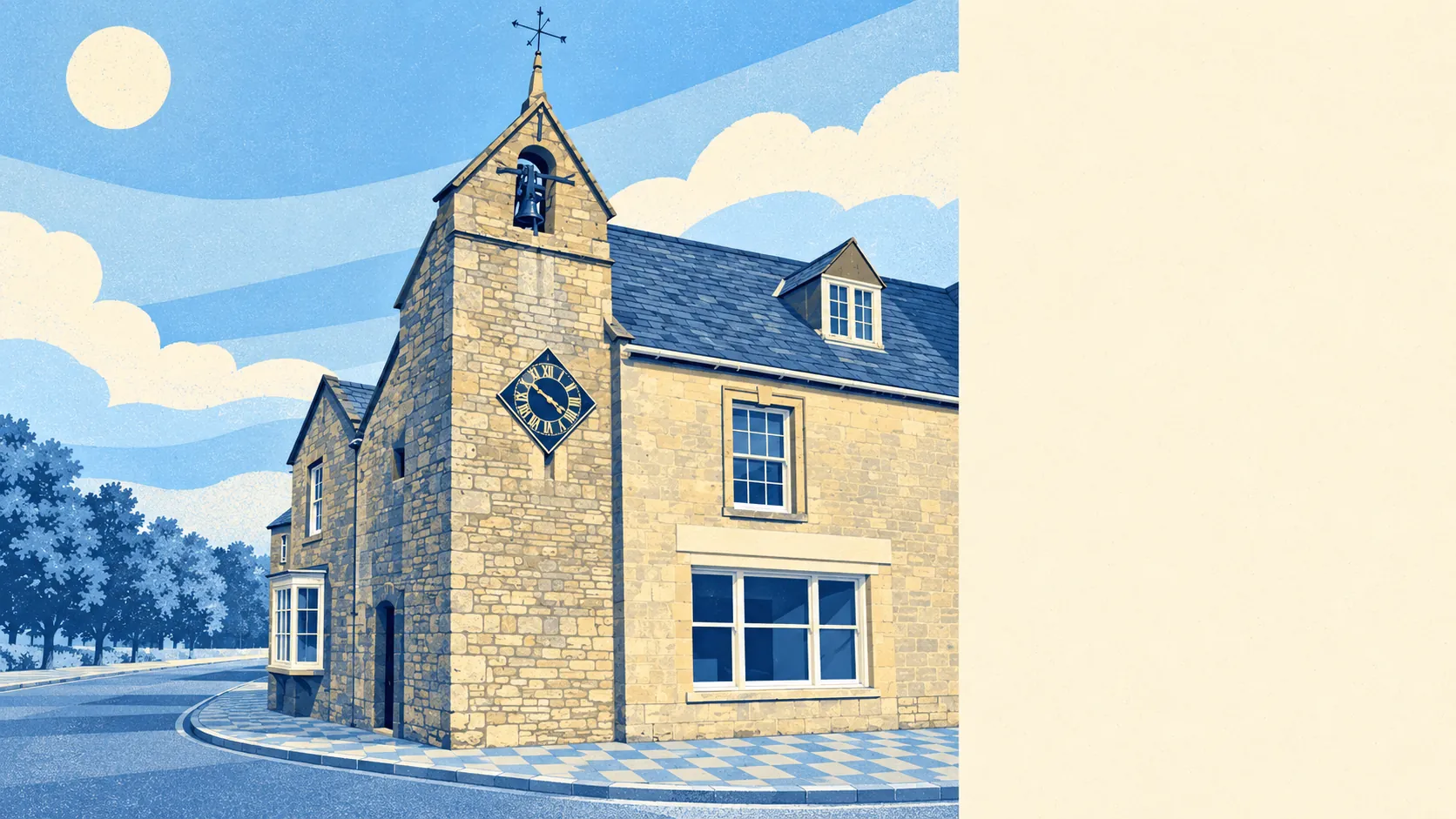
The old core is protected all the same. Ninety-six buildings are listed, two of them Grade II* and the rest Grade II, and the town centre is the Moreton-in-Marsh conservation area. Owning one of those buildings means getting consent for windows, doors and extensions, and planning officers in a Cotswold conservation area tend to say no to those. The Curfew Tower on the corner of Oxford Street has had a clock since 1648, and listed-building consent moves at about the speed it was built for.
The surroundings are the real case for living here. The nearest green space is about 90 metres from the average front door, water is about 190 metres away, and nearly half the area is inside the Cotswolds Area of Outstanding Natural Beauty. This page also covers the villages around the town, among them Batsford with its arboretum, Bourton-on-the-Hill, Blockley, Draycott, Longborough, Donnington, Broadwell, Evenlode, Adlestrop, Daylesford, Chastleton, Todenham, Lower Lemington and Stretton-on-Fosse. Sir Charles Cockerell of Sezincote House, the Lord Chancellor Viscount Sankey, the novelist Penelope Mortimer, Lord Mayor of London Nicholas Anstee and Dame Prue Leith are all on the town's roll of notable names. Between them they cover law, money, letters and lunch.
Moreton-in-Marsh is better than average, because it is a real town inside protected countryside, with green space a short walk from nearly every front door. Buyers who want the Area of Outstanding Natural Beauty on the doorstep and a station they might use one day will do well here. Anyone house-hunting near the low ground or the ditches should remember the name was given for a reason. People who need a hospital close by should look somewhere bigger.