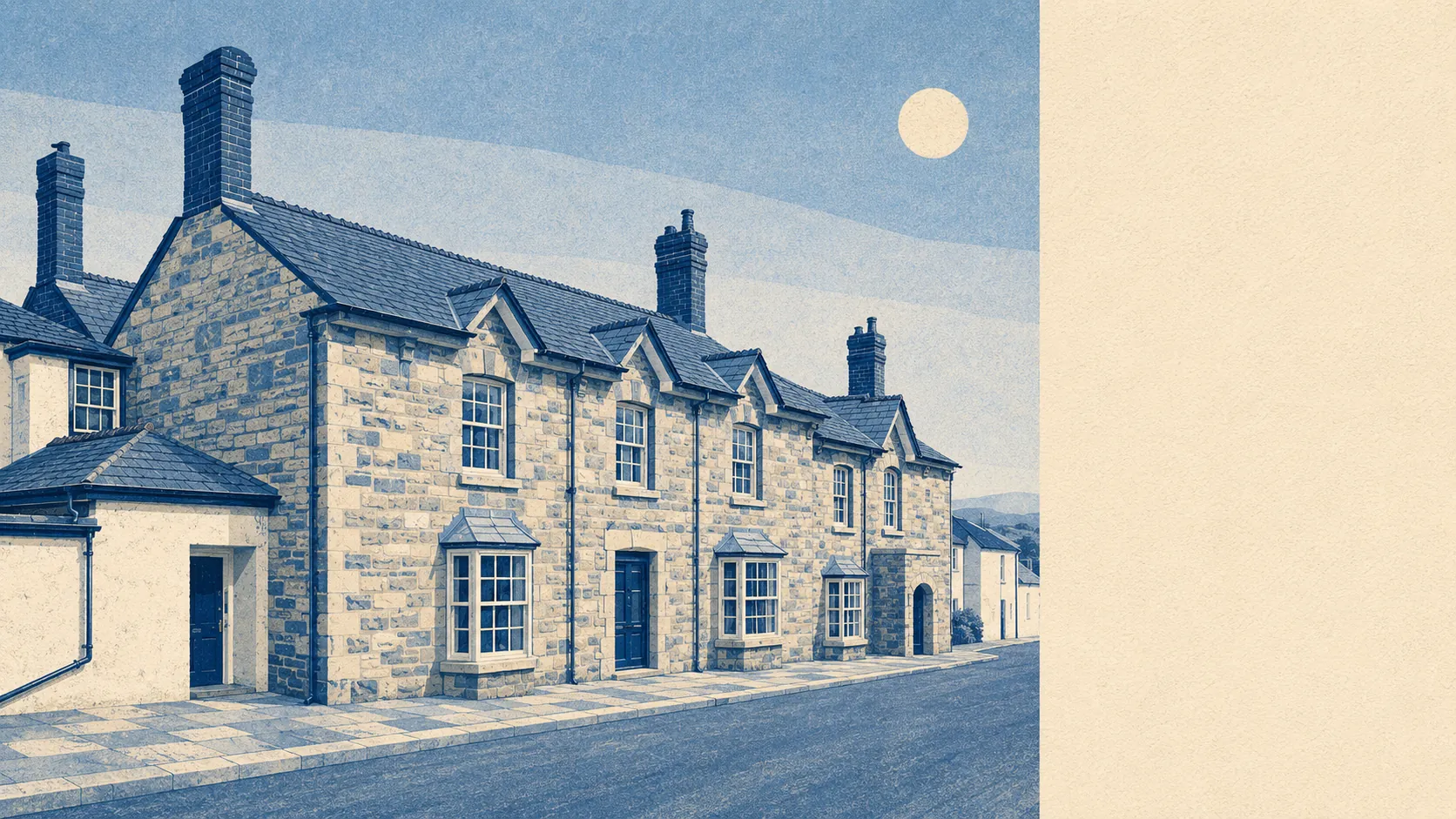
Lifton is the sound of a village that stopped auditioning. Seven in ten own their homes. The median resident is fifty. Nearly a third work from home, because the alternative is a car and a hedge-lined lane. It is a good place to live if you want the countryside to be the point rather than the backdrop, and a bad one if you need somewhere to be open after six.
The housing stock is the first thing to understand, because it settles most of the rest. Detached houses run the show at 39% of the dwellings on the council-tax valuation list, with semis at 24%, bungalows at 19% and terraces at 13%. Flats barely register at 4%, which means the studio-and-one-bed market other places rely on essentially does not exist here. Almost half the stock, 46%, was built before 1930, so what you are viewing is largely stone, cob, brick and Victorian proportions rather than anything with a modern airtightness figure. The energy certificates back that up: 24% sit at band D and 44% sit at band E or worse, against 32% managing band C or better. Mains gas reaches under 5% of households, and 15% run on electricity alone for heating. An older detached house heated entirely by electricity is a running-cost conversation you want before the viewing, not after the first winter bill.
On price, the Land Registry's last twelve months put the typical Lifton sale at £305,000 across 11 transactions, which is a thin market by any standard and worth remembering when someone tells you what the village is "worth". The type split within that is instructive: semi-detached homes came in around £361,000 and detached around £412,500. Council tax lands modestly, with band C the most common and 36% of dwellings in bands A or B, so the annual bill is unlikely to be the thing that catches you out. The heating might be.
Renting is a different story, mostly because there is not much of one to tell. The typical private rent across the West Devon area is about £840 a month. That is a district-wide figure covering everything from Tavistock flats to farmhouses, not a Lifton number, and in a village where flats are 4% of the stock you should read it as a regional yardstick rather than a menu.
On safety, the published rate for the area is around 46 crimes per thousand people over the twelve months to May 2026, which sits within a couple of percent of the West Devon average. Rural West Devon is not a place where crime figures do dramatic things, and Lifton is not the exception in either direction. Worth knowing separately: Devon and Cornwall Police charge in 8% of cases against 12% nationally, and record no suspect identified in 26%. That is a force statistic rather than a Lifton one, but it is the force you would be ringing.
Connectivity is where the village asks something of you. Nobody commutes by train, because there is no station to commute from, and the line that once ran through here closed to passengers in 1962. Half of working residents drive, 29% work from home, and the bus network amounts to six stops, four of which carry service data showing around ten weekday departures each and roughly one bus in the peak hour. All four run at weekends, which is more than a lot of Devon villages manage. By car, the nearest town centre is fifteen minutes, a general practice surgery fourteen, food shopping thirteen, and a hospital fifty-three. By public transport, those same journeys stretch to twenty-seven minutes, thirty-six, thirteen and two hours, and those modelled times date from 2019, so treat them as generous. Broadband is the quiet triumph: superfast reaches every premises, gigabit reaches 70%, and no premises falls below the universal service obligation. At least one mobile operator covers all but a sliver of the area, and all of them together cover 91%.
Water is the thing to take seriously. Of Lifton's postcodes, 17% carry a high rating on at least one flood indicator including surface water, 15% carry medium and 42% carry low. On the narrower river-and-sea measure, the Environment Agency puts 2% of postcodes in flood zone 3 and 4% in zone 2, rising to 14% under the climate-change allowance. The village sits near the confluence of the Wolf and the Lyd, and rivers are not sentimental about which cottage has been there since the seventeenth century. Get the exact address checked rather than the village. What the setting gives back is space: green space averages 126 metres from the front door with nearly six sites within a kilometre, water is 346 metres away with fourteen sites within a kilometre, and the National Cycle Network runs within 183 metres of 92% of postcodes. Radon sits in the highest band across every postcode here, which means testing is a normal part of buying in this part of Devon rather than a red flag. Ground conditions are otherwise unremarkable, with shrink-swell and the rest sitting in the lowest hazard classes.
Heritage is present without being oppressive. Twenty-two listed buildings, one of them grade one, and a single conservation area covering the village core. If you buy inside it, or buy one of the listed properties, window replacements, solar panels and anything visible from the street become a conversation with West Devon rather than a weekend project. Given how much of the stock predates 1930, the odds of that applying to you are not trivial.
The character of the place follows from the numbers rather than fighting them. Home ownership runs at 71%, the median age is fifty, and the typical household income across the area was around £51,400 gross in the financial year to March 2023. That is a settled, mostly middle-aged, mostly owner-occupied village where a third of households have three bedrooms and 28% have four or more. People are not moving through. They are staying.
It suits anyone who works from home, wants land or a garden, drives without resenting it, and treats a fifteen-minute run to the shops as normal rather than an ordeal. Families are decently served: Devon has 138 of 172 graded settings at good or better, three of them outstanding, and Lifton Community Academy is on the doorstep with a primary school seven minutes away by car.
It does not suit anyone who needs a station, anyone whose budget assumes a flat exists to buy, or anyone who wants to walk to a hospital appointment. If you need something open late, the nearest version of that life is a different postcode entirely.
The verdict is a genuine middling one, and the parts pull in opposite directions. Its real strength is the setting: green space and water on the doorstep, cycle routes through it, air quality that never comes up in conversation because there is nothing to say about it. The weak spot is flooding, and it is not a technicality in a village built where two rivers meet. Buy the right address here and you get a version of Devon most people are still saving for. Buy the wrong one and you will spend every November refreshing a river-level page.