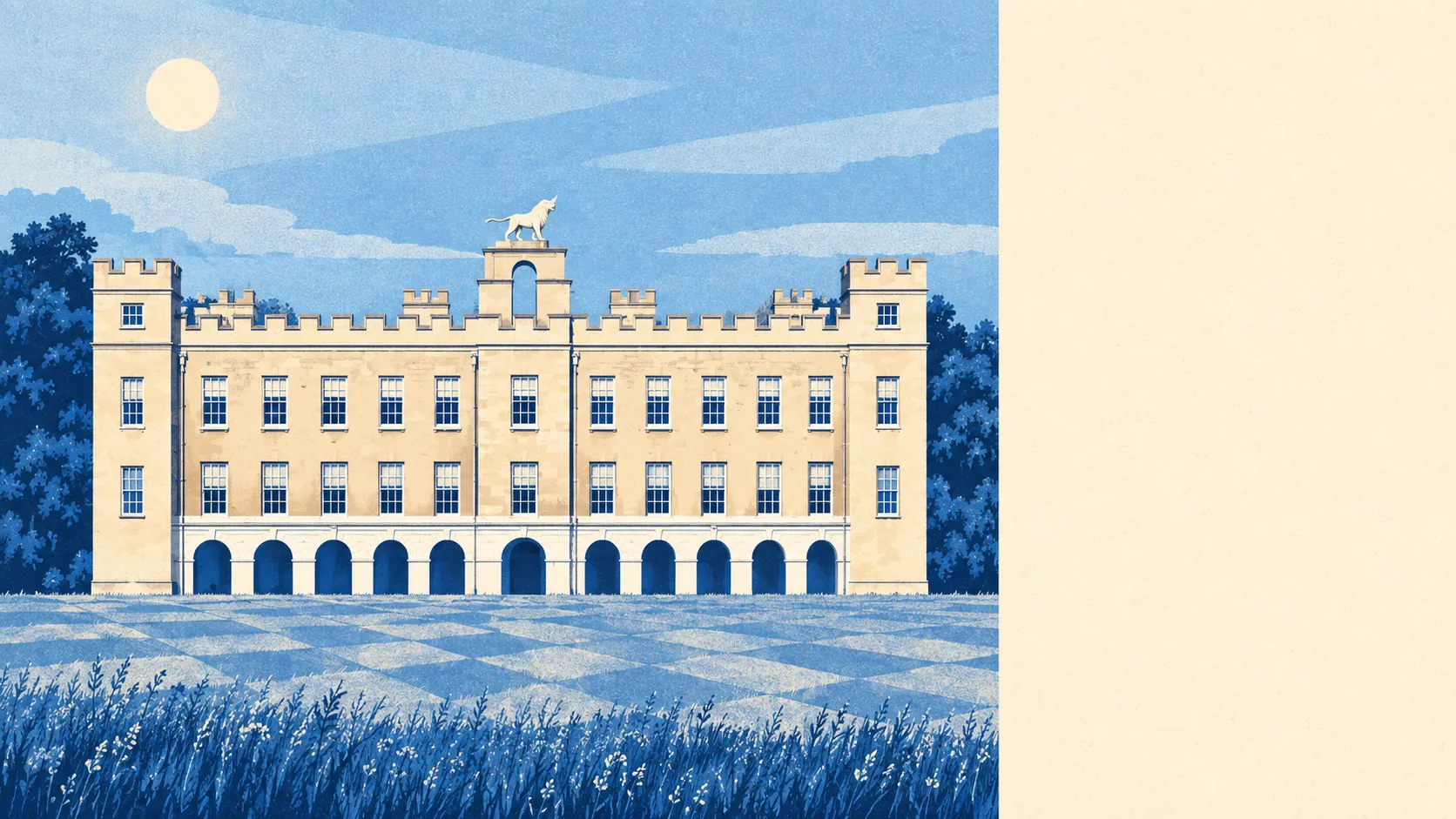
Very green for somewhere this far into London. Most homes are a short stroll from a park. The river is a few minutes further. Two of the largest landscaped estates in west London border the town. The countryside around Isleworth was designed by somebody, mostly for a duke.
On average, an Isleworth postcode is about 120 metres from the nearest public green space, with 28 green spaces within a kilometre. That's dense coverage for a suburb with a London-sized population. Capability Brown and the Adam brothers landscaped Syon Park between 1766 and 1773 for the Dukes of Northumberland. More than two centuries later, the town is still enjoying the result.
Water is close too. The nearest river, stream or lake is about 440 metres from the average postcode, and there are 46 bodies of water within a kilometre. The Thames runs along the eastern edge, the River Crane meets it here, the Duke of Northumberland's River splits off towards Isleworth Ait, and the Grand Union Canal passes to the north. Isleworth got the river frontage and the Crane's mouth on the same short stretch, with a canal thrown in.
The National Cycle Network is about 4.5 kilometres away on average, and no postcodes are close to it. There is no ancient woodland in the area. Most cycling here is a ride around the parks or along the towpath, and it doesn't plug into a long-distance route on the doorstep.
The ratings list counts 160 shops, 15 pubs and five restaurants around Isleworth. With fifteen pubs and five restaurants, the evening plan in Isleworth tends to be decided before anyone opens a menu.
Hounslow's council area recorded fine-particle pollution of about 8.6 micrograms per cubic metre in 2024. That's a borough-wide figure that includes the town centre and the main roads alike.
The character comes from the old estates and the river. Osterley Park, with Osterley House, is at the northern end, and Syon Park and Syon House border the town on the east. Lower Square and Church Street keep buildings from the 18th and early 19th centuries. Across the water are Kew, Richmond and the Old Deer Park. Isleworth has been a place where aristocrats built large houses since the 18th century. They brought the parks with them, and the town has kept the parks long after most of the aristocrats left.
Private gardens are generous too. Across Isleworth there are about 45,000 square metres of garden per 1,000 residents. Many homes have their own outdoor space as well as the parks. That's typical of interwar suburbs, where the houses came with gardens.
The council-tax valuation list for business premises counts 566 rateable premises in the area. Of those, 154 are classed as shops and 54 as offices. A premises on the list isn't necessarily trading today, but the mix shows a working suburb with a high street. Check the parades nearest the house you're considering to see what's actually trading on them.
Of the 175 food businesses rated for hygiene, about 82% have the top score of five, and only about 2% are rated low. Eating out here is generally safe, even if the choice leans heavily towards pubs.
None of the area is covered by an area of outstanding natural beauty, a site of special scientific interest or ancient woodland. Isleworth's green spaces are parkland, gardens and riverbank, laid out by people over centuries. They aren't wild countryside, and they don't need to be.
The surroundings are one of Isleworth's real strengths. Parks, river and gardens are within a short walk of almost every home.