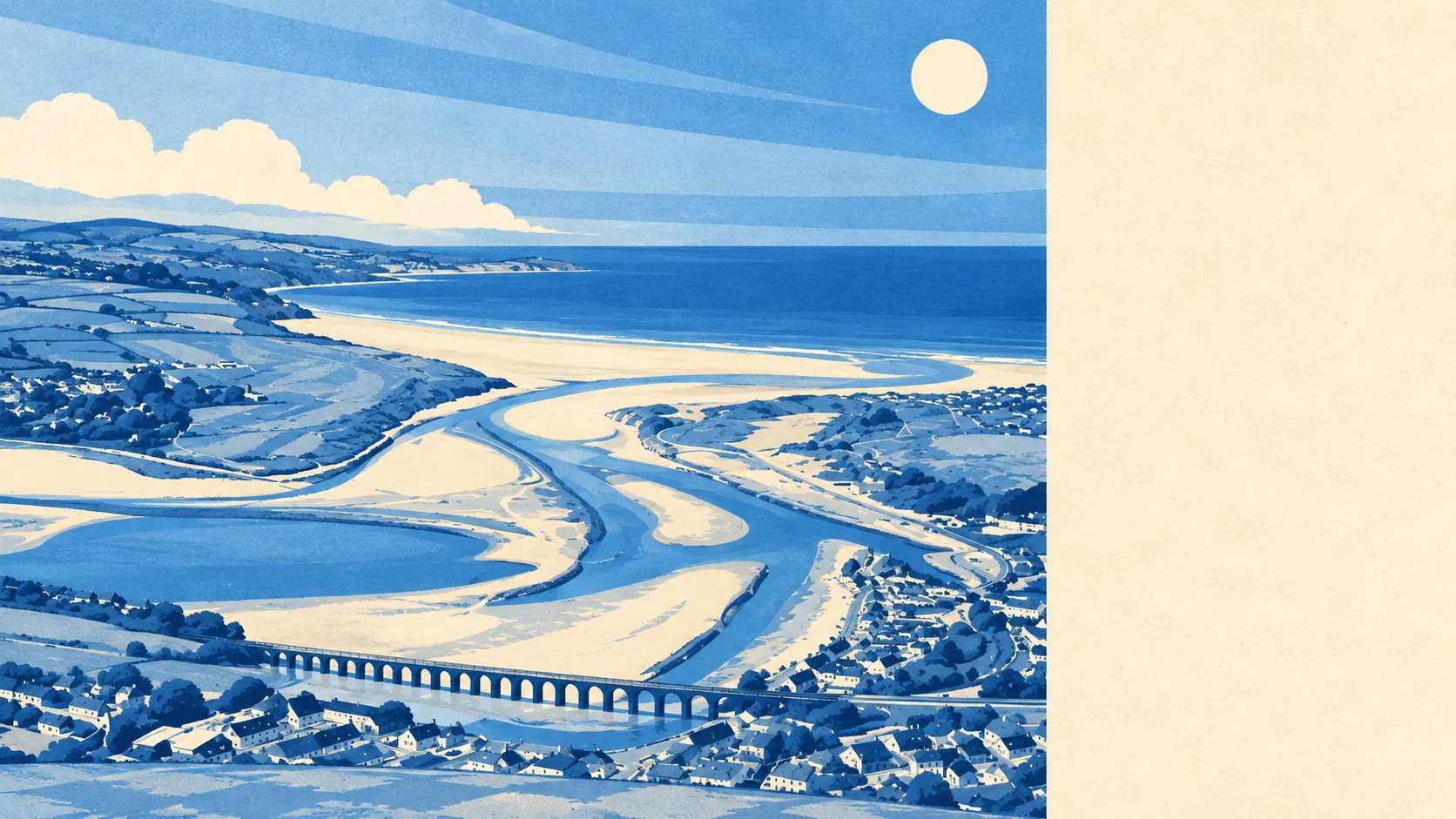
Hayle sits inside its landscape rather than next to it. Green space starts about 170 metres from the average front door. Water is barely further. Three miles of dunes run along the bay and an estuary wraps round the other side. For a town built on copper smelting and foundry work, the surroundings are absurdly good, and that is the single strongest thing this place has.
Green space is genuinely close here. The average postcode has around 14 green spaces within a kilometre, at an average distance of roughly 170 metres. That is not a park at the edge of town reachable by car, it is the sort of access where walking the dog is a decision made at the door rather than in the driveway.
Water is closer still. Blue space sits about 240 metres from the average postcode, with roughly 83 separate stretches of water within a kilometre. That number sounds implausible until you remember what the town is built around: the Hayle estuary, Copperhouse Pool, Carnsew Pool and the channels between them, all of which were engineered for sluicing ships in and out and now function as the reason people move here.
Getting further out is easy too. The National Cycle Network runs about 300 metres from the average postcode, with roughly 78% of postcodes classed as close to it. Ancient woodland does not feature at all in the area, which is unsurprising on this coast: the landscape here is dune, estuary and open ground rather than forest.
On the valuation list, the area carries 423 rateable premises, including 117 classed as shops, 92 as offices, 18 as pubs and 12 as restaurants. Those are premises on the list rather than businesses currently trading, so treat them as the shape of the place rather than a directory. The other number worth knowing is 501 holiday lets, which tells you exactly what sort of coastal economy sits alongside the everyday one.
Air quality is measured at council level rather than town level, and fine particle concentrations across Cornwall averaged about 5.1 micrograms per cubic metre in 2024. That is a county figure and it comes with no health claim attached, but it is the context for anywhere in the area.
The texture of the place comes from its industrial bones. Foundry and Copperhouse still name the two ends of the town, The Plantation sits above Carnsew Pool on the site of an Iron Age fort, and Phillack keeps its church on the estuary edge. Out from the centre you get Angarrack and Connor Downs inland, the towans running north along the bay, and Lelant and St Erth across the water towards Carbis Bay. It is a landscape that has been worked hard and still looks like it.
Private outdoor space is a real strength and rarely mentioned. Gardens amount to roughly 137,000 square metres per thousand residents across the area. In practice that means houses here come with their own ground rather than a shared courtyard and a view of someone else's bins.
Eating out is a good-news story. Of the 79 premises with a food hygiene rating, about 95% hold the top score and only around 1% sit at the bottom of the scale. That is a strong showing for a town of this size and it means the odds are heavily in your favour wherever you end up.
One honest absence: no area of outstanding natural beauty, no site of special scientific interest and no ancient woodland overlaps the area. The landscape here is not protected by designation, it is simply there, which means fewer constraints on what happens around you and fewer guarantees about it.
The surroundings are the best argument for living in Hayle, and it is not close. Water on two sides, green space at the end of the street, dunes along the bay, and gardens big enough to matter. Everything else about this town is a negotiation. This part is not.