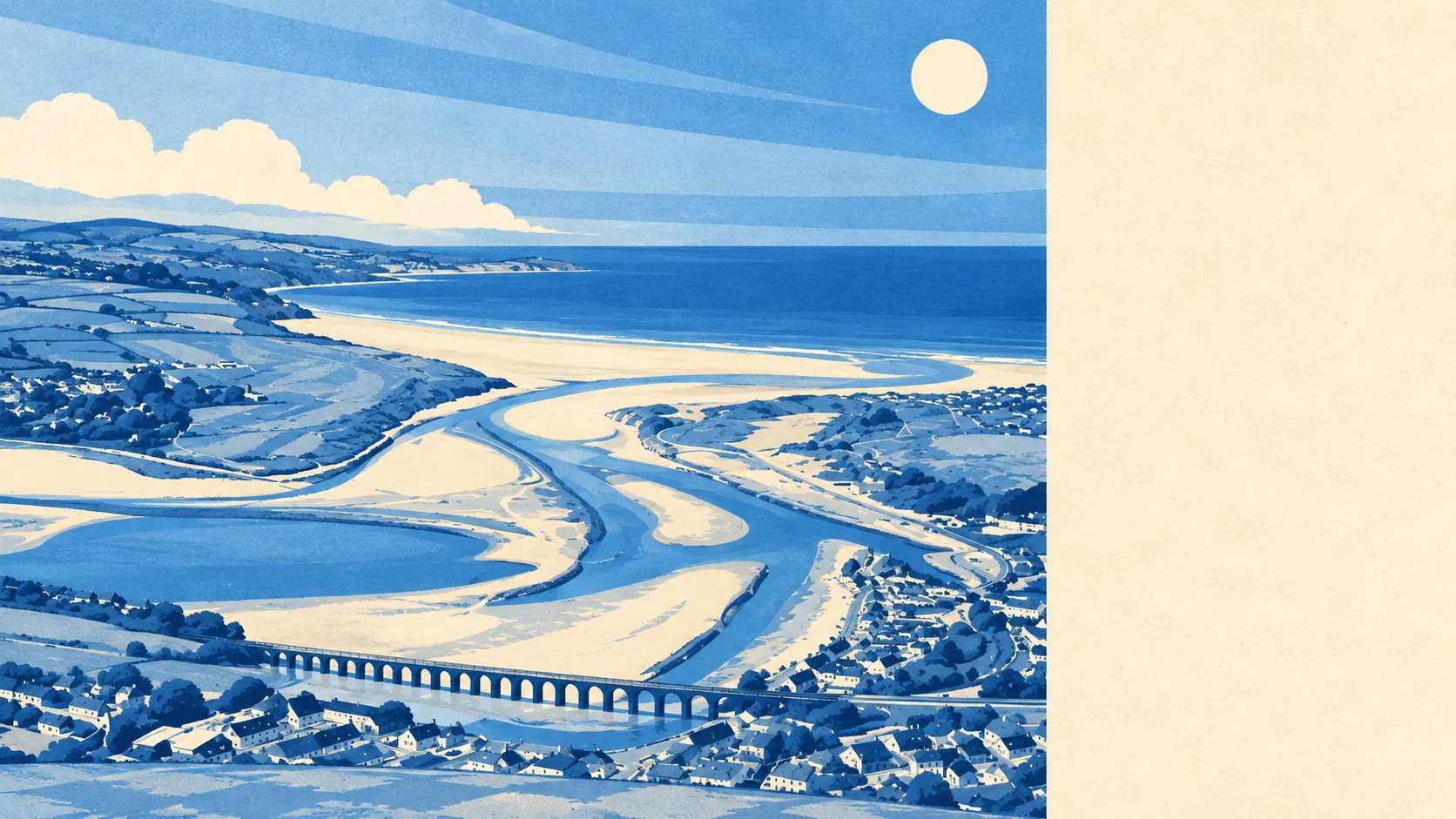
Hayle is the town people drive through to get somewhere prettier, and it has quietly been the better buy the whole time. Three miles of dunes on its doorstep. A station on the main line. Prices that St Ives stopped doing a long time ago. It is not a postcard, and that is exactly the point.
The housing stock is straightforwardly domestic. On the council tax valuation list, which covers every dwelling in the area rather than just the ones sold recently, about 33% of homes are terraced and a further 24% are bungalows, with detached and semi-detached sitting at roughly 15% and 16% respectively. Flats make up about 11%, which is low for anywhere within walking distance of a beach and tells you this was built as a place to live rather than a place to visit. Around 27% of the stock predates 1930, so the Victorian and Edwardian terraces are a real presence without dominating. Energy performance follows the pattern: roughly 60% of certificated properties sit in bands A to C, about 27% in band D, and around 13% in band E or worse, which is where the older granite and the solid walls show up on the bill. About 67% of homes run on mains gas and roughly 10% are heated by electricity alone. That last figure is worth checking before a viewing rather than after, because electric-only heating in a pre-war Cornish property is the sort of thing that turns a bargain into a standing order.
On price, the Land Registry's last twelve months put the typical sale at around £284,000 across 92 transactions, running to May 2026. Broken down by type, terraces came in at about £245,000, semi-detached at roughly £282,000, flats at around £223,000, and detached homes at about £399,000. The council tax picture matches the housing: band B is the most common, and roughly 55% of dwellings sit in bands A or B combined. Cornwall does not have many towns where those two facts line up this neatly, and it is the whole argument for Hayle in one paragraph.
Renting is harder to pin to the town itself. The typical private rent across the Cornwall area is about £1,000 a month as of April 2026, up roughly 5% over the year, but that is a county-wide figure from the Office for National Statistics rather than Hayle's own. Cornwall contains both St Mawes and the back end of Camborne, so treat it as a starting point and not a quote.
Safety is the section where the honest answer is slightly awkward. The published crime rate for the area is about 87 recorded crimes per thousand residents over the twelve months to May 2026, which sits roughly 18% above the Cornwall average of around 74. Violence and sexual offences account for about 46% of recorded crime against an England and Wales share of roughly 35%, though that category is a broad statutory grouping that includes assault without injury and runs high almost everywhere. Devon and Cornwall Police charged in about 8% of cases over the same period, against a national figure of roughly 12%. None of that makes Hayle frightening. It makes it a working town with a working town's numbers, which is a different thing from the one the seasonal visitors imagine.
Connectivity is genuinely good by Cornish standards and almost nobody uses it. Hayle Rail Station sits in the town, with Lelant, Lelant Saltings, St Erth, Carbis Bay and St Ives all on the same short stretch of line. About 1% of residents commute by train and another 2% by bus, while roughly 59% drive and around 18% work from home. There are 64 bus stops in the area, with 47 carrying service data, averaging about 40 weekday departures each and weekend service at roughly 94% of stops. Broadband is the standout: gigabit-capable connections reach about 80% of premises, superfast about 96%, and only around 0.2% fall below the universal service obligation. At least one mobile operator covers roughly 100% of the area on fourth or fifth generation service.
The surroundings are where Hayle stops apologising. Green space sits about 170 metres from the average postcode, with around 14 green spaces within a kilometre, and water is closer still at roughly 240 metres, which is what happens when a town is built around an estuary. Flood risk is the counterweight and it is not trivial. On the postcode indicators, which count postcodes carrying some risk on at least one measure including surface water, about 19% show high risk and roughly 21% medium. On the Environment Agency's river-and-sea flood zones, around 9% of the area sits in zone 3 and about 4% in zone 2, rising to roughly 24% under the climate-change allowance. Four flood events are on the recorded register, the most recent in 1985 and caused by the sea. Radon is a separate matter: the whole area sits in the highest band, which means testing rather than panic. Abandoned mine workings sit under around 89% of postcodes, an inevitability in a district that spent two centuries digging.
Heritage is lighter than the industrial history suggests. There are 130 listed buildings in the area, 12 of them grade two star and the rest grade two, with two conservation areas at Hayle and Phillack and six scheduled monuments in the vicinity. One entry sits on Historic England's Heritage at Risk register. Practically, that means most homes here are alterable without a consent battle, but the Foundry and Copperhouse ends carry real constraint, and anyone planning windows, extensions or a wood burner in the older streets should establish which side of a line they are on before exchange rather than after.
The neighbourhood reads as settled rather than transient. Around 62% of homes are owner-occupied, the typical resident is about 46, and median household income sits near £43,800 for the financial year to March 2023. Roughly 31% of households are single-person and about 16% are single pensioners, which is what a town looks like when people arrive and then stay. The page also covers Connor Downs on the Gwithian side, along with St Erth by the station and Leedstown inland, all of which run quieter and more rural than the town core.
Hayle suits buyers who want coastal Cornwall as a place to live rather than a place to photograph: families wanting a bungalow with a garden and a school run that does not involve a coach road, remote workers who need a connection that actually works, and downsizers who would rather spend the difference than the view premium. It suits people who can look at a flood map and make a decision from it.
It does not suit anyone buying the fantasy version. If the requirement is a fishing harbour with galleries and a chip shop queue, that is seven miles up the line and costs accordingly. Anyone who needs a hospital close by should look at the numbers first, because the nearest sits around 22 minutes away by car. And anyone who bristles at industrial architecture will spend a lot of time looking at black slag blocks.
That industry is the town's whole character. John Harvey set up a foundry here in 1779 that grew into an operation exporting beam engines worldwide, including the one that drained the Haarlemmermeer. Henry Jenner, who did more than anyone to revive the Cornish language, came from here, as did Kitty Lee Jenner, who helped establish the Cornish Gorsedh. John Gilbert Cock became the first Cornish footballer to score for England. It is a lot of consequence for a town most people experience through a windscreen.
So Hayle is a fair place to live rather than an obvious one, and the balance is the honest version of average. Its real strength is what surrounds it: green space and water are close enough to be part of the daily routine rather than a weekend outing, and the estuary and the towans do work that no amount of town-centre regeneration could. The weak spot is flood risk, which is concentrated enough to matter and specific enough to check street by street. Buy the right side of the water and Hayle is the best-value coastal town in west Cornwall. Buy the wrong side and the insurance renewal will tell you so every year.