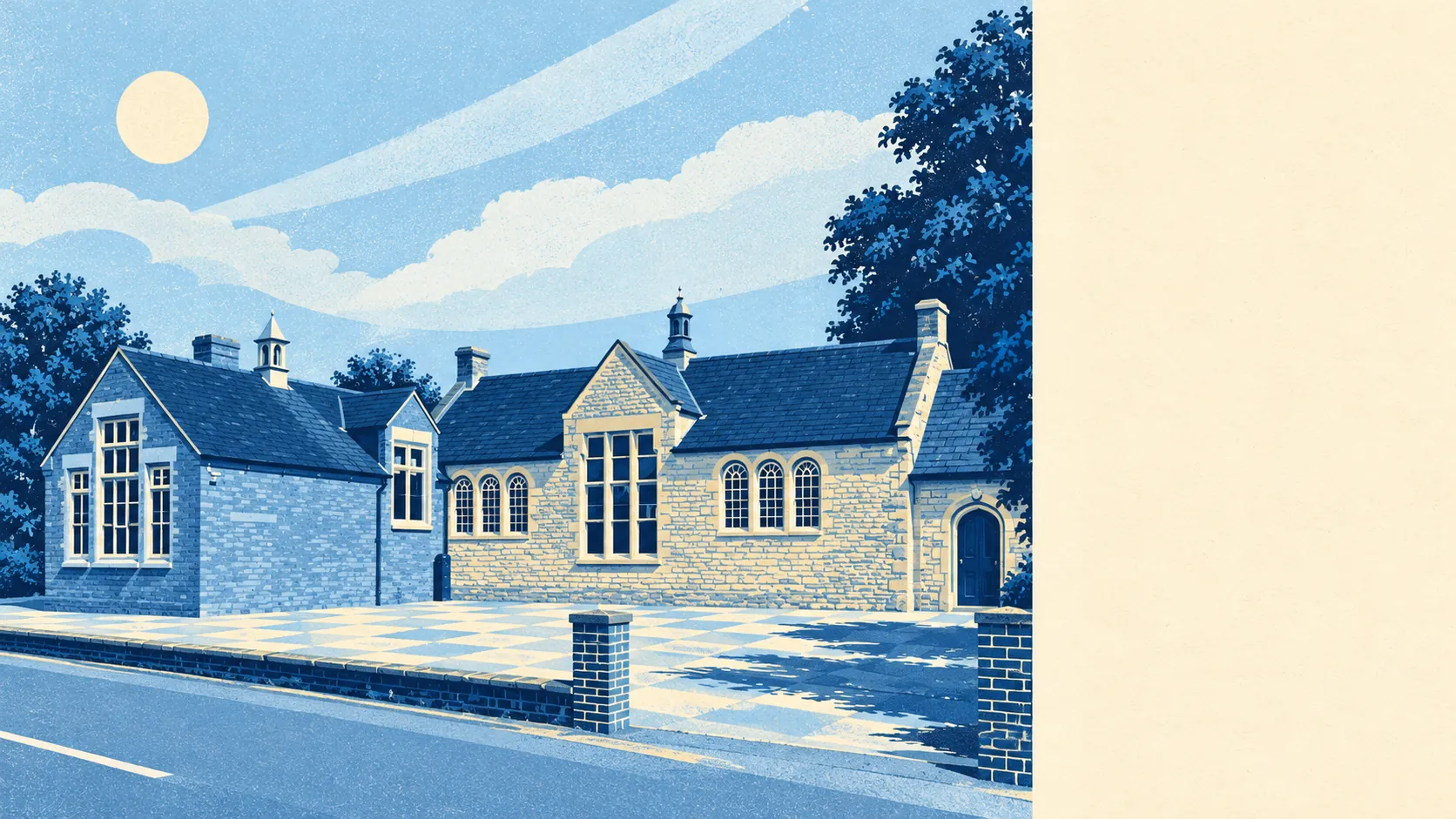
Hanslope lets you build the extension, and for a buyer with plans that beats most of what a village can offer. Nineteen listed buildings. One conservation area. Plenty of post-war semis and detached houses with room at the side. Crime runs at about half the Milton Keynes rate, and the only real snag is getting anywhere without a car.
Of those 19 listed buildings, 18 are Grade II and one is Grade I: the Church of St James the Great, a Norman foundation that earned its paperwork centuries before anyone thought of a kitchen diner. The single conservation area takes the village's own name, and inside it windows, doors and anything visible from the road get looked at more carefully. Outside it, a semi on the edge of the village answers to ordinary planning rules, which is why the council logged 204 planning applications across the area this page covers in the twelve months to July 2026. Somebody in Hanslope is always waiting for a decision on a garage conversion.
Thames Valley Police recorded crime here at a rate of about 52 per 1,000 residents in the year to May 2026, roughly 52% below the Milton Keynes average. Violence and sexual offences make up the largest share, as they do almost everywhere, though the totals are small enough that a handful of incidents moves the mix by several points. The most serious breach of the peace on record came in 1215, when King John's men took Hanslope Castle from William Maudit after his rebellion. The village has calmed down a good deal since.
The Environment Agency puts none of Hanslope inside the river-and-sea flood zones. The wider measure is less tidy: about 10% of postcodes here are at high risk on at least one flood indicator including surface water, another 6% at medium risk and 32% at low. The rivers stay out of it. The rain does not.
Green space is about 200 metres from the average front door, with roughly six green spaces within a kilometre, and water is about 280 metres away. The National Cycle Network passes within about 190 metres of most homes. Hanslope Park, south-east of the village, started as a medieval deer park and was later landscaped by Humphry Repton, back when the parish was still part of Salcey Forest's story.
Connectivity is where Hanslope struggles. The village has no station; Wolverton is the nearest. Castlethorpe had one of its own until 1964, and the West Coast Main Line still runs past both villages without stopping for either. Hanslope has 11 bus stops, each seeing about seven departures on a weekday and an average of zero in the peak hour, though all 11 get a weekend service. The Department for Transport's 2019 modelling put the nearest town centre about 26 minutes away by public transport and 16 by car, and the bus figure has had seven years to age since. At the last census about 1% of workers took the train, 1% the bus, 42% drove and 48% worked from home. Broadband does the commuting instead: gigabit-capable connections reach about 90% of premises, superfast reaches all of them, and every postcode gets 4G or 5G from at least one operator.
About 76% of households own their home, the typical resident is 45, and the Office for National Statistics models gross household income before tax at around £65,600 for the financial year to March 2023. Around 52% of households run two or more cars. That is the bus timetable's review, written on the driveways.
The Land Registry's figures for the year to mid-May 2026 show 30 sales at a typical price of about £375,000. Detached houses, 15 of the sales, went for around £475,000, semis for about £325,000 across nine sales, and terraces for about £375,000 across five. Five terraced sales is less a market than five families' news. Band C is the most common council tax band, and only about 15% of homes fall in bands A or B.
Renters get no figure for Hanslope on its own. The Office for National Statistics' typical private rent across the Milton Keynes area was about £1,330 a month in April 2026, and with only around 10% of households here renting privately, the village barely registers in that average.
The council-tax valuation list, which counts every home, puts detached houses at about 39% of the stock, semis 29%, terraces 15%, bungalows 12% and flats 6%. Only about 14% were built before 1930. Of the homes with an energy performance certificate, about 69% are rated A to C and 6% E or worse, and about 78% of households heat with mains gas. A village of detached houses and bungalows on decent plots is the kind of stock that grows sideways, and the energy ratings mean the extension is rarely fighting a draughty original.
The parish has history out of proportion to its bus service. In 1316 the Crown official Adam de Harvington was given the living here, and by 1327 he was Chancellor of the Exchequer. James Mayne, rector from 1841 to 1851, turned up again on Who Do You Think You Are? as Patsy Kensit's ancestor, with his grave shown at the church. In the 19th century the village was a centre of Buckinghamshire lacemaking, with Hanslope lace singled out as particularly fine. The rectors went further than the buses.
Hanslope is right for a buyer who drives, works from home or both, and who wants a big family house with a garden and the realistic prospect of making it bigger. It is wrong for anyone who needs a train they can walk to, or a teenager who needs to get somewhere after the last bus. Those buyers will be happier near the station in Wolverton.
The planners leave most of Hanslope alone, so the house you buy can become the one you wanted, while the trip into town stays something you plan your week around. That trade comes out well ahead for most buyers. Hanslope is a good village to buy into and a better one to build onto, provided you were never planning to leave it by bus.