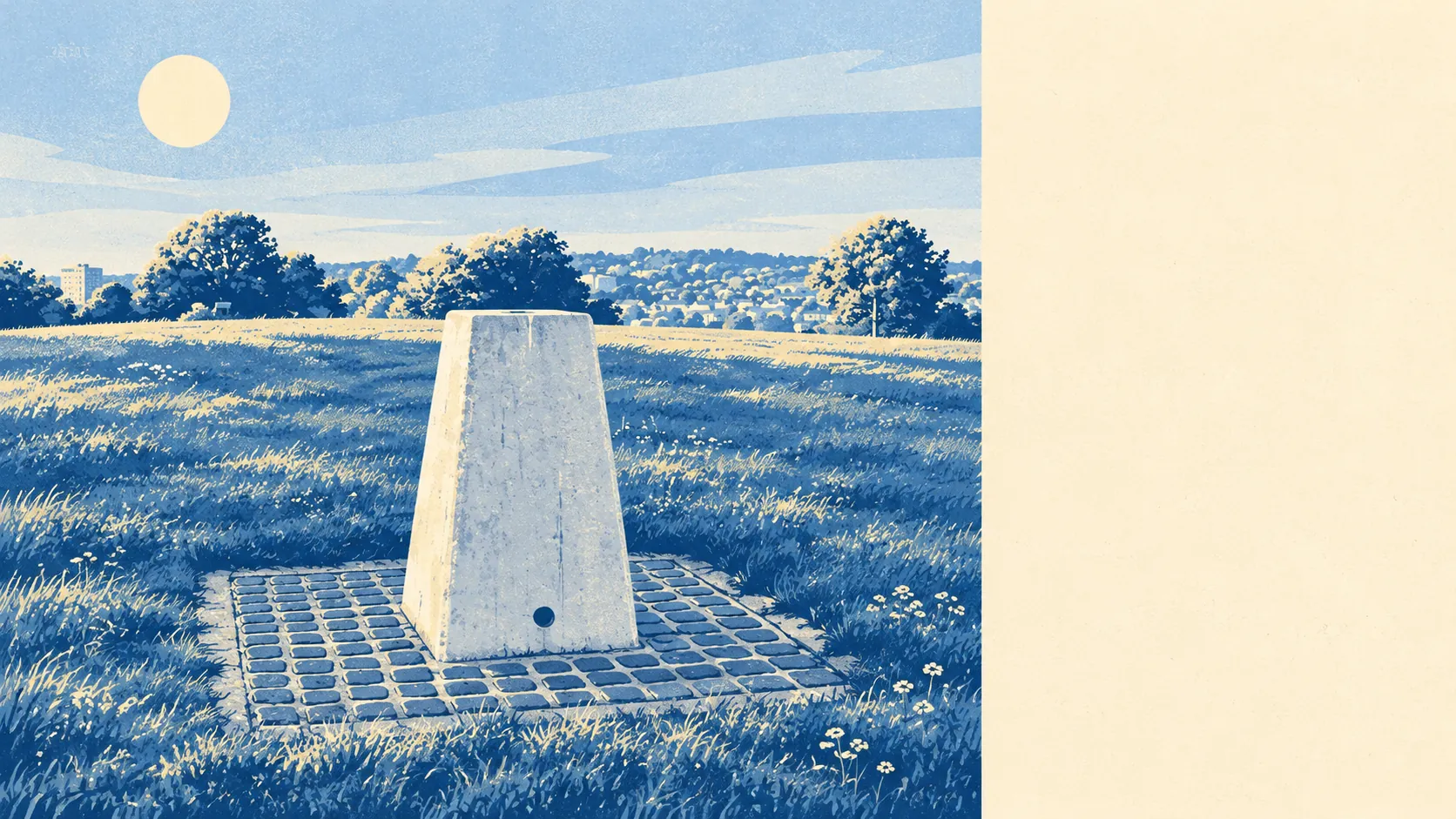
The area around Greenford is much greener than a west London suburb has any right to be. For most homes, a park is a couple of minutes' walk away. Water is close as well. Horsenden Hill rises on the eastern edge, and woods, fields and a canal fill the gaps between the housing estates. People who come here for the trains often find the green space is what makes them stay.
The typical Greenford home is about 130 metres from the nearest public green space, and on average there are about 29 separate green spaces within a kilometre. Between them, Ravenor Park, Horsenden Hill, Northala Fields, Marnham Fields and Brent Valley Park cover most points of the compass. Ravenor Park, the largest, hosts the Greenford Carnival every July.
Water is about 400 metres from the typical front door, with an average of about 29 water features within a kilometre. The Grand Union Canal runs through the north of the town. It once brought tea and coffee into the Lyons factory's own basin, and these days it mostly carries towpath walkers.
The National Cycle Network is about 9 kilometres away on average, and no Greenford postcode is close to it. Cyclists here use the towpath and local routes, since a long-distance cycle route is a trip in itself.
The rated-premises list counts 364 shops, 15 restaurants and nine pubs in Greenford. Westway Cross Shopping Park, with Next, Smyths Toys and Sports Direct, is where much of the big-box shopping goes on. Greenford is far better stocked for shopping than for a night out.
Fine-particle air pollution across the London Borough of Ealing measured about 8.7 micrograms per cubic metre in 2024. That is a borough-wide figure and says nothing about any one street.
Greenford is mostly interwar streets, with older pockets and nearby Perivale between them. The open ground breaks the housing up into sections: the hill on one side, parks and playing fields on the other, and the canal running through the north. Heritage is scattered through the wider area, with ten conservation areas, including Canalside, and listed buildings that are mostly churches. In 1856 William Perkin made the first aniline dye at his chemical works by the canal in North Greenford, and a blue plaque on Oldfield Lane North marks the site.
Private gardens add about 43,600 square metres of outdoor space for every 1,000 residents across Greenford's neighbourhoods. That fits a town that is mostly terraces and semis, where a back garden is normal.
The council's valuation list counts 1,601 rateable business premises. They include 356 shops, 302 warehouses and stores, 227 offices and two classes of industrial premises with 98 and 80 entries. These are premises on the list, which is not the same as businesses currently trading. The Lyons factory is now an industrial estate, and Greenford is still a place where goods are stored and shipped out.
Of the 361 food outlets with a hygiene rating, about 59% have the top score of five and about 8% are rated at the low end. Most places are fine, though not every one.
None of the area is a protected landscape. Nowhere is in an area of outstanding natural beauty or a site of special scientific interest, and there is no ancient woodland. The green space here is parkland and hillside that people use every day, not countryside they drive out to visit.
The setting is one of Greenford's real strengths. A hill, a canal and a park in walking distance are more than most suburbs this close to central London can offer.