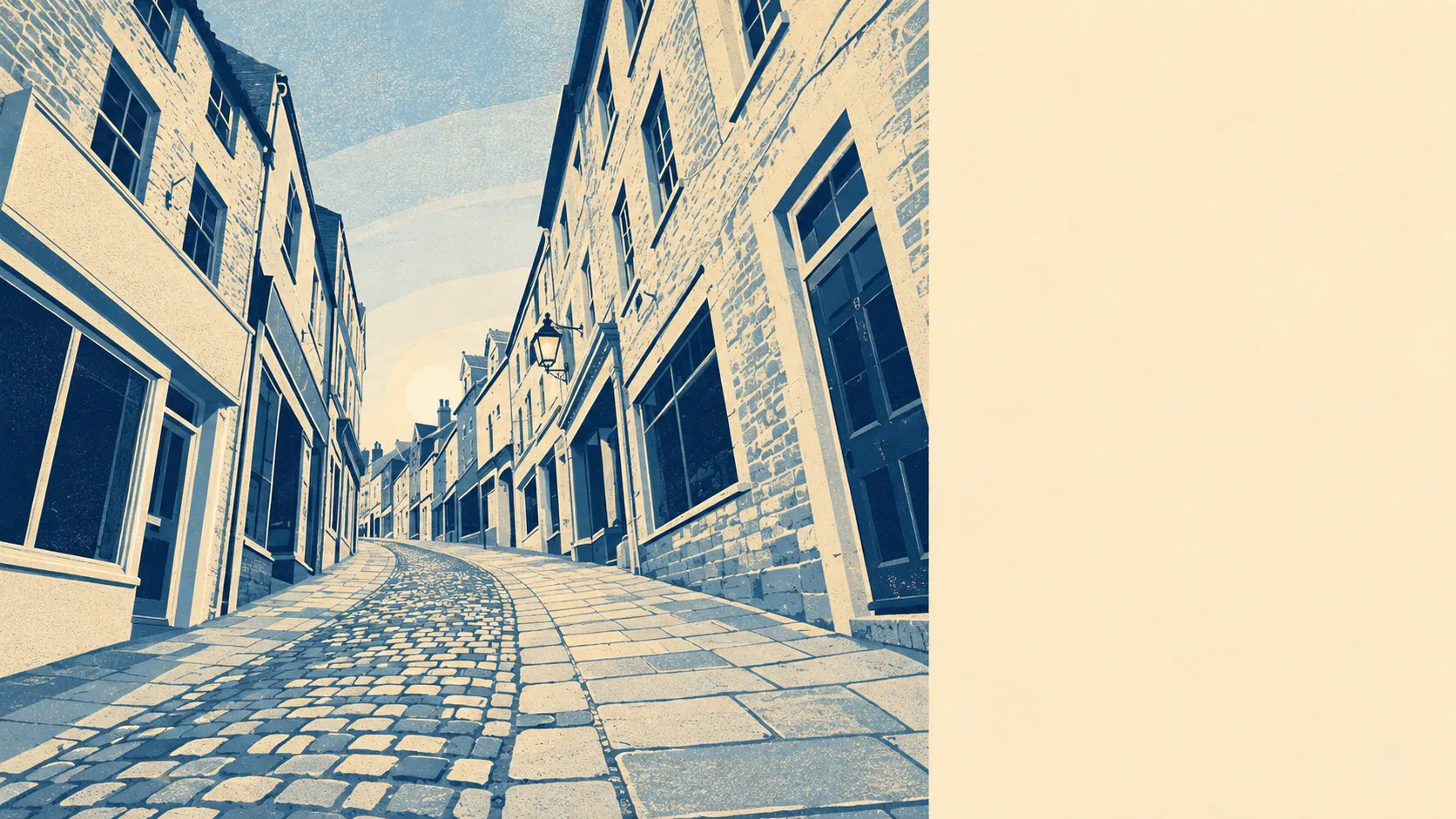
Yes, if you can live with a town that has opinions about itself. Nearly two thirds own their homes here. The typical resident is in their early forties. Green space starts about a hundred and ninety metres from the average front door. It is a working Somerset town with a well-developed sense of occasion, and the people who move here for the sourdough tend to stay for the hills.
The housing stock is where the town's history shows. Terraces run the show at roughly 31% of every dwelling on the council-tax list, with detached and semi-detached close behind at about 20% and 22%, bungalows at around 11%, and flats at only about 14%. Close to a quarter of it, 24%, went up before 1930, which in a town that was building purpose-made industrial housing in the Trinity area in the late seventeenth century is not a surprise. Around 75% of homes run on mains gas, and about 7% are on electric-only heating, which is the number to check before you fall in love with a stone cottage in winter. On energy certificates, roughly 57% of certificated stock sits in bands A to C, about 32% in band D, and around 11% at band E or worse. The pattern is the usual one for an old wool town: the recent estates on the edges are warm, the pretty bits are not.
On price, the Land Registry's last twelve months to May 2026 put the typical sale at £310,000 across 379 sales. Terraces came in around £290,000, semi-detached around £298,000, detached at about £435,000, and flats at roughly £159,000, which is the widest gap in the town and the reason two people can both say they bought in Frome and mean entirely different things. Council tax leans low: band B is the most common, and about 45% of dwellings sit in bands A or B. That is a town of modest houses with a few very good ones, priced accordingly.
Renting is measured across the wider area rather than the town itself. The typical private rent across the Somerset area is about £990 a month as of April 2026, up around 4% on the year. Treat it as the regional shape rather than the price of a specific flat on Catherine Hill.
Crime sits at about 88 recorded offences per thousand residents in the year to May 2026, which is roughly 5% below the Avon and Somerset average. That is the published rate for the area, not a headline anyone should build a personality around. The force charges in about 11% of cases, marginally under the England and Wales figure, which is a fact about policing rather than about Frome.
Frome Rail Station opened in 1850 and is one of the oldest still working in Britain, with services toward Bristol Temple Meads, Exeter St Davids, Weymouth and London Paddington. Almost nobody uses it to commute: about 30% of residents work from home and roughly 51% drive to work, against under 1% by train. There are 221 bus stops in the area and about 80% of the stops with service data see some weekend service. Broadband is the quiet win, with gigabit available to around 89% of premises and superfast to about 95%. The town centre is about nine minutes by car, closer to 15 by public transport.
On flooding, roughly 12% of postcodes carry a high rating on at least one flood indicator, including surface water, and about 17% a medium one. On the narrower river-and-sea measure, only about 1% of the area falls inside Environment Agency flood zone 3 and around 2% in zone 2. Those two figures answer different questions, and the surface-water one is the one that matters when the town is built on uneven high ground with a river through the middle of it. Around 2% of the area has a recorded historic flood, the most recent logged in February 2009 from overtopping of defences. Set against that, green space is close to everyone: about 190 metres to the nearest patch, roughly 22 patches within a kilometre, and water at around 350 metres. A sliver of the Cranborne Chase and West Wiltshire Downs protected landscape clips the edge.
Heritage is the constraint that catches people out. There are 799 listed buildings in the area, 17 of them Grade I and 59 Grade II star, along with seven conservation areas and 20 scheduled monuments. Cheap Street has never taken vehicles and its plot layout dates to around 1500. The Blue House, built in 1726, still houses residents. This is lovely to walk through and awkward to own: windows, doors, roofs and extensions in the protected streets go through consent, and the answer is not always the one you wanted. Five entries in the area sit on the Heritage at Risk register.
Home ownership runs at about 66%, the typical age is 43, and household income across the area's neighbourhoods runs at roughly £55,600 gross before tax in the financial year to March 2023. This page also covers Beckington, which sits across the River Frome from Lullington and keeps its own conservation area and a quieter version of the same idea.
It suits people who want a real town rather than a commuter dormitory: someone buying a terrace within walking distance of the Wednesday and Saturday markets, working from a back bedroom, and treating Bath as a train ride rather than a mortgage. It suits families willing to work with a three-tier school system, with Frome Community College taking pupils from 13.
It suits less well anyone whose life depends on a fast rail commute, or anyone planning a large rear extension on a period house in one of the protected streets. Buy the warm modern semi if you want a predictable heating bill; buy the stone one if you accept that the charm has a running cost.
The town produced Benjamin Baker, who went on to build the Forth Bridge, and Jenson Button, who has a street and a bridge over the river named after him. Between an engineer and a Formula One champion, Frome has a decent claim to knowing how to get somewhere.
The verdict is a good place to live with one clear pinch point. Its real strength is the surroundings and how close the green is to every front door, in a landscape that starts almost immediately once the streets run out. The weak spot is the freedom to alter your own home, because the same heritage that makes the place worth photographing means the planning department has a view on your windows. Everything else, price, safety, broadband, sits comfortably above middling. Come for the stone, stay for the hills, and get the consent in writing before you order the glazing.