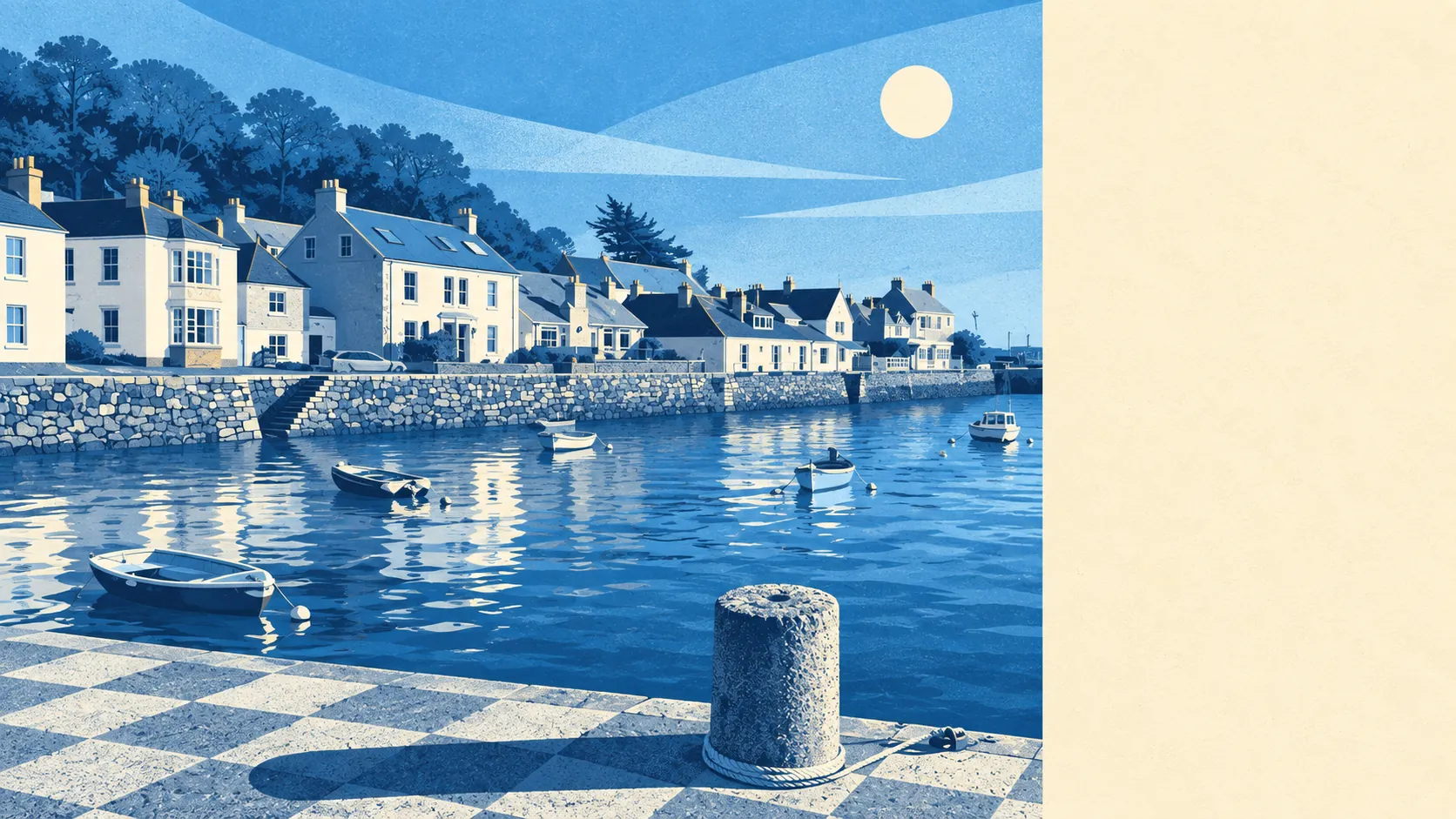
Flushing is a village where the water is both the amenity and the invoice. Seven in ten own their homes. The median resident is in their mid fifties. Most of the houses went up before insulation was a consideration, and a third of the postcodes carry a flood flag of some kind. Not a village with a view of the water, then. A bit of water with a village attached, and the bills reflect which one came first.
The stock is older and lower than the Cornish coastal cliche suggests. On the council tax valuation list, which covers every dwelling rather than only the ones certificated since 2008, terraced houses are the largest group at about 31%, bungalows take 22%, detached homes 20%, semis 17%, and flats only 10%. Around 40% of it was standing before 1930. The energy certificates tell you what that means in practice: roughly 11% of certificated homes sit in bands A to C, about 28% in band D, and around 61% in band E or worse. Heating is the part buyers underestimate. Only about 8% of households are on mains gas, the network having largely declined to come round the creek, while around 21% run on electricity alone and about 2% have no central heating at all. An electrically heated Victorian cottage with a granite wall facing the Penryn River is a romantic proposition in June and an accounting exercise in February.
Prices are firm and the sample is small. Across the Land Registry's last twelve months of recorded sales, to late January 2026, the median was about £445,000 across twelve transactions. The split by type is wide: semi-detached homes came in around £632,500 across four sales, terraced homes around £420,000 across six. Council tax lands mostly in band C, which is the modal band here, with roughly 22% of dwellings in bands A or B. The Cornwall band D charge runs to about £2,591 a year. For a village this size, twelve sales in a year is not a market so much as a queue.
Renting is a different exercise, because the meaningful figure is a Cornwall-wide one rather than the village's own. Typical private rent across the Cornwall area is about £1,000 a month, up around 5% on the year to April 2026. By size, that area-wide measure runs at roughly £689 a month for a one-bedroom home, £882 for two bedrooms and £1,078 for three. Flushing itself is a place people buy into, or inherit into, or holiday into, and the rental stock left over after all that is not large.
Safety is the standout. The published crime rate is about 35 recorded offences per 1,000 residents over the twelve months to May 2026, which sits roughly 53% below the Cornwall average. Devon and Cornwall Police charge in around 8% of cases against a national rate of about 12%, so the force's own record is weaker than the village's, which is a distinction worth understanding before anyone quotes the reassuring number back at you.
Getting anywhere is a choice between a boat, a car and a long think. No residents travel to work by train, and the nearest stations are Penryn, Penmere, Falmouth Town, Falmouth Docks and Perranwell, all of them on the wrong side of a body of water or a detour round it. About 50% drive to work and roughly 35% work from home, which is the highest-functioning answer available. Ten bus stops serve the village, eight with published timetables averaging around 13 weekday departures each, and all eight carry a weekend service. Modelled journey times put the nearest town centre at about 16 minutes by car or 29 by public transport, a supermarket at about 8 minutes, a doctor at around 13, and a hospital at about 32. Broadband is the one piece of infrastructure that arrived on time: superfast is available at effectively every premises, gigabit at around 80%, none below the universal service obligation, and at least one mobile operator reaches about 100% of the area.
The water that makes the place also complicates it. On the postcode-level indicators, which include surface water as well as rivers and sea, about 35% of postcodes carry a high flood indicator and around 30% a medium one. On the Environment Agency's river-and-sea flood zones, roughly 13% of postcodes fall inside flood zone 3, rising to about 17% once the climate-change allowance is applied. The median postcode sits around 124 metres from the coast, and the closest sits about 12 metres from it, so this is not an abstraction. The shoreline management policy for the village is to hold the line over the next twenty years and to shift to managed realignment beyond that, which is a polite way of saying the defences are a commitment with an expiry date. Against that, green space averages around 277 metres away with about six sites within a kilometre, and open water is closer still at roughly 207 metres.
Heritage is dense for a village of this size. There are 53 listed buildings, all of them Grade II, a conservation area covering Flushing, and one scheduled monument in the wayside cross at St Peter's churchyard. Anything visible from the street becomes a conversation with the planning department. Windows, doors, roof coverings, solar panels and the colour of the render all stop being personal decisions the moment you complete.
The people fit the fabric. Around 71% own their homes, the median age is about 56, and gross household income runs to roughly £54,000 a year on the modelled figure for the financial year to March 2023. This page also covers St Mawes, across the harbour on the Roseland side, which shares the same combination of deep water, short winters of activity and a summer population that arrives by boat.
It suits people who are done commuting daily, who want the water at the end of the road, and who understand that a listed cottage with electric heating and a flood indicator is a lifestyle purchase with a maintenance schedule attached. It suits sailors, obviously. It suits anyone whose working life now happens at a desk in a spare bedroom.
It does not suit anyone who needs a train, a large modern house, cheap heating or a market with enough sales in it to price a property confidently. It does not suit buyers who want flood risk to be somebody else's problem.
The village has been attracting this sort of person for centuries. James Silk Buckingham, later an author, politician and social reformer, grew up here when the packet officers filled the captains' houses on St Peter's Hill with dinners and dances most nights of the week. Admiral Sir Bartholomew Sulivan, who sailed with Charles Darwin aboard the Beagle, kept a house here as many of his colleagues did. Ethel and Bessie Charles, the first women admitted to the Royal Institute of British Architects, came from the village. Henry VIII meant to build a castle on Trefusis Point and ran out of money, and the Wheal Clinton lead mine opened in 1854 and closed in 1858 having found nothing worth the trouble. Flushing has a long record of expensive ideas that the water quietly declined to fund.
So, average overall, with the averages hiding a lot. The real strength is safety, where the recorded rate sits well below the county and the village has almost nothing in the way of trouble to report. The weak spot is flood risk, which is not a footnote here but the defining constraint on where you buy, what you insure and what the sea wall does in thirty years. Everything else follows from that: the houses are old because they were built for a working harbour, they are cold because nobody insulated a packet captain, and they are expensive because the view has never once gone out of fashion.