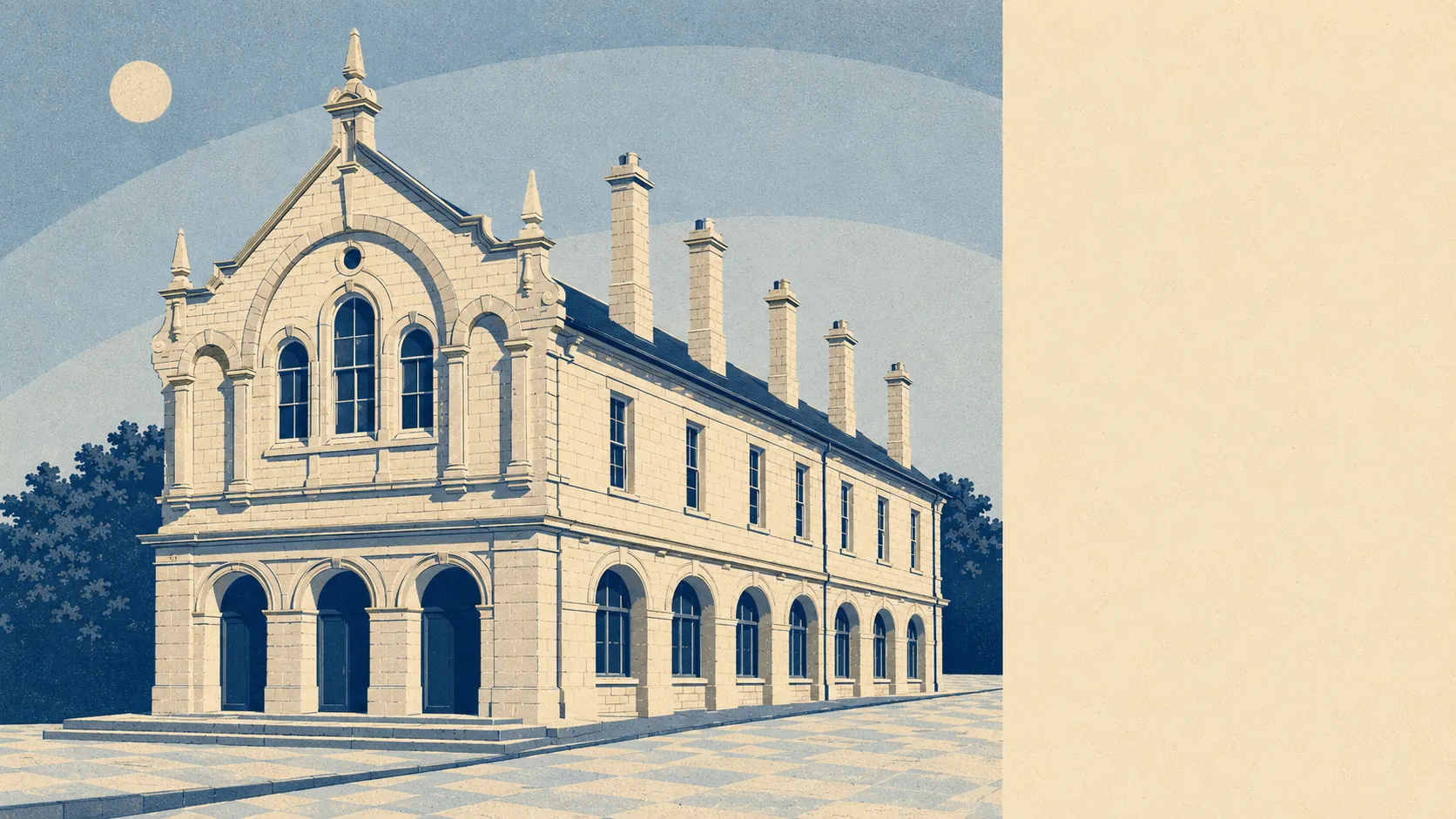
Yes, provided you have made peace with quiet. Seven in ten own their homes. The median resident is fifty. Most people drive to work, and the share commuting by train does not reach one percent, in a town that has its own railway station. Green space starts at the end of nearly every street. Not a commuter town with a station attached. A market town that mostly ignores the one it has.
The terrace runs the place. Around a third of dwellings on the council tax valuation list are terraced, roughly a fifth are semi-detached, and detached houses, bungalows and flats take up most of what is left, with flats at about 13%. Bungalows account for about as much of the stock as detached houses do, which tells you plenty about who has been buying here for the last forty years. Roughly a quarter of everything went up before 1930. On energy certificates, about 45% of homes reach band C or better, about 40% sit at band D, and roughly 16% land at E or worse. Around 74% run on mains gas. About 11% are heated by electricity alone, and electric-only heating in a pre-1930 terrace is the sort of detail that turns up on a January bill rather than in a listing photograph.
The Land Registry recorded 134 sales in the twelve months to late May 2026, at a median of £231,000. Terraces went at around £180,000, flats around £150,000, semis around £250,000, and detached houses around £320,000. The most common council tax band is B, and bands A and B together cover about 49% of dwellings. The valuation office was not being unkind about the town. It was being accurate.
Rent is published for the Somerset area rather than for Crewkerne on its own, so read it as the regional typical rather than the street outside: about £990 a month across all property types, up about 4% over the year. One-bedroom places average about £670, two-beds about £890, three-beds about £1,100.
Recorded crime for the area ran at about 75 offences per thousand people in the twelve months to May 2026, roughly 19% below the Somerset average of about 93. That is a published rate rather than something worked out from the resident headcount, and it puts the town comfortably on the quiet side of a county that is already not famous for jeopardy. Avon and Somerset Constabulary charged about 11% of cases over the same period, against about 12% nationally, so the odds of a resolution are much what they are anywhere. Which is either reassuring or not, depending on your view of the national figure.
About 61% drive to work, about 20% work from home, and about 13% walk. Fewer than one in a hundred commute by train, and fewer still by bus. Crewkerne Rail Station is actually in Misterton, which says something about how enthusiastically the town welcomed the line in 1860. There are 33 bus stops in the area, and the 28 with published timetables average about 11 weekday departures each, with about seven in ten seeing any weekend service at all. The Department for Transport's modelled journey times put the nearest hospital at about 27 minutes by car and about 50 minutes by public transport, though those were modelled in 2019 and the public transport half has aged worse than the car half. The town centre is about 13 minutes on foot, a food shop about nine, a doctor about 14. Superfast broadband reaches about 99% of premises, gigabit about 34%, and nothing at all falls below the universal service obligation minimum. Nearly every address gets a modern mobile signal from at least one network, and about 97% from all of them.
On flood, about 8% of postcodes carry a high rating on at least one indicator including surface water, and about 10% a medium one. On the Environment Agency's river and sea zones proper, about 1% sit in zone 3 and about 1% in zone 2, rising to about 5% once climate projections are applied. Four flood events have been recorded here, the most recent in 2008, caused by a blocked culvert. Less biblical than the word flood suggests. The surroundings are where this place earns its keep: the average postcode sits about 210 metres from green space, with about 15 separate green spaces inside a kilometre and water about 490 metres away. Every postcode also falls into an elevated radon band, topping out at the highest class, which means a test kit before the survey rather than a conversation after it.
There are 169 listed buildings in and around the town, one at Grade I and eight at Grade II star, plus two conservation areas covering Crewkerne itself and Misterton, and one entry on the Heritage at Risk register. In practice that means the window you want, the door you want and the panels you want on the roof stop being your decision and start being the council's. The fifteenth-century parish church that the wool and cloth money paid for is the reason the rules exist, and the rules do not care that your sash frames are rotting.
About 69% own their homes outright or on a mortgage. The median age is fifty. Median household income ran at about £46,000 before tax in the financial year to March 2023, about £34,500 after it. Around a third of households are a single person, and about 18% are a pensioner living alone. This page also covers the villages in the town's orbit: Misterton immediately south-east, where the station sits, Haselbury Plucknett and North Perrott out towards the Dorset border, and West Chinnock to the north-east. They are quieter again, which in this part of Somerset is an achievement.
Crewkerne suits a particular buyer very well. If you are after a three-bedroom semi with a garden, work from home most days, want a doctor and a food shop inside a quarter-hour walk, and have children heading for Wadham School at about 27 minutes on foot, the town is both priced and built for exactly that life.
It suits another buyer badly, and quickly. If your week depends on a train that turns up when you need it, a hospital that is not half an hour of A-road away, or anything open late on a Tuesday, the arithmetic will not improve however long you stare at it. Yeovil is the bigger town in the other direction, and buying there means accepting a busier place in exchange for the connections. That trade is honest in both directions, and the people who refuse to pick a side end up moving twice.
The town has a long history of producing people who then went and did the interesting part elsewhere. Thomas Coryat, a traveller and writer of the late Elizabethan and early Jacobean age, was born here around 1577. So was John Caswell, a mathematician. Joshua Fry was born here in 1699 and left to become a surveyor and mapmaker in colonial Virginia, ending up in its legislature. Ralph Reader of Gang Show fame and Sir Leonard Pearce, whose name is bound up with Battersea Power Station, both come from here too. John de Combe founded a grammar school in the town in 1499 and it ran until 1904, which is a decent innings for anything.
So, a good place to live, and an easy one to be wrong about. Its real strength is what surrounds it: green space within a couple of minutes of nearly every front door, and countryside that is a daily fact rather than a weekend outing. The weak spot is transport and connectivity, and it is not a close call, with a station in the next village, buses that thin out by Saturday and gigabit broadband at about a third of premises. Buy here for the fields, the stone and the price. Ask the town for anything faster and it will politely decline.