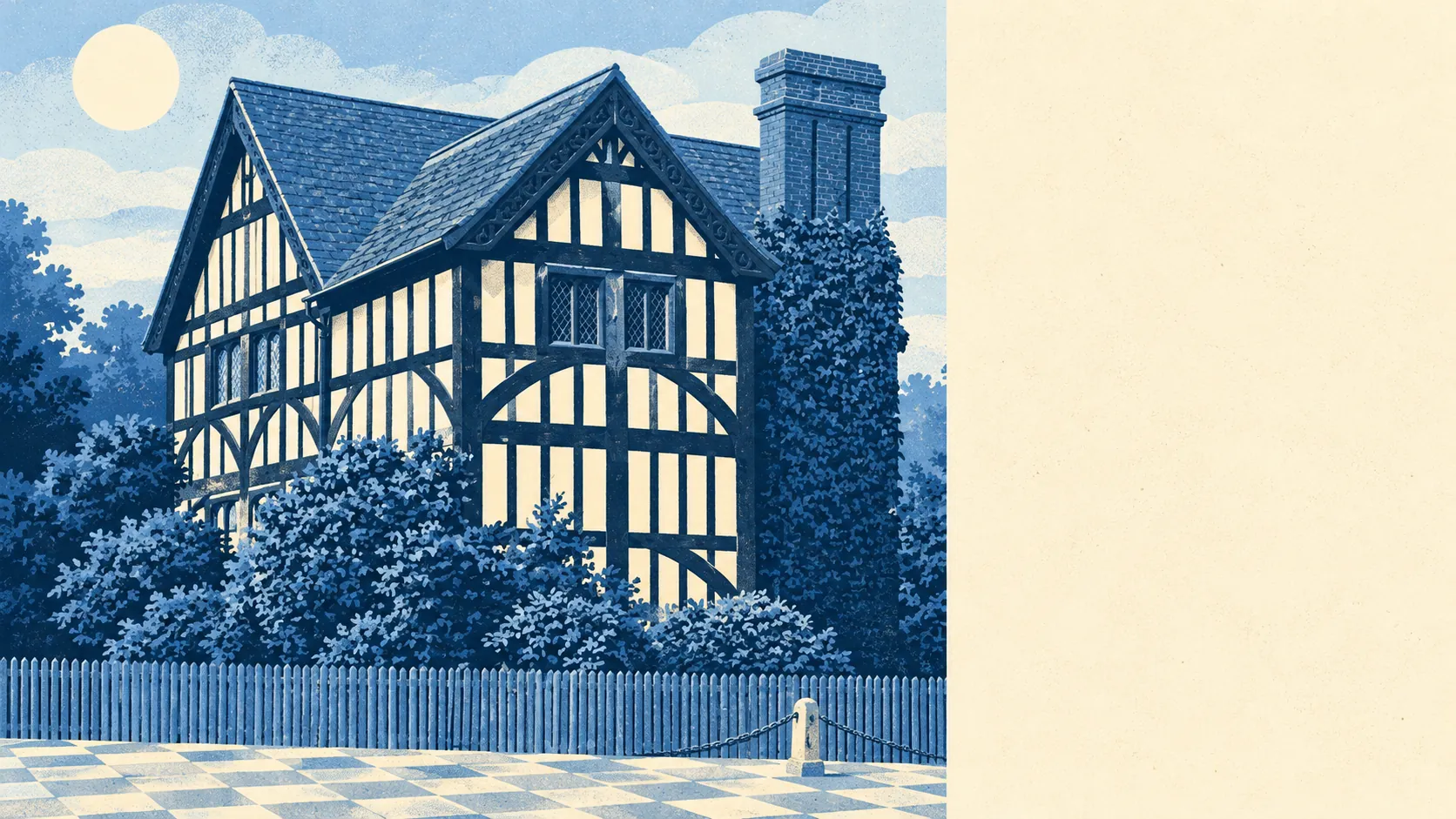
You can extend most houses in Chingford, and the ground under them will ask harder questions than the heritage officer. Listed buildings are few, and almost all of them are Grade II. Conservation areas cover a handful of neighbourhoods. The neighbours file planning applications constantly. Every one of those extensions goes into clay that swells and shrinks with the weather.
Historic England lists 60 buildings in the area. None is Grade I, 5 are Grade II* and the other 55 are Grade II. Listing covers the inside of a building as well as the outside, so in a listed house even a new internal doorway or a replacement window needs listed building consent from the council on top of any planning permission. Sixty listed buildings spread across a suburb of tens of thousands of homes means most owners will never meet a listing officer.
Five conservation areas fall in and around Chingford, among them Chingford Green and Ropers Field. Inside one, the council takes a closer interest in anything visible from the street, from extensions and roof alterations to the loss of trees and front boundaries, and some work that elsewhere would go ahead without an application needs one here. The council's conservation area maps will tell you in a minute whether a house falls inside one, and that is the check worth making on any house with a project in mind. On Chingford Green the council has opinions on your front elevation; out in the interwar streets it mostly has opinions on your paperwork.
There is one scheduled monument in the area, the strictest tier of protection, and it matters only to owners whose land runs up against it.
The neighbours are not shy about building. Waltham Forest logged 1,474 planning applications in the area between March 2024 and June 2026, and 706 in the twelve months to June 2026. That is the paper trail of a suburb that keeps finding out the loft has a better future than storage.
The ground is the part that needs real thought. The British Geological Survey's shrink-swell mapping places all of Chingford at class 3, its published hazard class for clay that swells when wet and shrinks when dry. That does not stop anyone building. It means new foundations may need to go deeper than on firmer ground, especially near trees whose roots pull moisture out of the soil, and a structural engineer's view belongs in the budget from the first sketch. Epping Forest gives Chingford its trees, and the clay under the gardens takes them very seriously.
Four listed buildings in the area are on Historic England's Heritage at Risk register. Those are buildings in poor condition whose repair can attract grant money and will attract close attention from the council. They are a matter for their owners and the conservation officers, and not a risk to anyone buying an ordinary semi nearby.
For a typical house outside a conservation area and not itself listed, many rear extensions and loft conversions can go ahead under permitted development, the national rules that let some work proceed without a full planning application, though there are limits on size and the council may still need to be notified. Inside a conservation area, or in a listed building, the room for that shrinks and an application becomes the normal route. Building regulations apply everywhere, and on Chingford's clay that is where the foundation design gets checked.
Chingford gives an owner a fair amount of freedom, with the heritage rules biting only in a few pockets and the clay setting the terms everywhere else. Most extensions here are a question of engineering and patience more than of permission.