Buckingham works well for anyone whose commute runs on a car or a router, and less well for anyone still waiting for a train. The middle is Georgian and handsome, the outskirts are newer and practical, and a field or a riverbank is a short walk from most front doors. About two-thirds own their homes. Crime runs below the county average. Water is the weak spot.
That makes it a good fit for families, home-workers and people who drive, and the facts below keep coming back to those three. The Land Registry's twelve months to May 2026 put the typical sale at about £370,000, across 184 sales. Type moves the price a long way. Flats went for around £179,000, terraces £300,000, semis £350,000 and detached houses £490,000, and detached houses were the biggest single group sold. Band C is the most common council tax band, with about 23% of homes in the two cheapest bands, A and B.
Renting across the whole Buckinghamshire area costs about £1,470 a month for a typical private let as of April 2026. That is a county-wide average from the Office for National Statistics' rent index, and Buckingham is one small corner of a large county.
The Georgian postcard is a small frame. A fire in 1725 cleared Castle Street, Castle Hill and the north side of Market Hill, and the rebuild gave the centre its looks. Then in 1971 the county council set up the Buckingham Development Company to grow the town and build a bypass, and most of the housing came after that. On the council tax valuation list, about 32% of homes are detached, 25% terraced, 22% semi-detached, 16% flats and 5% bungalows, and only about 10% were built before 1930. About 67% of homes with an energy certificate are rated A to C, and about 81% are on mains gas. Buyers who picture a Georgian townhouse are mostly looking at a house built around a cul-de-sac.
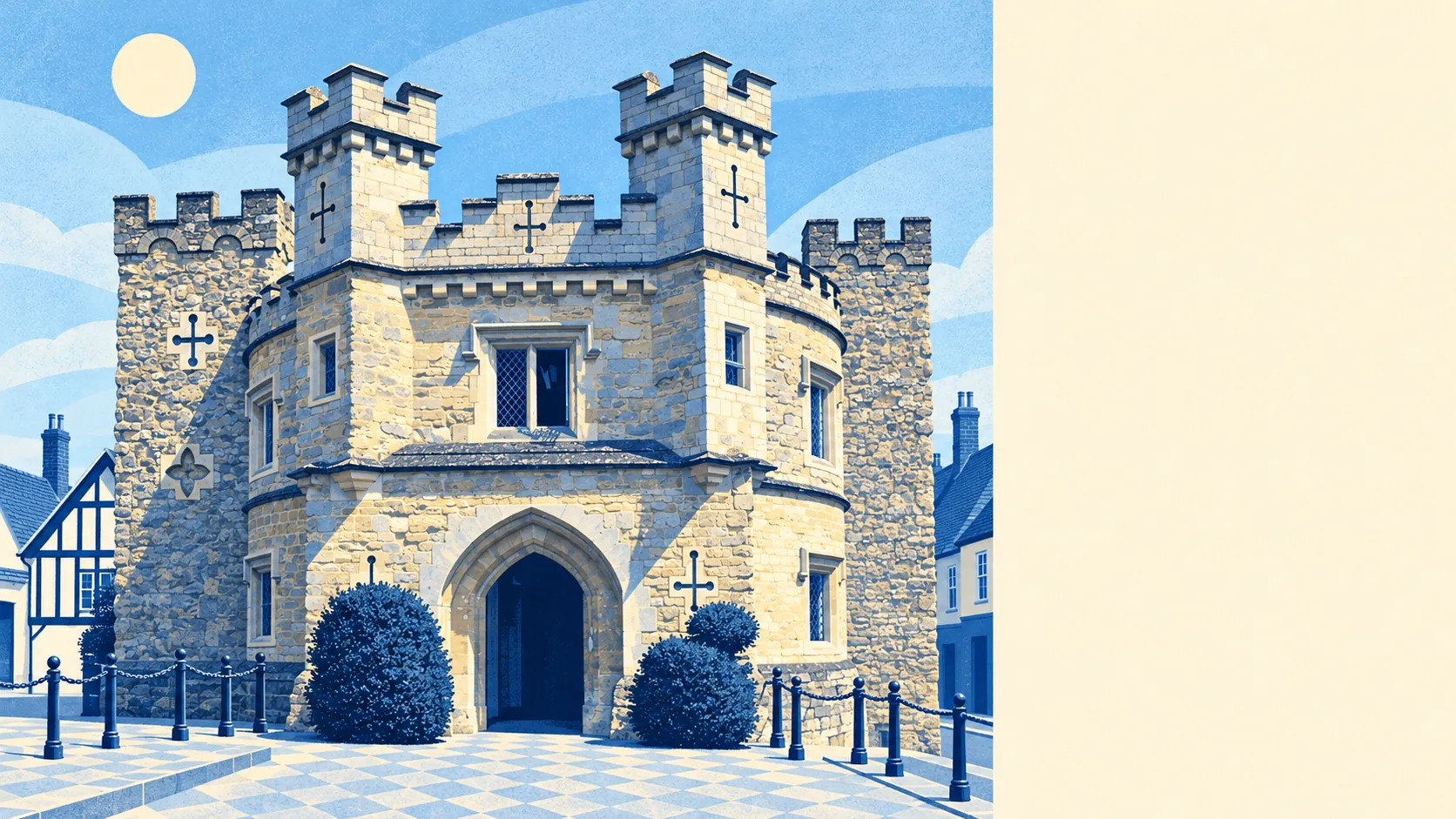
Where the old stock survives, it is protected. Historic England lists 200 buildings here: 3 at Grade I, 8 at Grade II* and 189 at Grade II. The two conservation areas are Buckingham itself and Maids Moreton. Castle House on West Street is Grade I and goes back to the fifteenth century, and the Town Hall is Grade II*. Inside those boundaries, new windows, a rear extension or a different front door can all need consent first. The fifteenth century has views on plastic windows, and the council enforces them.
About 66% of households own their home, the median resident is 41, and the Office for National Statistics models gross household income at about £70,000 a year, averaged across the area for the year to March 2023. The University of Buckingham is the oldest of the country's private universities. The Royal Latin School is a grammar school, with the Buckingham School as the secondary modern beside it. George and Sam Baldock both went through the Royal Latin and into football careers. John Bercow was the town's MP before he became Speaker of the House of Commons, and Bernie Marsden, Robert Maxwell and Gillian Blake also appear on its list of notable people. For a town this size, it has sent a lot of loud voices into the wider world.
Flood is where Buckingham does worst. About 18% of postcodes are at high risk on at least one flood indicator, and that measure includes surface water as well as rivers. The Environment Agency's river-and-sea flood zones are smaller: about 2% of the area is in Flood Zone 3 and about 4% in Zone 2. The agency holds 71 recorded flood events, the latest in July 2007. The River Great Ouse loops round the old town, but on these numbers rain that has nowhere to drain causes more of the risk than the river does.
The station closed to passengers in 1964, and it shows. At the 2021 census about 47% of working residents drove to work, about 37% worked from home and about 1% took the train. There are 51 bus stops, which average 28 departures each on a weekday and roughly one an hour at peak. Gigabit broadband reaches about 91% of premises. The car and the home office do the commuting here, and the timetable is a backup.
Thames Valley Police figures put crime at about 57 per 1,000 residents in the year to May 2026, about 12% below the Buckinghamshire average. Violence and sexual offences, a broad legal category that includes common assault with no injury, make up the largest share here, as they do almost everywhere.
The surroundings are where Buckingham does best. Green space averages about 120 metres from a front door and water about 240 metres. Capability Brown's gardens at Stowe are just up the A422, and a Parkrun has been held every week since 2014. This page also covers the villages around the town. Maids Moreton now runs straight into Buckingham, while Gawcott, Padbury, Tingewick, Thornborough, Akeley and Steeple Claydon each have their own centre. Plenty of people chose a village and drive into Buckingham for the market, which is the reverse of how the town was laid out.
Buckingham beats the average for a family that wants a grammar school, a Georgian high street and fields close by, and that commutes by car or from the kitchen table. The green space and the walks are the strongest reason to come. The flood map is the reason to look closely at which street you buy on, because a low-lying one off the river is a different purchase from a house on the slope. Anyone who needs a train every morning, or a guarantee that the garden will stay dry, should look somewhere else.