Bromham is a village people move into and then refuse to leave, and getting through the door costs serious money. Nearly nine in ten households own their home. The typical sale runs to about £400,000. A detached house costs comfortably over half a million. The neighbours are excellent, and they have no plans to sell.
Around 87% of households here own their home, the typical resident is 49, and the Office for National Statistics models gross household income across the area at a median of about £82,000 for the financial year to March 2023. That is a community of people who arrived with a career already in progress and a removal van they only intend to use once. Low turnover is what holds a village together. The street you buy into is likely to have the same faces at the summer fete ten years later, and nobody here thinks that is a problem.
The cost of joining is where Bromham stops being friendly. The Land Registry's twelve months to April 2026 recorded 59 sales at a median of £400,000. Detached houses, 30 of those sales, went for a median of about £523,000. Semis, 21 sales, came in at £390,000. The terraced end of the market managed eight sales at a median of about £288,000, so the cheapest way in comes up eight times a year and goes quickly. Council tax follows the housing. Band D is the most common band, and only about 7% of homes are in bands A or B.
Renting is a minority pursuit, with about 9% of households renting privately. The typical private rent across the Bedford area was about £1,170 a month in April 2026, a borough-wide figure that covers town-centre flats as well as four-bed detached houses on village closes. Bromham has very few of the former and plenty of the latter, so a tenant here should expect to pay above that line.
The council-tax valuation list puts about 47% of Bromham's homes as detached, roughly a quarter as semis, and about 12% each as terraces and bungalows. Flats are about 1%, so the starter rung of the ladder has been sawn off. Only about 7% of homes were built before 1930, and the energy certificates reflect a village that is mostly post-war brick. About half the certificated homes are rated A to C and 43% are rated D. Around 83% of households heat with mains gas. Draughty period cottages are not the usual worry here. The usual worry is a 1970s detached house that has had one boiler too many.
Safety is a strong point. Bedfordshire Police figures for the year to May 2026 put Bromham at about 38 crimes per 1,000 residents, roughly 61% below the Bedford borough average. Vehicle crime makes up about a fifth of a small total, against about one in twenty nationally. On a base this low, a few break-ins can move that share a long way, so it shouldn't be read as a pattern. Over half of households run two or more cars, though, and crime tends to go where the targets are parked.
Flooding needs a proper look, though it shouldn't put anyone off. About 9% of Bromham's postcodes carry a high rating on at least one flood indicator once surface water is counted, and about 16% a medium one. In the Environment Agency's river-and-sea flood zones the shares are far smaller: about 1% in zone 3 and 4% in zone 2. The agency holds 11 recorded flood events for the area, the most recent dated 1980. Surface water is the part of that picture that moves, and it's the part the village-wide numbers can't settle.
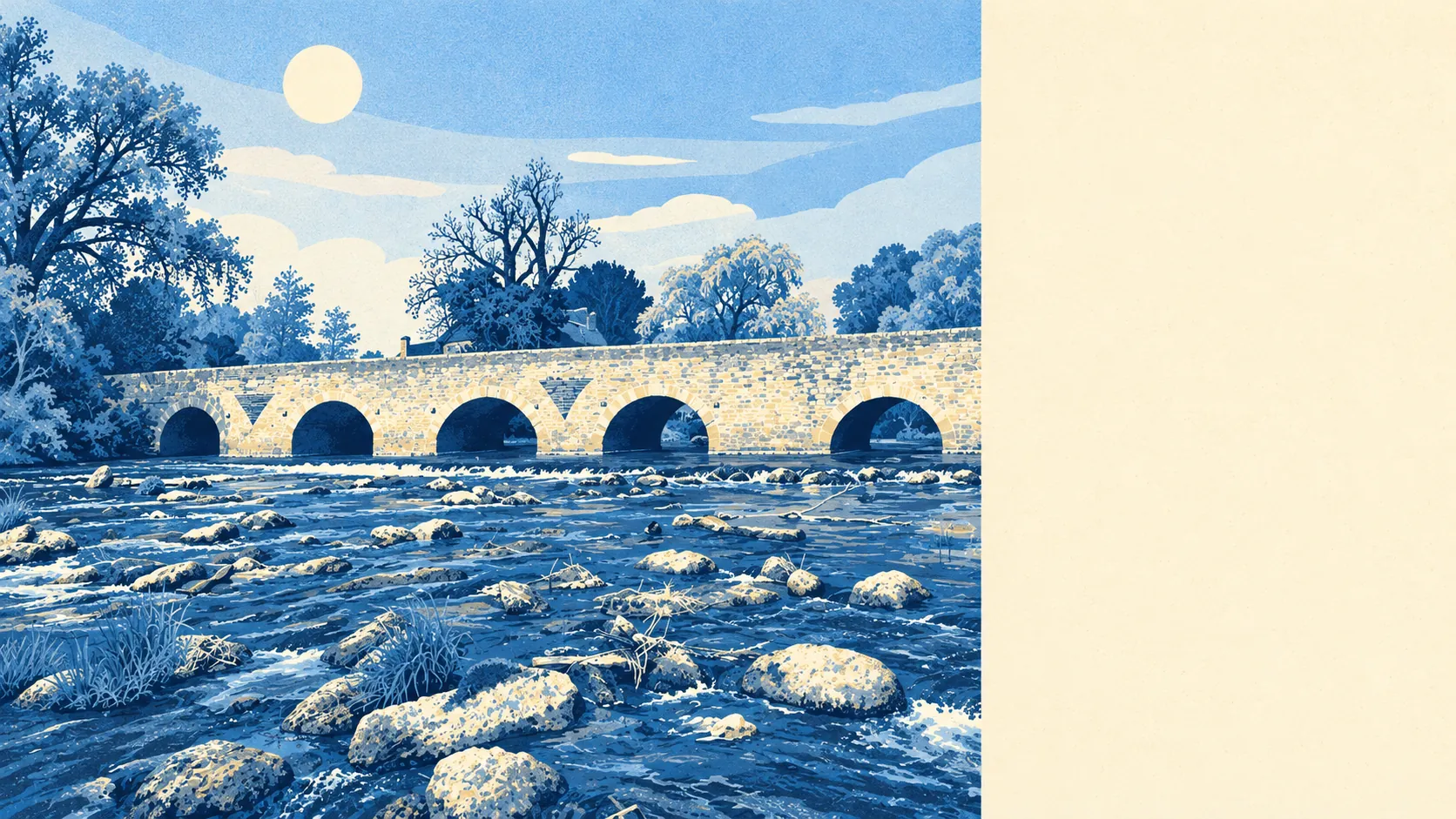
Outdoor space is close to everybody. Green space is about 240 metres from the average front door, and water is about the same distance. Bromham Bridge is a scheduled monument, and a short way upriver Stevington, which this page also covers, is on the River Great Ouse itself. With gardens like these, plenty of residents walk the dog no further than the back lawn.
Heritage rules rarely get in the way. The area has 26 listed buildings: two Grade I, including Bromham Hall, and 24 Grade II. The only conservation area inside the boundary is Biddenham's. With so little of the stock built before the war, most owners can extend, reroof or knock through without asking a planning officer's opinion of their windows.
Getting around depends on the car. The Department for Transport's 2019 modelling puts Bedford town centre about 14 minutes away by car and about 30 by public transport, and the bus figure has probably aged worse than the road one. Bedford and Bedford St Johns stations are the nearest rail, but only about 1% of working residents commuted by train, against 49% who drove and 41% who worked from home. The village has 33 bus stops. Broadband is good: gigabit-capable connections reach about 81% of premises, superfast reaches all of them, and 4G or 5G from every operator covers nearly every postcode. The home office is better connected than the bus stop.
The village has always attracted people with something to show for themselves. Early in the eighteenth century the manor was bought by Sir Thomas Trevor, Attorney General and later Lord Privy Seal, whose mother was a daughter of John Hampden. Three of his sons inherited the title in turn, and the fourth Lord Trevor was made Viscount Hampden. The actor and musician Matt Berry is the more recent name on the notable-residents list. The village has kept its standards up.
Bromham is right for families and established professionals who want a detached house, a garden, a short drive into Bedford and neighbours who plan to stay put. First-time buyers looking for a flat and anyone who needs a train every morning should look elsewhere, because the village has almost none of the first and only a car journey to the second.
Bromham is a very good place to live once you are in, with a close, long-staying community and safe streets. The catch is the entry fee. Buyers with a large budget and no plans to move again should take it, and anyone hoping to buy cheaply will find the cheap houses are rarely for sale.