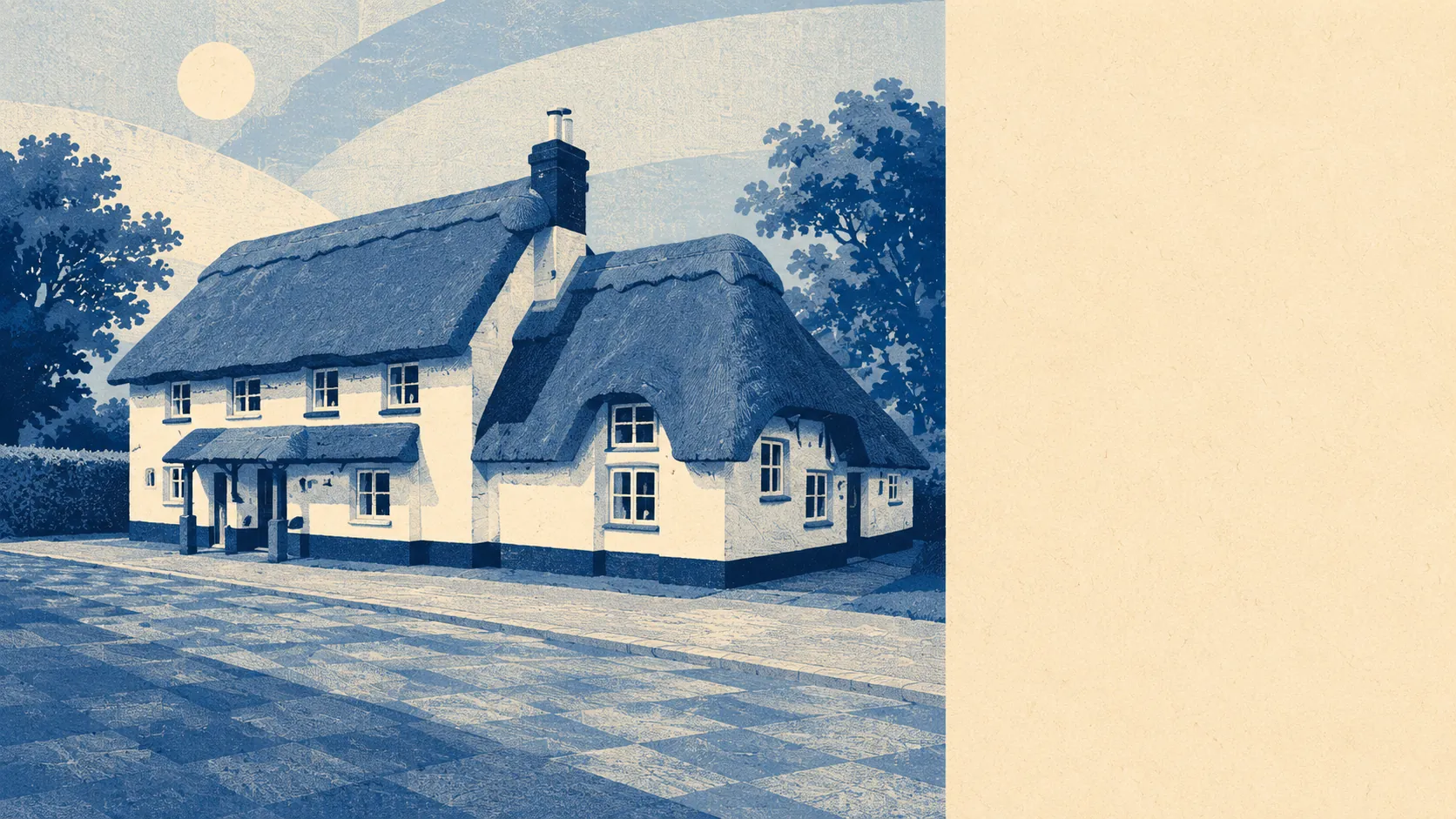
Bransgore is a good place to live and an awkward place to arrive at. Four in five households own the roof over their heads. The typical resident is in their early fifties. Half the working population drives out in the morning, and most of the rest works from the spare room. The crime rate runs well under the New Forest average and the cost of getting through the front door runs well over what anyone expects of a village.
Look at what is actually built here and the rest of the answer explains itself. On the council tax valuation list, which covers every dwelling rather than only the ones certificated in recent years, about 46% of homes are detached and another 21% are bungalows. Semis account for roughly 16%, terraces for 10%, and flats for about 4%. That last figure is the one that shapes everything: there is almost no small, cheap, easy-entry stock to buy your way in with. About 26% of dwellings predate 1930. Energy certificates put around 42% of certificated homes in band D and 23% in band E or worse, with 35% reaching band C or better. Roughly 71% run on mains gas and about 4% on electricity alone, which in a large older house with original windows is less a heating bill than a standing order.
The Land Registry recorded 77 sales in the twelve months to May 2026, at a median of about £462,000. Detached houses made up 44 of those and ran to a median near £572,500. Semis came in around £410,000, terraces around £345,000, and the four flats that changed hands around £321,250. Council tax sits most often in band E, and only about 7% of dwellings fall in bands A or B. The cheap end of Bransgore is mostly a rumour that estate agents pass between themselves.
Renting is a narrow door into the same expensive room. Typical private rent across the New Forest area is about £1,240 a month as of April 2026, which is a district-wide figure rather than the village's own. By size that runs to roughly £860 for one bedroom, £1,130 for two, £1,380 for three, and £1,980 for four or more.
Safety is where the place quietly wins. The published neighbourhood crime figures give the area about 42 recorded crimes per 1,000 residents in the twelve months to May 2026, roughly 27% below the New Forest average of about 57. That is the strongest single thing about living here, and nobody has ever moved to a village because of the recorded crime rate. They move for the quiet and get the low numbers thrown in.
Getting anywhere is the trade. About 49% of working residents drive to work and about 40% work from home, which leaves rail on 0.2% and buses on 0.6%. Around 64% of households run two cars or more, and only about 6% run none. There is no station in the village, and the nearest ones are at Hinton Admiral, Christchurch and New Milton. Department for Transport modelling puts the nearest town centre at about 14 minutes by car and about 46 by public transport, which is the whole argument in two numbers. There are 132 bus stops in the area averaging 11 scheduled weekday departures each, 53 of them carry any weekend service at all, and the average stop sees half a bus in the peak hour. Broadband is the better story: superfast reaches about 91% of premises, gigabit-capable about 63%, and about 2% sit below the universal service obligation minimum. Every postcode has mobile coverage from at least one operator, and 99% have it from all of them.
The surroundings are the reason people put up with the commute. Green space averages about 560 metres from a front door with roughly four sites within a kilometre, and water is closer still at about 390 metres, with 16 within a kilometre. The New Forest Site of Special Scientific Interest clips the edge of the area, covering about 0.7% of it, and ancient woodland another 0.4%. On flooding, two different measures apply and they answer different questions. Counted by postcode across all indicators including surface water, about 10% carry a high rating, 12% medium and 25% low. Counted by the Environment Agency's river-and-sea flood zones, about 1% of the area sits in zone 3 and 2% in zone 2, rising to about 5% under the climate-change allowance. No historic flood extents are recorded here. That did not stop a housing scheme near Derrit Lane being approved in 2023 on ground objectors were fairly clear about.
Heritage constraint is real and unevenly spread. The area holds 240 listed buildings, three of them grade one and six grade two star, along with seven conservation areas taking in Burley, Sopley, Winkton, Burton, Verno Lane, Old Milton Green and Ringwood, plus 17 scheduled monuments, most of them bowl barrows sitting quietly in the heath. Barrows make excellent neighbours and inflexible planning constraints. If your house is listed or your street is in a conservation area, windows, extensions and solar panels stop being shopping decisions and start being applications.
The people match the housing. Around 81% own their homes, the median age is 53, and modelled household income before tax averaged about £65,500 in the financial year to March 2023. Roughly 39% hold a degree, about 15% of households are a pensioner living alone, and about 19% are couples with children. It is a settled place with money in it and a slow turnover of front doors.
It suits a family or a couple who want space, a garden and low background noise, who already own something to sell, and who accept that two cars is the entry requirement rather than a lifestyle choice. It suits people who intend to stay a long time, because the housing here rewards patience over trading up.
It does not suit a first-time buyer hoping the flats will save them, because there are barely any. It does not suit anyone who commutes by train and expects to walk to one, or who wants a modern low-bill house without the energy-certificate lottery of older stock.
Bransgore is above average as a place to live and it is honest about how it gets there. Its real strength is safety, with a recorded crime rate meaningfully below the New Forest average and a settled, owner-occupied population behind it. The weak spot is price and value, where a market of large detached houses, almost no flats and a council tax band E middle makes the entry cost high and the choices few. Buy here for the life, not the bargain. The bargain left before the bypass.