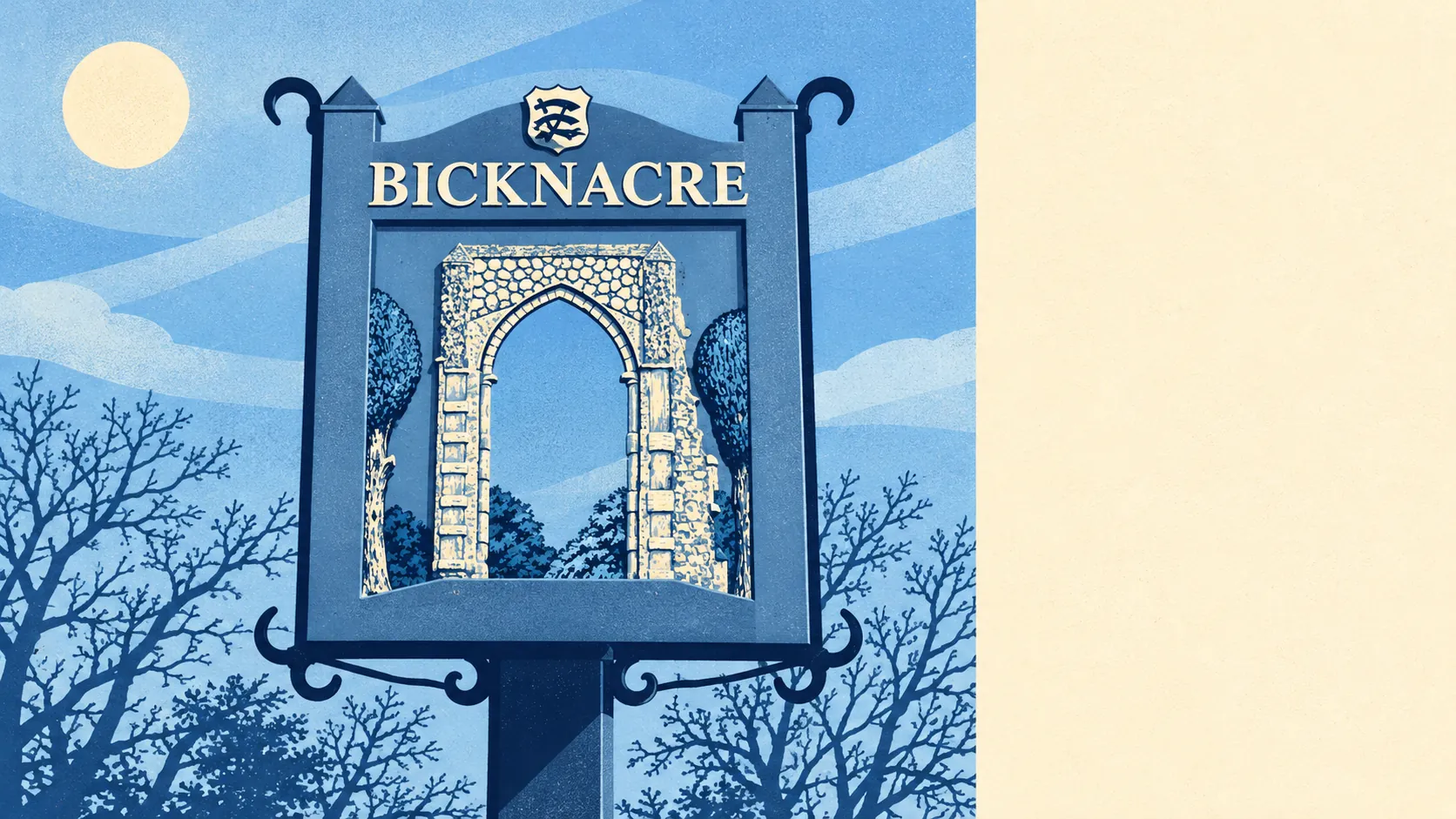
Bicknacre is a middling place to live that looks like open country from the car window and turns out to be mostly fenced. The average home is about half a kilometre from the nearest public green space. None of the farmland around it has any protected landscape status. Most of the green a buyer sees belongs to a farmer or the people next door. What the village does have is a very low crime rate and plenty of detached houses with prices to match.
On average there are about three public green spaces within a kilometre of a front door, and water is closer still, at roughly 270 metres. The nearest stretch of the national cycle network is about 4.4 kilometres away. There is no Area of Outstanding Natural Beauty, no Site of Special Scientific Interest and no ancient woodland in the area. Most of the outdoor space is private: across the three neighbourhood areas there are about 295,000 square metres of garden for every 1,000 residents, so a lot of people have their own patch. The public land is a short list. There are Priory Fields around the old Priory Arch, looked after by a volunteer group, and St Giles Churchyard on Moor Hall Lane, which Essex Wildlife Trust marks as a nature reserve. The village's official wildlife haven is a graveyard.
Safety is where Bicknacre does well. The published police.uk rate for the area is about 38 crimes per 1,000 residents in the year to May 2026, roughly 55% below the Chelmsford average of about 84. Across the whole wider area that comes to 210 recorded crimes in twelve months, a total small enough that a handful of incidents can move the mix from one year to the next.
The Land Registry recorded 63 sales in the year to May 2026, at a typical price of about £495,000. Detached houses made up the biggest group, 35 sales at a typical £595,000. Semis went for about £453,000 and terraced houses for about £440,000. Only three flats sold all year, at around £375,000 each, so anyone hoping to start small here will be waiting a while. Band E is the most common council tax band, and only about 30% of homes are in bands A or B.
Renting is a sideline. The Office for National Statistics puts typical private rent across the Chelmsford area at about £1,440 a month as of April 2026, up about 7% on a year earlier. That figure is for the whole borough. The village has no rent figure of its own.
On the council tax list, about 42% of homes are detached, 12% are bungalows, 11% semis, 10% terraces and 13% flats. Only about 12% were built before 1930. Most of the village came in two waves: an estate of executive homes on farmland to the north in 1969, then the Thriftwood Estate on the south side in the 1980s. In 2001 Chelmsford's council refused a plan for thousands more homes on farmland. So the village that turned down a new town is largely made of the estates it said yes to earlier. Energy certificates put about 43% of rated homes in bands A to C and about 24% in E or worse. Only about half the homes are on mains gas, and around 6% rely on electric heating alone.
Flood risk depends on which map you read. On the Environment Agency's river-and-sea flood zones, less than 1% of the area falls in the highest zone. On the wider postcode indicators, which include surface water, about 20% of postcodes are rated high on at least one measure, another 20% medium and about 42% low. The only recorded flood event is from February 1947, when a main river burst its banks. The river map hardly notices Bicknacre. The surface-water map notices quite a lot of it.
The car does most of the work. About 52% of working residents drive to work, about 38% work from home, and fewer than 2% take the train. South Woodham Ferrers and Chelmsford are the nearest stations. The Department for Transport's 2019 modelling put the town centre 16 minutes away by car and about 28 by public transport, and the bus figure is the one more likely to have aged since. There are 78 bus stops, averaging about 110 departures each on a weekday, and nearly all of them have a weekend service. Gigabit broadband reaches about 53% of premises and superfast about 90%. At least one operator has 4G or 5G across the whole area. When the village festival wanted a celebrity in 2006, it got Perry McCarthy, The Stig from Top Gear, which fits a place where half the workforce commutes by car.
About 83% of households across the Bicknacre area own their homes. The median age is 49. Office for National Statistics modelling puts gross household income at about £70,600 in the financial year to March 2023. This is a place for people who have already bought, and who plan to stay put.
The wider area has 74 listed buildings: one at Grade I, six at Grade II* and 67 at Grade II. There is one conservation area, East Hanningfield The Tye, so most homes in Bicknacre itself can be extended under the ordinary rules, while anything listed or near the green at East Hanningfield needs a proper application. The one scheduled monument is Bicknacre Priory. That means the only structure nobody is allowed to extend is the one without a roof.
Priory Primary School is in the village, and East Hanningfield Church of England Primary Academy serves the neighbouring part of the area. Across the 10 primary schools in the surrounding postcode districts, the average maths score at the end of primary school is about 105. On the Department for Transport's 2019 modelling, a primary school is about an 11-minute walk away, and a secondary is 16 minutes by car or 25 by public transport. Ofsted's numbers here cover all of Essex: 218 of 246 graded settings are good or better, and 22 are outstanding. Those figures describe a county, even though they get quoted about one village.
Bicknacre works for a family that wants a detached house, a garden and a low crime record, and doesn't mind driving everywhere. It works less well for a first-time buyer looking at the three flats that sell each year, for anyone without a car, and for anyone who pictured walking out of the door straight into protected countryside.
The fields around Bicknacre are for looking at. The green space you can actually use is mostly your own garden or a short drive away. Bicknacre is a perfectly decent place to live, and the low crime rate is what most buyers are really paying for.