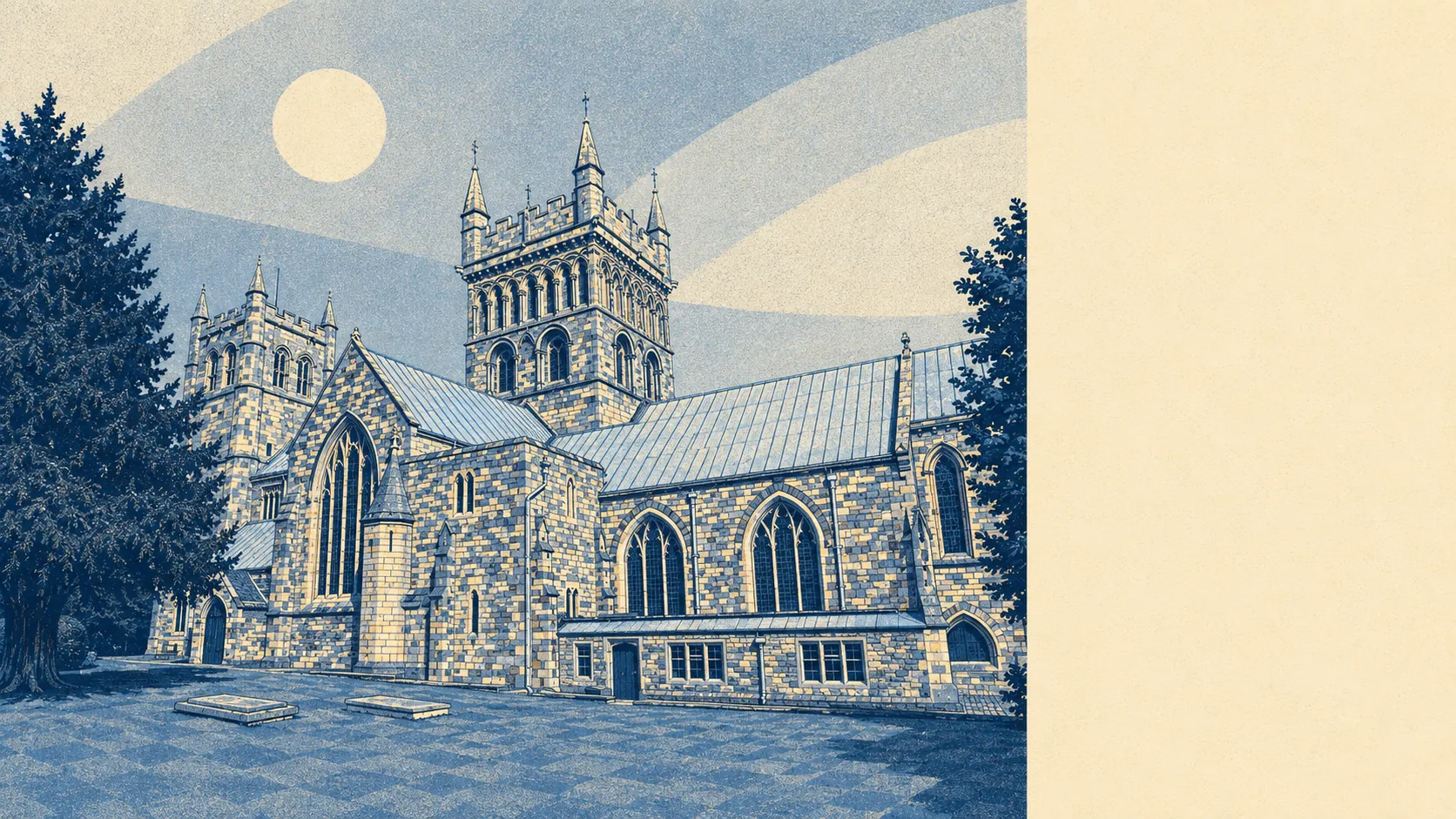
The surroundings are the strongest argument this town makes. Open ground a few hundred metres from the average front door. Water closer than that, and a great deal of it. Cycle routes on the doorstep for most of the place. This is working countryside rather than protected scenery, which turns out to be the more useful kind to live in.
Public green space sits about 270 metres from the typical address, with around 11 separate sites within a kilometre. That is not one big park doing all the work but a scatter of them, which matters because it means the walk to grass is short from almost anywhere rather than short from the expensive streets.
Water is the defining feature. Blue space averages about 340 metres from the typical address, and there are around 36 separate water features within a kilometre. That is an unusual density for an inland town, and it is the direct consequence of sitting where the Stour meets the Allen. Two rivers do not tiptoe through a place. They shape the footpaths, the bridges, the meadows and, on the wrong week in winter, the conversation.
Getting into it is easy. The National Cycle Network runs about 410 metres from the average postcode, and roughly 69% of postcodes sit close to a route. For a town where most people drive to work, the leisure infrastructure is considerably better than the commuting infrastructure.
The high street, counted as premises rather than as atmosphere, comes to 221 shops, 35 pubs and 12 restaurants. Thirty-five pubs against twelve restaurants is a fairly clear statement of how the town spends an evening, and it does not involve tasting menus.
On air, fine-particle pollution across the Dorset council area averaged about 5.5 micrograms per cubic metre in 2024, which is a council-wide figure rather than a street-level one.
The character comes from what surrounds the town rather than the town itself. Pamphill and Canford Magna sit in their own conservation areas, Kingston Lacy House and Dean's Court anchor the estate landscape, and Julian's Bridge and Walford Bridge carry the roads over the rivers much as they have for centuries. Then there are the villages, which include Colehill, Corfe Mullen, Merley, Furzehill and Cowgrove, alongside God's Blessing Green, Happy Bottom and Pig Oak. Somebody named those places while entirely sober and the county has simply lived with it since.
Private outdoor space is the part nobody publishes and everyone wants to know. Gardens here run to roughly 179,000 square metres for every thousand residents, which is the measure that actually tells you whether homes have their own outdoor room rather than a shared view of somebody else's. In Wimborne they generally do, and that is the quiet reason families stop looking once they have viewed a few.
On the commercial side, the valuation list records 637 rateable premises coded for the town, and across the wider area the records count around 400 office premises, 221 shops and 36 holiday lets. Those are premises on a list rather than businesses currently trading, so treat them as the shape of the built stock rather than a directory of what is open on a Tuesday.
Eating out is safer here than the average. Of 117 rated food premises, about 91% hold the top hygiene score, and none sit at the bottom of the scale. That is a good record for a town with this many places serving food.
One honest absence is worth stating: no area of outstanding natural beauty overlaps here, no site of special scientific interest, and no ancient woodland. The landscape around Wimborne is farmed, grazed, walked and lived in rather than designated and admired from a layby. That is a description, not a criticism, and for most buyers it is the point.
The setting is where Wimborne genuinely excels: rivers on two sides, green space minutes from almost every door, cycle routes running out into open country, and gardens big enough to matter. Everything else about the town is a negotiation. This part is not.