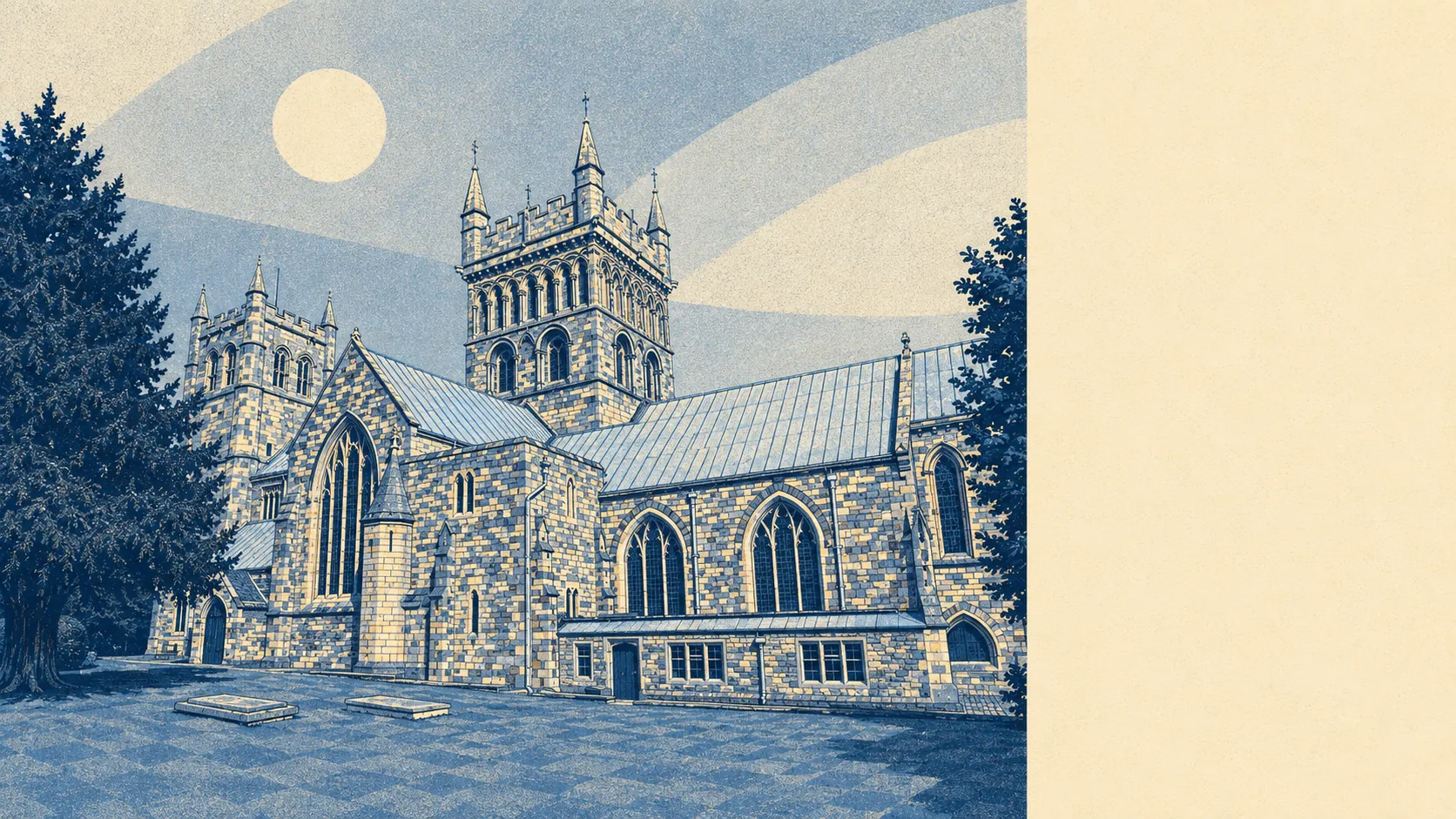
Yes, provided you have made peace with the fact that nothing much is going to happen to you here. The minster has been standing since long before anyone thought to build a bypass around it. Most people own their homes outright. The typical resident is closer to fifty than thirty. Wimborne is not a town on the way up or the way down, and that steadiness is either exactly what you want or the thing that will drive you out within two winters.
The housing is unusually flat in character, in the literal sense that a lot of it is single storey. Roughly a quarter of dwellings on the council-tax valuation list are bungalows, another quarter are detached, and semis and terraces take about a sixth each. Flats make up around a fifth. Only about 16% of the stock predates 1930, which will surprise anyone who has walked past the minster and assumed the whole town was carved out of the same era. Most of what people actually live in went up after the war. On energy certificates the mix lands mid-table: about 57% sit in bands A to C, a third are band D, and roughly one in ten are band E or worse. Around 78% run on mains gas, and about 9% are on electric-only heating, which in a post-war bungalow with modest insulation is the kind of thing worth establishing before the viewing rather than after the first quarterly bill.
On price, the Land Registry's last twelve months put the typical sale at £380,000 across 231 transactions, with the split by type doing most of the explaining. Detached houses ran to a median of about £518,000. Semis came in around £379,000, terraces around £320,000, and flats around £195,000. That is a wide spread for one market town, and it means the headline figure describes almost nobody. On council tax, band D is the most common band, and only about 19% of dwellings sit in bands A or B, so the cheap end of the tax scale is thin here. Band D in this area is charged at roughly £2,765 a year.
Renting is a different market again. Across the Dorset area, typical private rent is about £1,040 a month, up around 4% over the year. That is the wider local-authority figure rather than Wimborne's own, and in a town this desirable it is likely to sit at the friendlier end of what you will actually be asked for.
Safety is the number that spoils the postcard. Recorded crime runs at about 64 offences per thousand residents over the year to May 2026, which sits roughly 16% above the Dorset average. The mix is the interesting part: anti-social behaviour makes up about 27% of recorded incidents against roughly 16% nationally, and shoplifting about 11% against 8%. That is a town-centre profile rather than a residential one. A market town with a busy retail core and a night-time economy generates exactly this shape of statistic, and the people it happens to are mostly shopkeepers rather than householders. Dorset Police charge in about 14% of cases against a national rate of 12%, which is at least a force that follows through.
Getting anywhere is a car job, and the town has known this since 1977 when the last goods train left the station that had already stopped taking passengers in 1964. About 54% of residents drive to work and only 0.2% take a train, which is what happens when the Beeching Axe removes your railway and nobody puts it back. Buses do the work instead: 99 stops in the area, 58 of them with published service data averaging around 37 weekday departures, and about 95% carry a weekend service. Journey-time modelling puts the town centre about 10 minutes away by car and 18 by public transport. Broadband is the quiet triumph. About 81% of premises can get gigabit connections, about 98% can get superfast, and no premises fall below the universal service obligation. Around 33% of residents work from home, and the infrastructure supports it.
Water is a real consideration at the confluence of two rivers. The Environment Agency's mapping puts about 11% of the area in the river-and-sea flood zone 3 and roughly 17% in zone 2, rising to about 34% under the climate-change allowance. On the broader postcode indicators, which include surface water, around 7% of postcodes carry a high rating on at least one measure and about 17% a medium one. Four flood events are on record, the most recent in December 1989 when channel capacity was exceeded. The compensation for living near that much water is the green: open space averages about 270 metres from the front door, with around 11 sites within a kilometre, and water within about 340 metres. Roughly 69% of postcodes sit close to a National Cycle Network route. On ground conditions, the whole area falls into shrink-swell hazard class 3, and about 60% carries a soluble-rock rating at class 3 or above, both of which a surveyor will want to look at properly.
The heritage is the constraint nobody mentions until the quote arrives. There are 198 listed buildings in the area, three of them Grade I and ten Grade II star, plus five conservation areas including Wimborne Minster itself, Rowlands Hill-St John's Hill and Burts Hill-Merrifield. Nine scheduled monuments sit in the wider area. If your house falls inside one of those boundaries, the windows you fancy replacing become a planning conversation rather than a weekend, and the difference in cost between what you wanted and what you are allowed is real.
The character of the place follows from who lives here. About 71% own their homes, the typical resident is 49, and household income runs to roughly £58,500 gross before tax. About 31% of households are one person living alone, and around 18% are pensioners on their own. This is a town of settled people who have finished moving, which produces a particular kind of quiet and a particular kind of Tuesday.
It suits anyone who wants a proper town centre they can walk into, green space in every direction, and a house with a garden they will not have to fight for. It suits people working from home who need the connection more than the commute. Families do well: Ofsted has graded 86 settings across Dorset, 68 of them good or better, two outstanding.
It does not suit anyone who needs a station. It does not suit anyone under thirty-five hoping for a scene, because Wimborne's idea of a night out finishes at a reasonable hour and the town has no intention of changing that for you.
The names attached to the place tell you something about its range. Isaac Gulliver, the smuggler, and Montague Druitt, a Jack the Ripper suspect, sit alongside Robert Fripp of King Crimson and Eddie Howe, the football manager. Farrow and Ball started in the town and is still headquartered nearby in Ferndown, which explains the front doors on half the streets in the conservation area.
Wimborne Minster is a good place to live, and its real strength is what surrounds it: green space in walking distance from almost every address, water everywhere, cycle routes on the doorstep. The weak spot is safety, and specifically a town-centre crime profile that runs above the Dorset average without much of it landing on residential streets. Buy here for the setting and the settled quiet. Do not buy here expecting the town to entertain you, because it stopped trying to do that around the time the last train left.