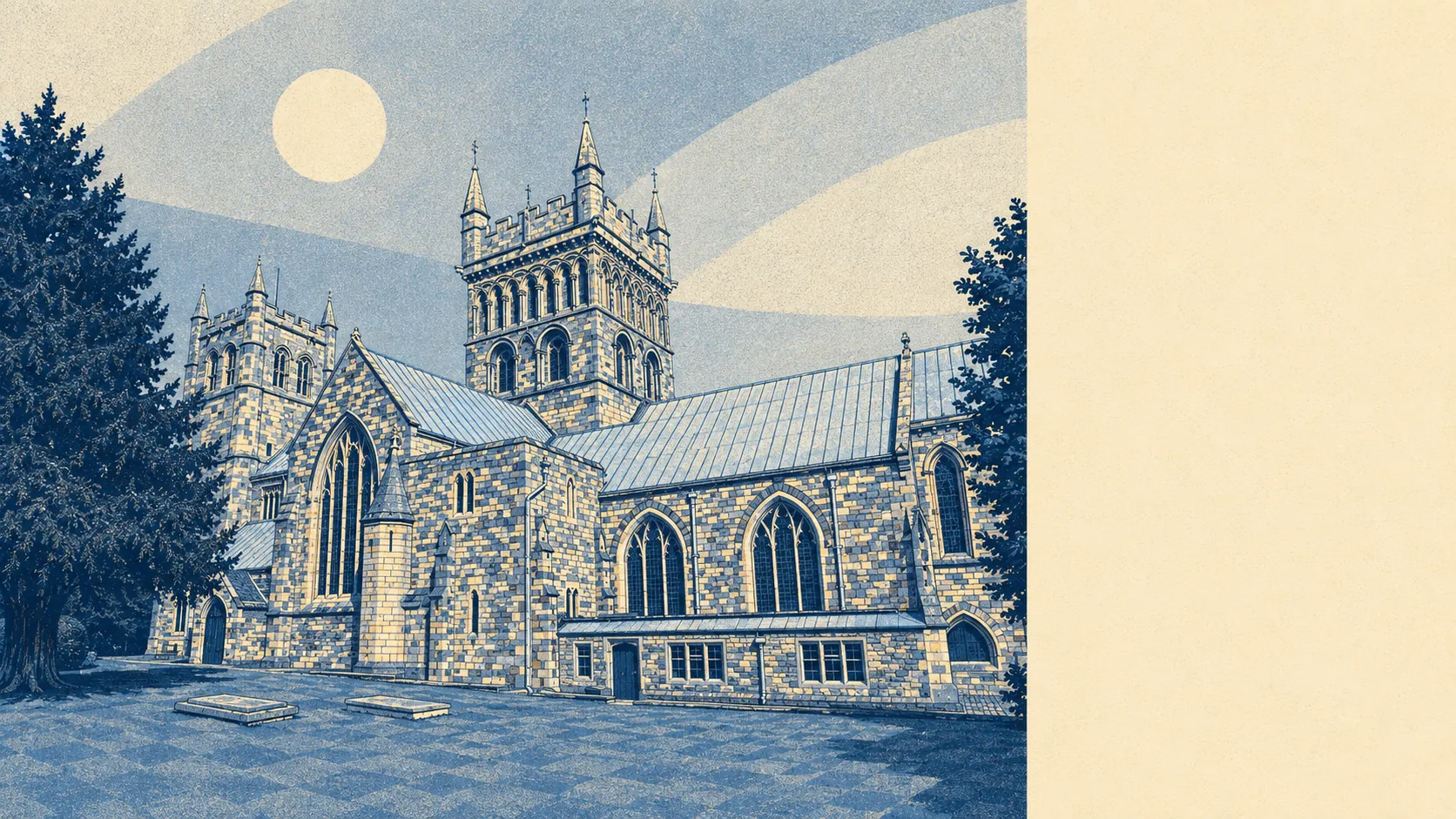
Usually yes, but this is a town where the answer depends entirely on which side of a line your front door sits. Nearly two hundred listed buildings. Five conservation areas. Nine scheduled monuments in the surrounding countryside. Hundreds of planning applications going in every year, so plenty of people clearly manage it. Wimborne carries more protected fabric than a town this size has any business carrying, and the first job is finding out whether any of it is yours.
The national heritage list records 198 listed buildings across the area: three at Grade I, ten at Grade II star, and 185 at Grade II. Listing is not a plaque, it is a legal status, and it attaches to the whole building rather than the pretty bit at the front. Alterations affecting the character of a listed building need consent in their own right, interiors included, and that covers work most owners assume is theirs to do: windows, internal walls, roof coverings, chimneys. The council takes no interest in the fact that a previous owner replaced the windows without asking. It takes a great deal of interest in the fact that you own them now.
Five conservation areas sit within the area, including the one covering the town's own historic core. Conservation area status works differently from listing. The building itself may be entirely unremarkable, but the controls apply to what the street looks like, which means demolition, tree work and some external alterations come under tighter scrutiny, and permitted development rights can be restricted rather than assumed. What is waved through on a post-war estate a mile away can require a full application inside the boundary.
Nine scheduled monuments lie in the wider area, mostly burial mounds and lengths of Roman road. That is the strictest protection tier in the system and it matters mainly if your land sits on or beside one, in which case the conversation stops being about design and starts being about archaeology.
None of this has stopped anyone. Planning records show 1,703 applications across the area between April 2024 and July 2026, with 690 of those in the most recent twelve months. That is a town constantly rebuilding its own kitchens. The system here is busy rather than closed, and the people who get through it are the ones who established the constraints before paying an architect rather than after.
The ground has its own view. The British Geological Survey puts the whole of this area at shrink-swell hazard class three, meaning clay-rich ground that expands and contracts with moisture across the seasons. For an extension that translates into foundation depth, care about mature trees near the footprint, and a structural engineer worth the fee. It is a design cost rather than a reason not to build, but discovering it at quotation stage is considerably better than discovering it at excavation stage.
Practically, most homes in Wimborne sit outside all of this and the usual permitted development allowances apply in the usual way. The trap is assuming that because the house next door managed a rear extension without a full application, yours can too. Listing, conservation area boundaries and any local restriction on permitted rights are address-specific, and the council's own mapping will tell you which apply to your particular address in about five minutes. Do that before the first drawing, not after the third.
Freedom to alter a home is the tightest thing about living here. The heritage that makes Wimborne worth buying into is the same heritage that will sit across the table when you want a bigger kitchen, and outside the protected streets that trade barely registers, while inside them it defines the whole project.