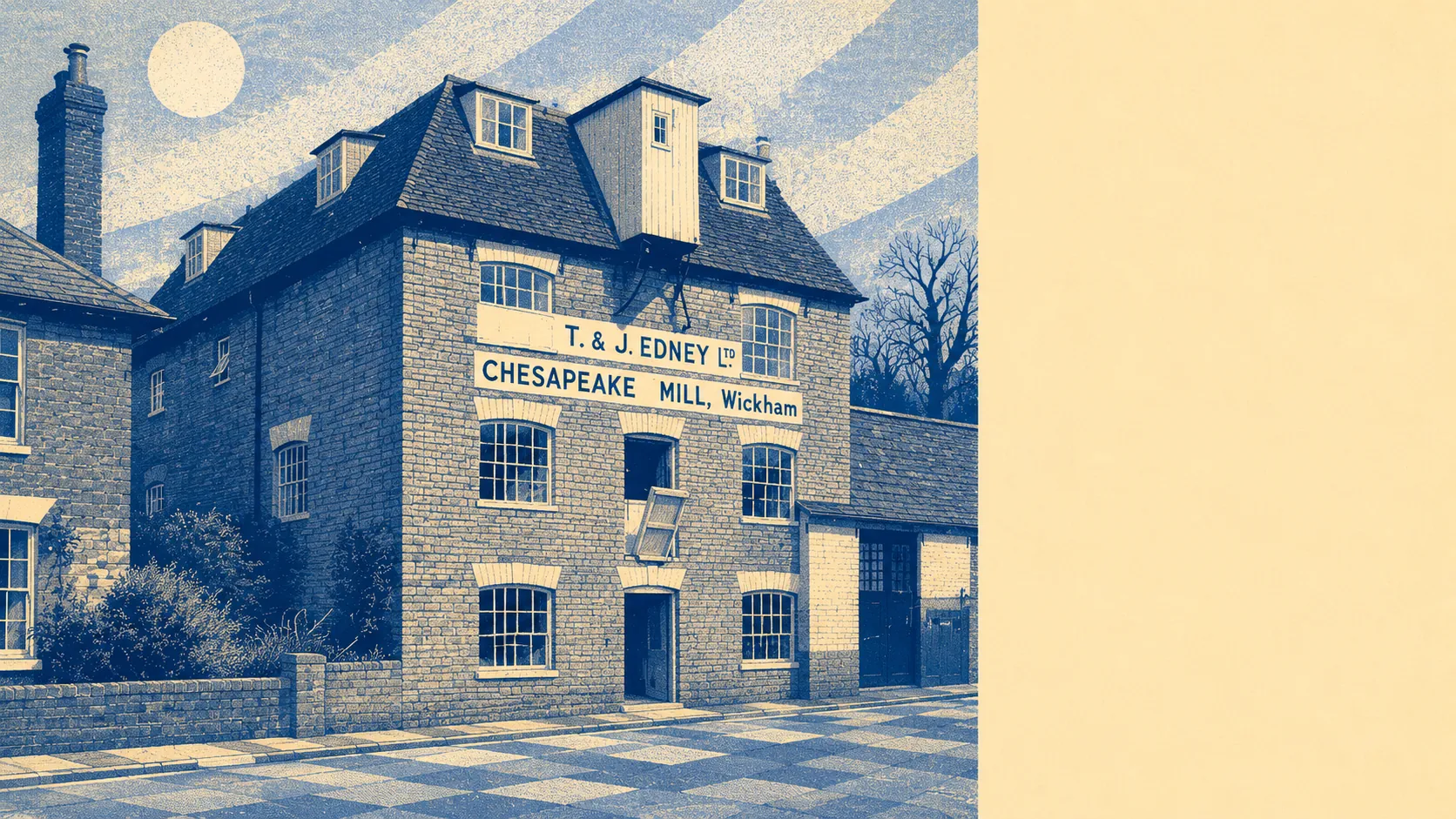
Wickham is a good place to live if you buy the right half of it. The old village is a proper Georgian set piece, with a market square, a watermill built from the timbers of a captured American warship, and a horse fair that traces back to a medieval charter. Green space sits almost on the doorstep. The snag is a boundary that wanders south and scoops up a wedge of Waterlooville, which is why the published safety numbers read harsher than the village itself has earned. Buy the conservation core and it is one thing. Buy the ragged edge and it is quietly another.
Start with what you would actually be buying. Around two thirds of the homes are houses, with roughly a quarter flats and a small tail of bungalows, and the dominant era is post-war rather than the chocolate-box Georgian the square advertises. Older stock survives, but only about one home in six predates the 1930s, so the listed cottages are the exception you pay a premium for, not the rule. On energy, the stock behaves well for its age. About two thirds of homes sit in the top efficiency bands of A to C, roughly one in five lands at band D, and the genuinely cold and expensive-to-run properties, band E and worse, make up under one in six. For a rural area with heritage constraints, that is a better spread than the timbered high street would lead you to expect.
Money is where the village sorts its buyers. The typical sale over the last year came in at about £360,000, which is the figure that lures people who think a Hampshire village should cost more. It splits hard by type. A detached house runs to roughly £520,000, a semi to about £355,000, a terrace to around £320,000, and a flat to about £230,000, so the headline hides four quite different markets stacked under one postcode. Council tax leans mid-range, with band C the most common and roughly a quarter of homes falling in the two lowest bands. Nobody here is getting the sub-band-A bargain, and nobody is getting stung with a mansion bill either.
Renting is thinner on local detail, so the honest figure is the wider one. Typical private rent across the Winchester area sits at about £1,500 a month. Treat that as the district benchmark rather than a Wickham-specific quote, because a conservation-area cottage and a new-build on the fringe will not politely average out to the same number.
Safety is the dimension that drags the whole picture down, and it needs reading carefully. The published crime rate runs at roughly 84 incidents per thousand residents a year, about a third above the Winchester average. Before that scares anyone off the square, remember where the boundary reaches. The rate is a published figure for the whole ward, and the ward includes suburban streets doing the heavy lifting on the numbers. The Georgian core is not generating that. The map is.
Schools are solid without shouting about it. The local primary picture is faintly above the national bar, with a Key Stage 2 maths score just over the expected standard of 100, and secondary results come in with an Attainment 8 score of about 45, which is broadly middling. None of the schools in the area carry a current published Ofsted grade, so this is results-on-paper rather than an inspector's verdict. Wickham Church of England Primary School anchors the village end, and older children feed toward Swanmore College up the valley. If schooling is the deciding factor, the numbers are reassuring rather than remarkable.
Getting out is a car job and always has been. The old branch line through the village closed to passengers in 1955 and is now a footpath, which is charming on a Sunday and useless on a Monday. Almost nobody commutes by train, about half drive to work, and a third work from home, which tells you how the place actually functions. The nearest proper station is at Fareham, and the town centre is about 14 minutes away by car against 26 by public transport, a gap that explains the driveways. Broadband softens the isolation. Superfast coverage reaches roughly eight in ten homes and gigabit connections about four in ten, with next to nothing stuck below the basic universal standard.
On the environment, the village earns its keep. Green space is genuinely close, a couple of minutes' walk on average, with something like nine separate patches within a kilometre of a typical home. Flood risk is the caveat: about one in ten postcodes carry a high surface-water risk, though the slice actually inside the most serious river-flood zone stays small. The River Meon gave the village its old tanning and brewing trades and occasionally reminds people it is still there.
Heritage is a double-edged thing here. There are 206 listed buildings, five of them at the top Grade I level, six conservation areas in the wider frame, and a scatter of scheduled monuments. That is what keeps the square looking like the square. It is also what turns a new window, a side extension, or a solar panel into a paperwork saga. Buy into the protected core and you are buying the rules along with the view.
The people who live here own their homes at a fair clip, with just over half owner-occupied, a typical age of about 39, and a household income around £70,000. That is comfortable-commuter territory rather than either struggling or gilded, which fits the village's whole even-handed personality.
It suits a buyer who wants a market square, a churchyard with actual history in it, and a walk to open fields, and who has made peace with driving to a train. It suits families chasing steady schools over showy ones.
It does not suit anyone who needs to step off a platform onto a commuter service, or who wants a listed cottage they can gut on a whim. And it does not suit the buyer who wants Bishop's Waltham polish at Bishop's Waltham prices, spots Wickham's softer median, and moves in without checking which street they are on, then discovers the ward statistics were quietly borrowed from Waterlooville all along.
The village has form for interesting occupants. Sir Richard Grindall, who commanded HMS Prince at the Battle of Trafalgar, lies in the churchyard. Amelia King, refused a place in the Women's Land Army and then finally allowed in, worked at Frith Farm here into the 1940s. Mary Donaldson, later the first woman to serve as Lord Mayor of London, came from the village too. It is a small place with a habit of producing people who went on to sit at bigger tables.
The verdict lands at average overall, and the average is doing a lot of quiet work. The surroundings and green space are the standout, close to the top of the scale, and the safety figure is the anchor pulling the other way, worse on paper than the village core deserves. Buy the conservation streets and you get a calmer, cheaper cousin of the polished Hampshire villages up the road. Buy on the Waterlooville edge because the price looked kind, and you have bought the postcode's problems with the Wickham address printed on top.