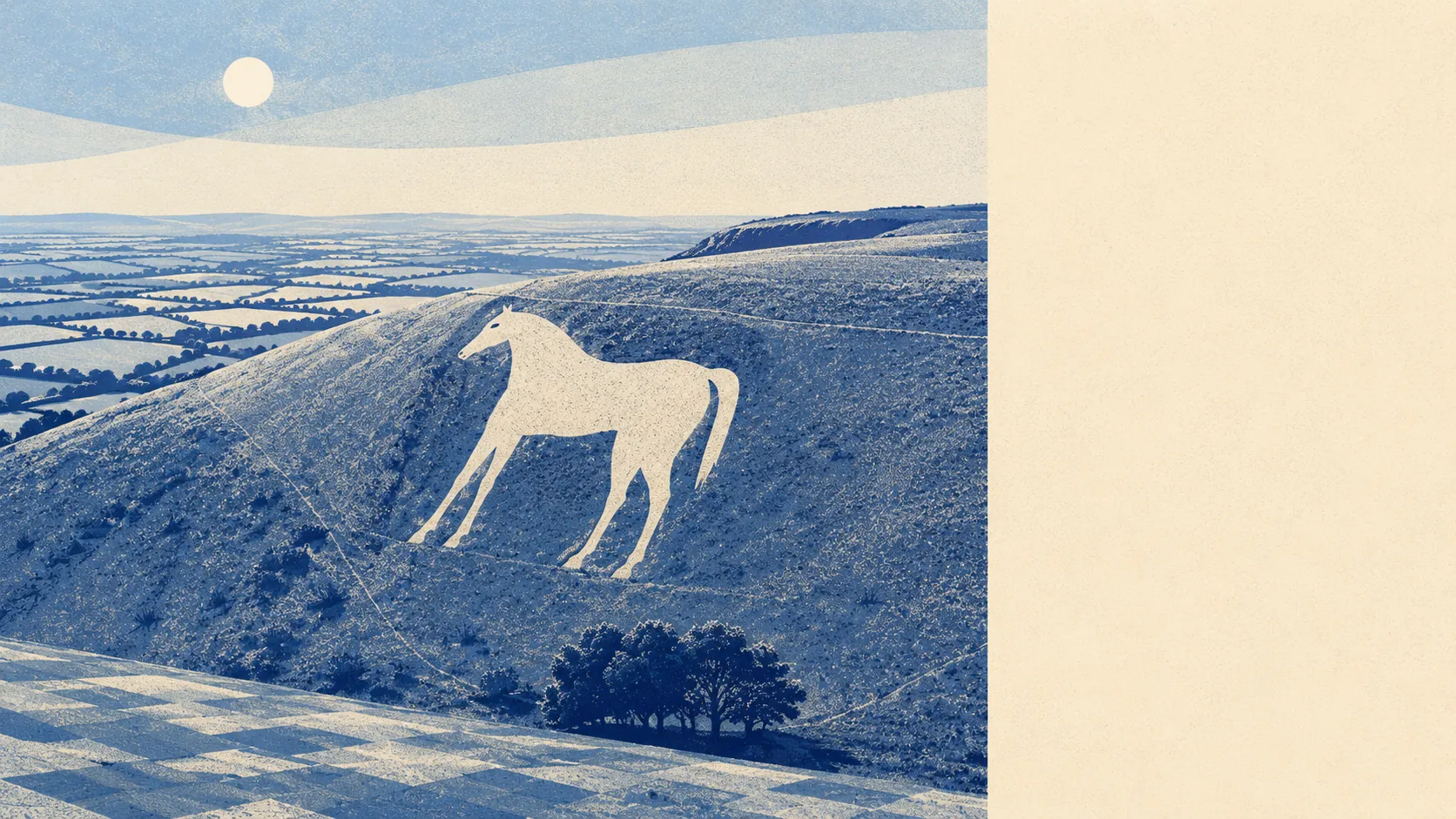
Yes, if you want a proper town rather than a pretty one. The White Horse on the hill has been the main tourist attraction since the eighteenth century and nothing has knocked it off top spot. Two-thirds of people own their homes. Trains go almost everywhere from a station most passengers just change at. Westbury is a place that works, which turns out to be a different thing from a place that photographs.
The housing is mostly houses, which sounds obvious until you compare it with anywhere within an hour of Bath. The council tax valuation list, which covers every dwelling in the town rather than only the ones sold recently, puts semi-detached at 27% of the stock, terraced at 26%, detached at 21%, bungalows at 14% and flats at 11%. Around 16% of it predates 1930, which means the Victorian-and-earlier stock is the minority here, not the default: the bulk went up in the last seventy years, with a substantial run built between 2000 and 2008. Energy certificates back that up. Around 63% of certificated property sits in bands A to C, 28% in band D, and only 9% at band E or worse. Roughly 73% is on mains gas, with about 11% running on electricity alone. That last group is worth identifying before you offer rather than after, because electric-only heating in an older property is the difference between a manageable winter and an expensive one.
The Land Registry's last twelve months put the typical sale at £260,000 across 243 transactions, which is a decent depth of market for a town this size. Split it by type and the picture opens up: detached at £348,000, semi-detached at £265,000, terraced at £227,000, flats at £123,000. That flat figure is the one that makes people from Bath read the sentence twice. Council tax lands mostly in the lower bands, with band B the most common and about 43% of dwellings in bands A or B combined. Westbury is not a town where the tax bill catches you out.
Renting is measured across the wider Wiltshire authority rather than the town itself, and the typical private rent there runs to about £1,060 a month. Treat that as the area figure it is, not as a Westbury number.
The recorded crime rate is about 62 offences per thousand residents in the year to May 2026, which sits within a point of the Wiltshire average. That is a published rate on its own population base, not something worked out from the town's headcount. What it means in practice is that Westbury is neither the quiet exception nor the local problem. It is ordinary, and ordinary is what most people are actually asking for when they ask whether somewhere is safe.
Connectivity is where Westbury quietly outperforms places that cost half as much again. Westbury railway station sits northwest of the town centre on the junction where the Reading to Taunton line crosses the Wessex Main Line, which is why so much of the West Country's timetable passes through. Dilton Marsh station serves the southwest of the town as a request stop. Warminster and Trowbridge stations are both nearby. Around 96 bus stops sit within the town's bounds, with roughly 43 scheduled weekday departures per stop and 85% of them carrying a weekend service. Only about 2% of residents commute by train and 1% by bus, though, because 57% drive and 26% work from home. Broadband is the standout: gigabit-capable service reaches about 88% of premises, superfast reaches 98%, and nothing sits below the universal service obligation. At least one operator gives four or five G coverage across the whole town.
The environment is the best thing about living here and the flooding is the worst. Green space averages around 166 metres from the typical postcode, with roughly 26 sites within a kilometre, and water is closer still at about 252 metres. That is a genuinely unusual amount of accessible outdoors for a town rather than a village. Against that, about 14% of postcodes carry a high rating on at least one flood indicator, including surface water, and 21% a medium one. The Environment Agency's river-and-sea flood zones are much narrower, covering under 2% of the area, rising to about 8% once climate projections are applied. The two measures answer different questions and both matter: the zones tell you about the Biss and its brook, the postcode indicators tell you about where the water goes when the drains give up. Ground conditions add one more thing to know, with shrink-swell clay rated at the moderate class across around 83% of the area, which is a Kimmeridge Clay fact rather than a Westbury one.
Heritage is present without being oppressive. There are 169 listed buildings in the area, one of them Grade I and seven Grade II star, plus one conservation area covering the historic centre and four scheduled monuments in the surrounding landscape. All Saints' Church, the town hall on the Market Place, Bank House, Edgar House and the Phipps mausoleum in the cemetery are all on the list. If you buy inside the conservation area or one of the listed buildings, window replacements and external alterations go through consent. Buy anywhere else, and the paperwork is the same as anywhere else.
Around 68% of homes are owner-occupied and the typical resident is 41. Household income in the area ran to roughly £58,600 gross for the financial year to March 2023. Chapmanslade, out towards the Somerset border with its hamlets at Short Street and Thoulstone, is covered on this page too, and reads as the village version of the same proposition.
Westbury suits people who want a house with a garden, a station that goes places, and change from what a two-bed flat costs closer to Bath. It suits anyone whose work moved home permanently and who no longer needs to live near an office. It suits people who would rather have a Tesco Express at Leigh Park than a farmers market with a waiting list.
It does not suit anyone who needs a town centre that entertains them. The market stopped in the middle of the nineteenth century and the shopping parade is a 1960s pair of yellow brick ranges facing each other. Nor does it suit anyone unwilling to check a flood map before offering, because the answer varies street by street here in a way it does not in most places.
The town has form for producing people who left. Joshua Marshman went to India and helped translate the Bible into Chinese. John Cogswell sailed from Westbury Leigh to North America and became a politician there. Abraham Laverton bought the last two working cloth mills, ran them until the industry gave out, and paid for the west window of the church. The Phipps family became the largest landowners in the parish and then built themselves a mausoleum with a spire on it, which is one way to make sure nobody forgets.
Westbury is a good place to live, and its real strength is the ground it sits on: green space and water within a few minutes of most front doors, with Salisbury Plain and the White Horse doing the scenery for free. The weak spot is flood risk, which is not town-wide but is real enough that the map is a conveyancing question rather than a curiosity. Get the address right and the rest of it holds up better than the price suggests.