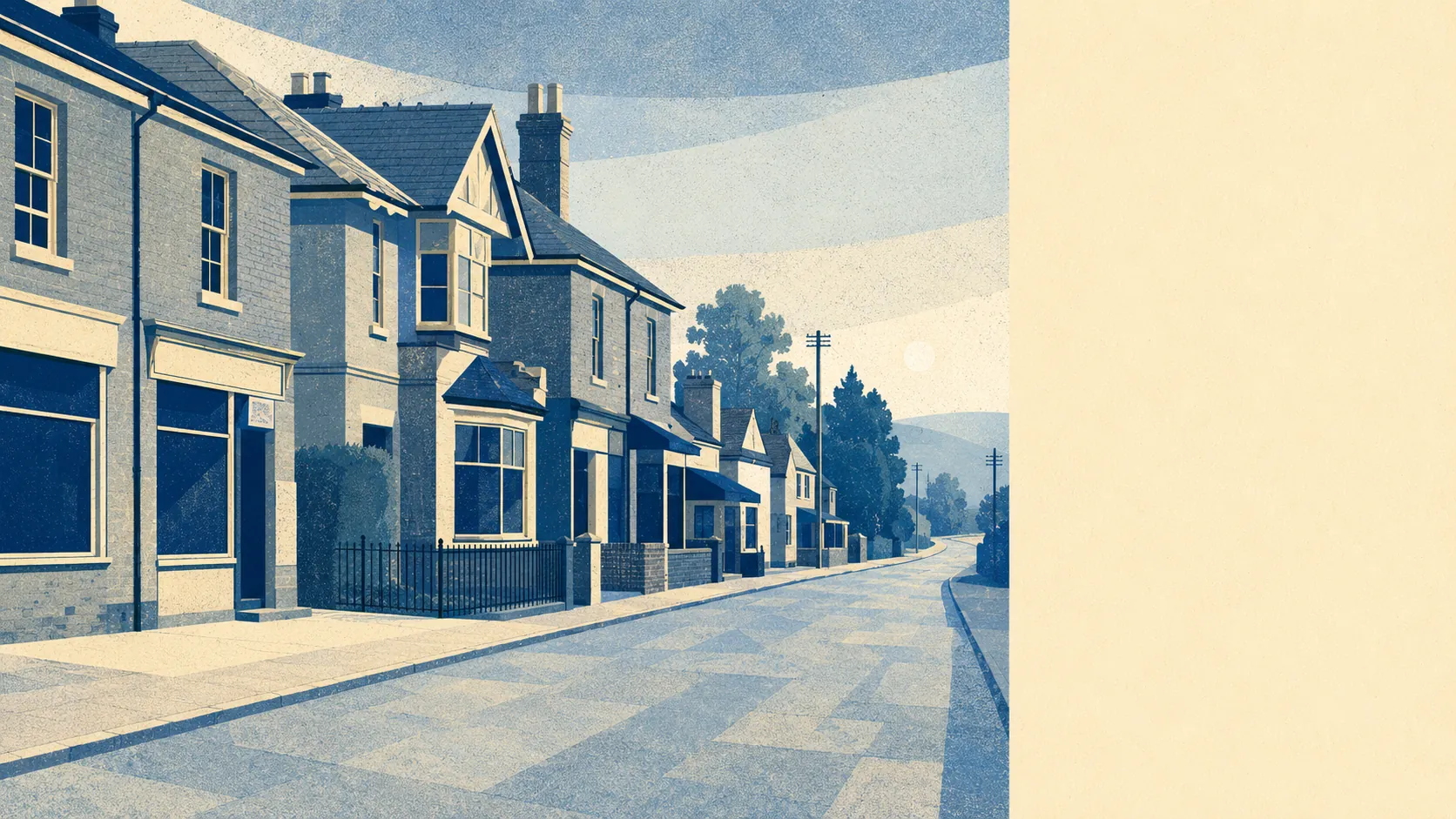
West End is a good place to live if your idea of a good life runs on trees, off-street parking and never quite having to admit you live next to Southampton. Roughly three in four homes are owned rather than rented. The typical resident is closer to fifty than forty. Woodland begins at the end of most streets, and the countryside people pay to escape into on weekends is already the view from the kitchen window. This is comfortable, low-drama Hampshire that has decided it is a village and dares you to disagree.
The housing is mostly houses, which sounds obvious until you have spent time in places where it is not. Around three in five properties are houses, roughly one in five is a flat, and about one in seven is a bungalow, the last of which tells you something honest about who moves here and why. Most of it went up in the late twentieth century, so the walls are not Victorian and neither are the heating bills. More than half the stock sits in the upper energy-rating bands, the single biggest group is one rung below that, and fewer than one in ten homes lands in the poor bands where winter becomes a line item. Nobody restores a period cottage here. They buy something built after the moon landings and get on with their lives.
A home here runs to about £323,000 as a typical sale over the past year, spread across not many transactions, so the market is steady rather than frantic. The gap between property types is the real story. A detached house sits around £472,500, a semi around £325,000, a terrace around £262,500, and a flat around £163,500, which is the clearest possible map of how far your money stretches depending on how much wall you are willing to share. Council tax mostly lands in band C, with about a quarter of homes down in the two cheapest bands, so the monthly bills match the sensible-suburb pitch.
Renting rather than buying puts you at about £1,210 a month, which is the typical private rent across the wider Eastleigh area rather than West End's own street-level figure. Treat it as the neighbourhood you are shopping in, not a quote for a specific door. It buys the same thing the sale prices do: space, quiet, and a garden you are expected to actually maintain.
On crime, the published rate is about 74 recorded offences per thousand people, which runs a little over one tenth above the Eastleigh average. That sounds worse than it feels on the ground, and the honest reading is that West End is a low-crime suburb sitting fractionally above a low-crime borough, not a place with a problem. The number is a comparison to its neighbours, not a warning.
Here is where the village fantasy meets the timetable. West End has no railway station of its own, and next to nobody here commutes by train, which are two facts that reinforce each other. The nearest lines run from Hedge End, Southampton Airport Parkway and Southampton Central, all of which involve getting in the car first. And get in the car most people do: about half the working population drives to work, while a third now work from home and have quietly stopped caring about any of this. Broadband is the saving grace, with gigabit speeds reaching roughly nine in ten homes and superfast coverage close to universal, so the third that never leave the house are at least doing it at speed.
Flooding is a minor footnote rather than a headline. Around nine in a hundred postcodes carry a higher surface-water risk and only about one in a hundred falls inside the Environment Agency's top river-flood zone, which for a place this green is a decent result. Green space is the whole point of the address: it is typically a couple of minutes' walk away, with something close to twenty separate green spaces within a kilometre of the average front door. Telegraph Woods and Itchen Valley Country Park are not amenities you drive to. They are the reason the estate agent used the word countryside.
Heritage will not cramp your style unless you go looking for it. There are eight listed buildings, all of them in the lowest listing grade, and two conservation areas: Gaters Mill and Romill Close, and Orchards Way. Three scheduled monuments sit in the wider area for the history buffs. For the overwhelming majority of homes this means you can change your windows, extend the back, and repaint the front without a heritage officer developing an opinion. If you buy inside one of the conservation areas, assume the opposite and budget for the paperwork.
The character follows from the ownership. With about three quarters of homes owner-occupied and a median age in the late forties, this is a settled, stay-put sort of place where people mow verges and know which bins go out when. Household income sits around £57,000, and a shade under a third of adults hold a degree, which is the demographic shorthand for comfortable-professional rather than flashy. It is prosperous in the way that does not announce itself, which is the way West End likes everything.
It suits families who want a modern-ish house, a real garden and a school run measured in minutes, and who consider a woodland walk a genuine weekend event rather than a chore. It suits downsizers, which is what all those bungalows are quietly telling you. It suits anyone whose work has gone remote and who wants the countryside without the isolation.
It does not suit anyone who lives by the train. If your life depends on stepping onto a platform and being in London or the office within the hour, West End will make you buy a car and resent it. It does not suit people who want a high street with a pulse, night life, or the feeling that something might happen. Nothing much happens here, and that is the entire selling point.
The place has one properly fitting famous son. Richard St. Barbe Baker, the forester and environmental activist who spent his life planting trees, was born in West End, which is either a lovely coincidence or proof that the woodland gets to you early. The rest of the history is quietly practical: the village grew up along the old turnpike between Romsey and Portsmouth, its Telegraph Woods are named after a Napoleonic-era signal station that once relayed messages toward Plymouth, and the workhouse that opened in the mid nineteenth century eventually became Moorgreen Hospital. A place that started as somewhere you passed through on the way to somewhere else has spent two centuries persuading people to stop.
The verdict comes out above average, and it earns it honestly. The strongest thing about West End is the thing money cannot fake: a settled, well-off, low-churn community that genuinely functions as a place rather than a postcode. The weakest thing is getting anywhere by public transport, which is a polite way of saying you will drive. If you can accept a life organised around the car and the calendar of a village that likes its evenings quiet, West End rewards you with green, space and neighbours who stay. If you cannot, the train that West End does not have will always be the one you wish it did.