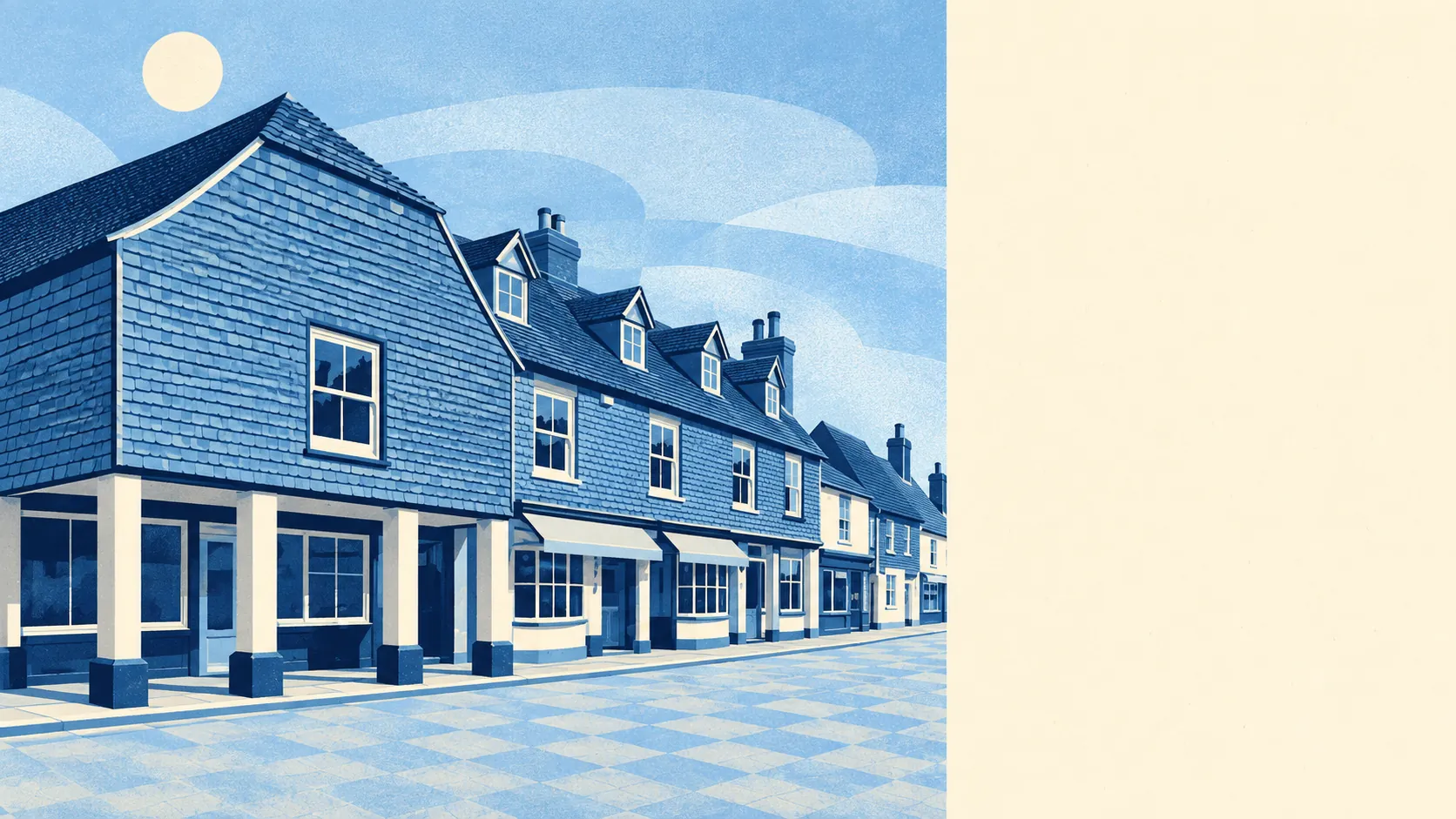
The countryside around Wadhurst is the reason anyone pays Wadhurst prices. Green space is a short walk from most front doors. Water is closer still. The gardens are big enough to lose a dog in. The town is the bit in the middle that gives you somewhere to park.
Green space is close and plentiful. The average home in Wadhurst sits about 430 metres from the nearest green space, with about six green spaces within a kilometre. That is a short stroll rather than an expedition, and in a town on a ridge of the Weald the stroll usually comes with a view.
Water is closer than the grass. The average home is about 290 metres from the nearest blue space, with about 14 within a kilometre: ponds, streams and the headwaters of the River Bewl and the Limden, which rise within the parish. Bewl Water, the reservoir, is nearby, which gives the area a large body of water that nobody had to pay a seaside premium for.
Cyclists get less. The nearest point on the National Cycle Network averages about 6.8 kilometres away, and none of the town's postcodes sit close to it. The lanes are there. The signed route isn't. No ancient woodland falls within the town's own boundary either, though the wider Weald around it is wooded ridge country.
The high street is small, practical and heavy on offices. The rating list records 52 shops, 8 pubs and 5 restaurants, alongside 70 offices and 22 holiday lets, across 128 rateable premises in all. These are premises on the valuation list rather than a count of businesses trading today, but the shape is clear: enough pubs for a town twice the size, and not enough restaurants to avoid seeing the neighbours on a Friday.
The air is clean. Fine-particle pollution across the Wealden council area averaged about 6.4 micrograms per cubic metre in 2024, a figure for the whole district rather than for Wadhurst's streets.
The whole town sits inside the High Weald Area of Outstanding Natural Beauty. Nothing in Wadhurst overlaps a site of special scientific interest, and no ancient woodland falls within the town's own boundary. The designation that matters here is the one that covers everything, and it is the one that keeps the fields around the town looking like fields.
The character comes from the hamlets and the history as much as the town. Sparrow's Green, Turner's Green and Best Beech Hill grew into Wadhurst when the railway arrived, and Tidebrook sits out in the parish beyond. The Weald's iron industry left its marks in the wider area, from the Riverhall blast furnace to the remains of a Romano-British ironworks north of Bardown Oast Farm, and the ruins of the Premonstratensian Abbey at Bayham sit within reach. Wadhurst Castle has a registered park and garden. For a town that looks sleepy from the high street, the surrounding country has done a lot of industry over the centuries, most of it now covered in sheep.
Private gardens are generous. Across the town there is about 577,000 square metres of garden for every 1,000 residents. Most homes here come with outdoor space measured in lawnmower hours rather than square feet.
Food standards are sound. Of 25 food outlets with a hygiene rating, 60% hold the top score of five, and none sit in the lowest bands.
The surrounding area is Wadhurst's real strength: protected countryside on every side, water and green space a few minutes' walk away, and gardens that make the price per square metre look slightly less unreasonable.