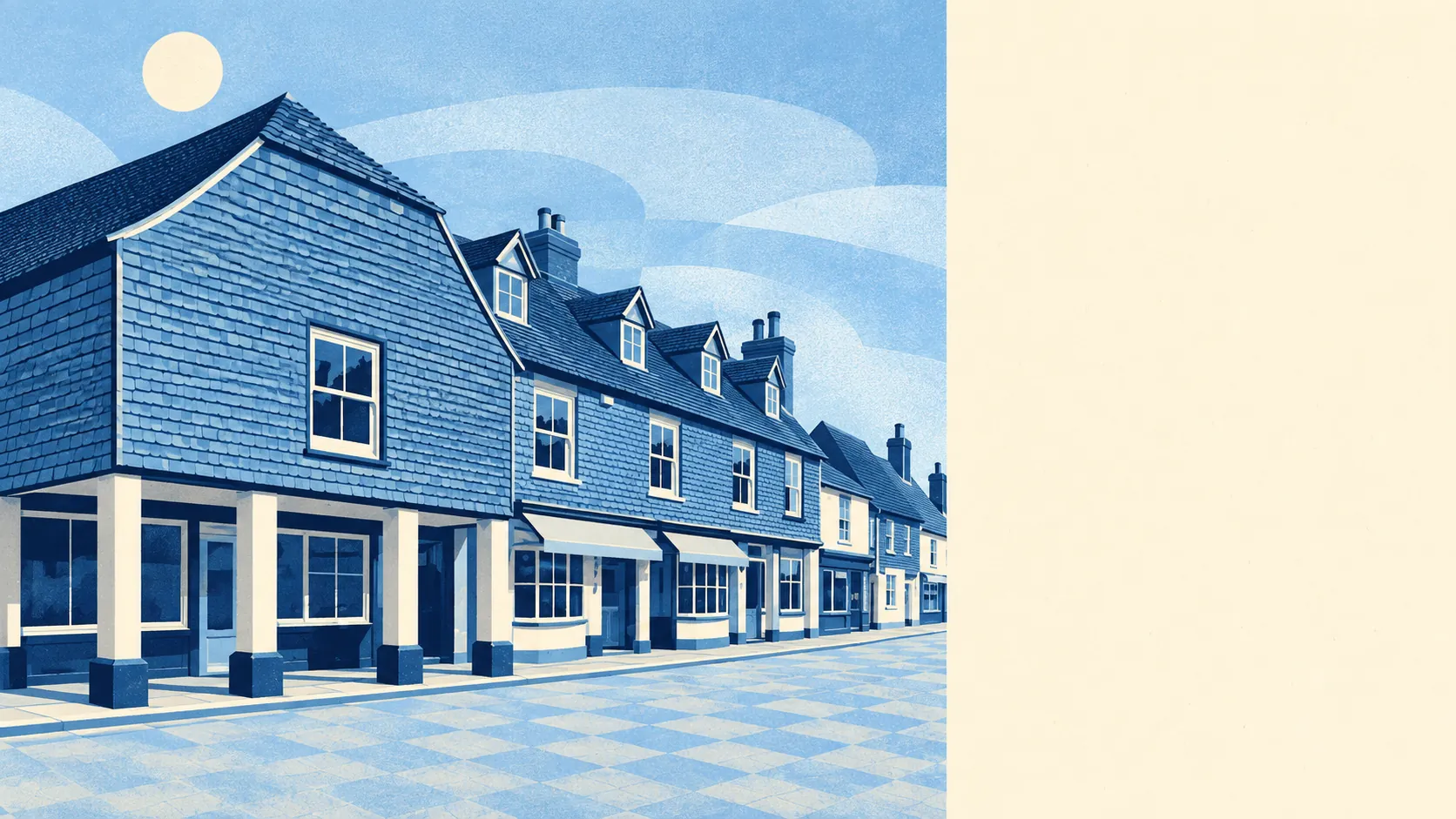
Wadhurst is a good place to live for people who rarely need to leave it. Half the working residents work from home. Crime runs well below the rest of Wealden. The whole town sits inside the High Weald. The trouble only starts when you need to get somewhere, or buy your way in.
The housing is mostly detached, with period stock the energy assessors struggle to love. The council-tax valuation list puts about 36% of homes as detached, 23% semi-detached, 15% terraced, 12% flats and 8% bungalows, and about 44% were built before 1930. On energy performance certificates, about 44% rate A to C, 40% sit at D and 16% are E or worse. About 64% of homes are on mains gas and about 6% rely on electric-only heating, so the old farmhouse on the edge of town deserves a question about its boiler before anyone mentions its beams. Every listing will call the draughts "character".
Prices assume you already won the game somewhere else. The Land Registry recorded 43 sales in the twelve months to May 2026, with a typical price of about £535,000. Detached houses went for around £1,100,000 across 11 sales, semi-detached for about £605,000 across 15, terraces for about £430,000 across 9 and flats for about £321,000 across 8. The most common council-tax band is G, and only about 9% of homes sit in bands A or B. That is a town where the cheap end of the tax list is a rounding error.
Renting doesn't offer a cheap way in. The typical private rent across the Wealden area was about £1,260 a month as of April 2026. That is the district figure, not Wadhurst's own, and an area dominated by four-bedroom detached houses is unlikely to be the part of Wealden that drags the average down.
Safety is the strongest argument for the place. Police figures for the year to May 2026 put Wadhurst at about 40 crimes per 1,000 residents, roughly 28% below the Wealden average. Anti-social behaviour makes up about 27% of recorded incidents, against about 16% nationally. The totals are small enough that a few incidents shift those shares by several points, so the mix says more about a quiet town's thin case count than about any settled problem. The main hazard on a Saturday night is probably a reversing Range Rover.
Schooling is decent, and the wider area does well on inspections. The town's state primary is Wadhurst CofE Primary School and Nursery in Sparrow's Green, and the state secondary is Uplands Academy. The one primary in the district with published results averaged 104 in the end-of-primary maths tests, and the one secondary averaged 42.5 on the Attainment 8 measure at sixteen. Across East Sussex, Ofsted has graded 54 of 67 settings good or better, with 7 outstanding. Sacred Heart School is the independent Catholic prep option, and Stonegate Church of England Primary School sits out towards Stonegate. Parents here pick schools the way they pick houses: by how far the drive is.
Transport is where the town stops trying. Wadhurst Rail Station sits north of the town on the line to London, with Stonegate and Frant stations nearby, yet only about 3% of working residents take the train to work. About 38% drive and 51% work from home. Seventeen bus stops cover the area, averaging about 20 weekday services each and roughly one bus an hour at peak. Broadband is better than the buses: about 99% of premises can get superfast and 76% can get gigabit, and mobile coverage from all operators reaches about 97% of the area. The Department for Transport's 2019 modelling puts the nearest hospital about 26 minutes away by car. A home office is standard kit here, and the railway is for Christmas shopping.
The surroundings are the other big draw. Every postcode in the town sits inside the High Weald Area of Outstanding Natural Beauty, the average home is about 430 metres from green space and about 290 metres from water, and Bewl Water is close by. On flooding, none of the town falls within the Environment Agency's river-and-sea flood zones. Measured by postcode, about 13% show a high reading on at least one flood indicator, which includes surface water running off a ridge-top town after heavy rain. Radon sits in the lowest band. Anyone buying at the bottom of a slope should check the exact address, and everyone else can enjoy the view.
Heritage rules will slow down any ambitious extension. There are 86 listed buildings, one Grade I, one Grade II* and 84 Grade II, including the Parish Church of St Peter and St Paul, and two conservation areas, Wadhurst and Pell Green. Inside those boundaries, new windows and roof changes need permission, and owners of listed buildings have to deal with the planning office for almost any alteration. Henry III gave the town a Saturday market in 1253. The planning office has been almost as protective of it ever since.
This is a settled, comfortable, owner-occupied town. About 77% of households own their home and the typical resident is 51. The Office for National Statistics' modelled gross household income for the area was about £65,000 in the financial year to March 2023. Nobody moves here on a first salary.
Wadhurst suits a household with equity from a bigger city, a job that lives on a laptop and children at an age where a good primary a walk away matters more than nightlife. It suits people who want a High Street, a church and a hill to walk up, and who plan to stay long enough for the stamp duty to feel like a distant memory.
It won't suit anyone who needs a daily train, a cheap first flat or a late-night bus home. If you want to extend a listed house in a conservation area, bring patience and an architect who enjoys correspondence.
The town has a habit of attracting people who could live anywhere. Jeff Beck lived here for decades until his death, the architect William Bidlake moved here in 1924 and practised until his death, and the exiled writer Irfan Orga lived at Spike Island in the 1960s. Davina McCall lived at Faircrouch House until 2019. Rock guitarists and television presenters looking for peace and quiet tend to find it in the same places. Wadhurst has spent the best part of half a century being one of them.
Wadhurst is an above-average place to live that charges well above average for the privilege. Its real strength is the surrounding countryside: the High Weald on every doorstep, water and green space a short walk away, and a crime rate most of Sussex would envy. The weak spot is value, with a £535,000 typical sale price, band G as the norm and very little at the bottom of the ladder. Buy here for the hills and the quiet, and budget for the train as a hobby.