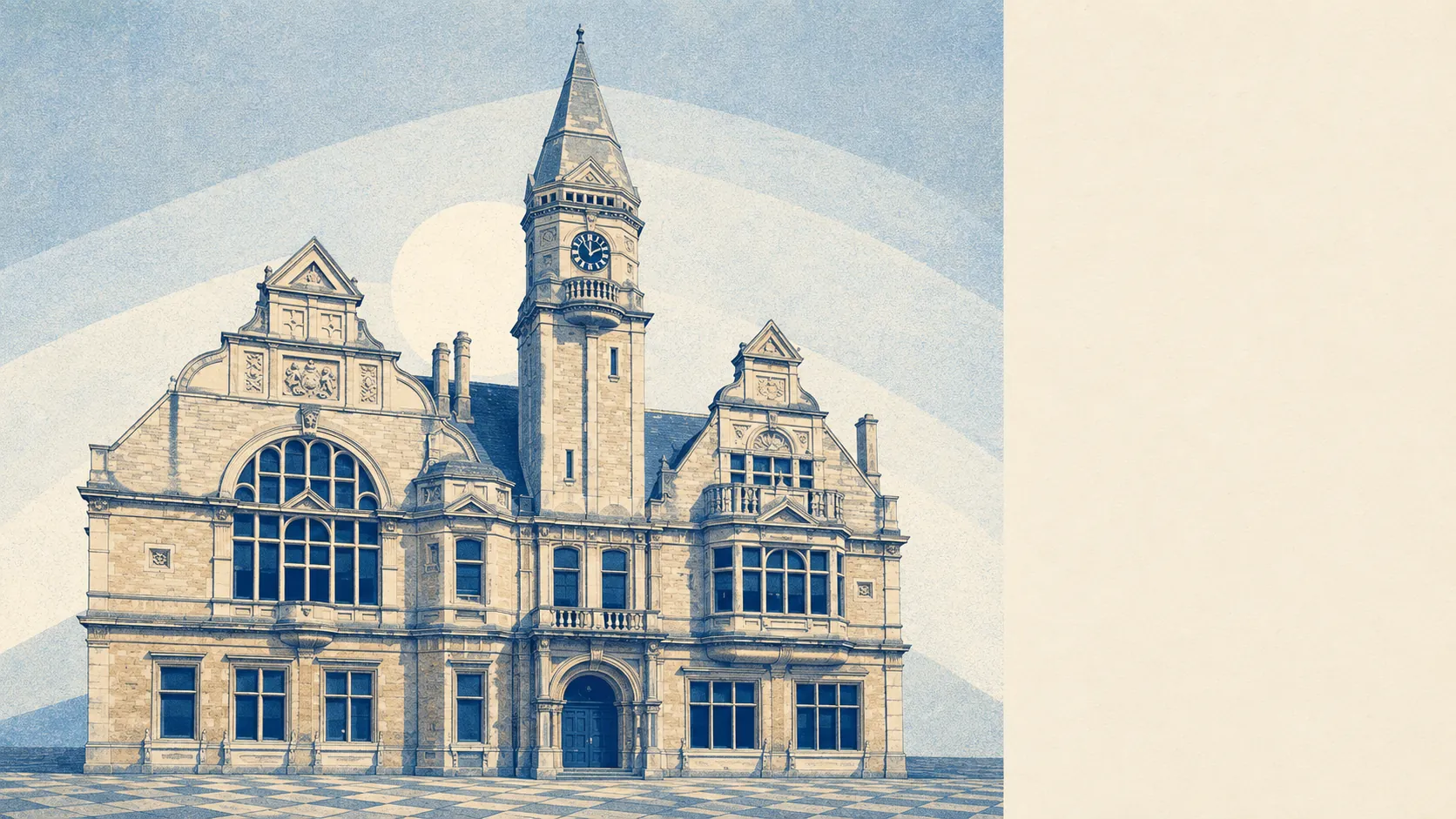
Trowbridge is where you buy a whole house instead of an idea. Two thirds of homes are owned outright or on a mortgage. The typical sale is a long way under what Bath charges for a flat. Nearly every street is inside a few minutes' walk of somewhere green. That is the trade in one line, and the town has stopped apologising for it.
The housing stock is almost boringly reasonable, which turns out to be a feature. On the council tax valuation list, terraced houses run to roughly 27% of dwellings, semis to 25%, detached to 24%, flats to 16% and bungalows to 8%, which means the market here is not dominated by any one shape of home. Only about 16% of dwellings predate 1930, so the postcard-Georgian version of west Wiltshire is a small minority of what you will actually be shown. Around 78% of homes run on mains gas, with roughly 9% on electricity alone, and that second figure is the one to check before the viewing rather than after: electric-only heating in an older, poorly insulated house is a running cost that no amount of period charm negotiates away.
On price, the Land Registry's last twelve months put the typical Trowbridge sale at about £275,000 across roughly 514 transactions, which is a genuinely deep market rather than a handful of sales moving an average around. Split by type, flats sit at around £138,000, terraces at roughly £235,000, semis at about £285,000 and detached houses at around £373,000. The council tax picture matches: the most common band is B, and roughly 42% of dwellings sit in band A or B, which is a town of ordinary homes rather than an enclave pretending it is Bradford-on-Avon. A band D bill runs to about £2,570 a year.
Renting is dearer than the buying figures might lead you to expect. Typical private rent across the Wiltshire area is about £1,060 a month, up roughly 7% over the year to April 2026. That is an area-wide figure covering everything from Salisbury villages to the county town itself, so treat it as the shape of the market rather than the price of the specific flat you are looking at. By size, the Wiltshire typicals run at around £733 a month for a one-bed, £952 for a two-bed and £1,193 for a three-bed.
Safety is where Trowbridge stops looking like a bargain. The published crime rate is about 92 recorded crimes per 1,000 residents over the year to May 2026, roughly 47% above the Wiltshire average. The mix is the part worth reading properly. Anti-social behaviour makes up about 22% of recorded crimes against roughly 16% nationally, and shoplifting about 13% against roughly 8%. That is a town-centre retail-and-nuisance profile, the signature of a place with a compact commercial core that the surrounding villages all drive into, and it is not the same thing as a burglary problem on residential streets. Wiltshire Police charge in about 10% of cases against a national figure of around 12%, and record no suspect identified in roughly 34%, which is the honest context for what reporting something actually achieves.
Getting about is better than a Wiltshire town of this size has any right to expect. Trowbridge Rail Station puts you on lines toward Bath, Bristol, Westbury and Melksham, with Bradford-on-Avon, Avoncliff and Freshford stations on the same corridor, though only around 1% of residents commute by train and roughly 51% drive. There are 227 bus stops in the area, about 80% of those with service data run at weekends, and the average stop sees around 54 scheduled weekday departures. Broadband is the quiet win: gigabit-capable service reaches about 88% of premises, superfast about 99%, and no premises sit below the universal service obligation. Around 28% of people work mainly from home, which those two facts together make survivable.
The surroundings are the town's strongest suit and it barely mentions them. Average distance to green space is about 143 metres, with roughly 25 green spaces within a kilometre of the typical postcode, and water is not much further at around 291 metres. Flood risk needs its two measures kept apart, because they answer different questions. On the Environment Agency's river-and-sea flood zones, about 1% of the area sits in zone 2 and well under 1% in zone 3, which is a small footprint along the River Biss. On the broader postcode indicator, which includes surface water, roughly 22% of postcodes carry a high rating on at least one measure. Surface water is the live issue here, not the river, and it is postcode-level rather than address-level: the address you are buying needs checking on its own. On ground conditions, the British Geological Survey puts about 71% of the area in the higher landslide susceptibility classes and roughly 29% in the higher shrink-swell clay classes, which is a survey question rather than a reason to walk away.
Heritage constraint is real but concentrated. There are 368 listed buildings in the area, 6 of them grade one and 19 grade two star, and four conservation areas covering Trowbridge, New Town, Hilperton Road and Hilperton. Inside those boundaries, replacement windows, solar panels and anything that changes a frontage become a conversation with the planners rather than a weekend decision. Outside them, which is most of the town, you can get on with it.
The people picture is straightforward. Around 66% of households own their home, the median age is about 41, and typical household income runs to roughly £55,000 gross before tax. Roughly 29% of households are single people. It is a town of working households rather than commuting professionals or retirees, and it reads that way on a Tuesday afternoon.
Trowbridge suits anyone who wants a proper house with proper rooms, a station that goes somewhere useful, and enough money left over to heat it. It suits people working from home who need reliable broadband more than they need a wine bar. It suits first-time buyers priced out of Bath and Bradford-on-Avon who have run the numbers and stopped being sentimental about them.
It does not suit anyone who wants the town centre to be the reason they moved. It does not suit buyers who will be unsettled by the anti-social behaviour figures without reading where they cluster. And anyone assuming a west Wiltshire town means a Georgian frontage should look properly at what is actually for sale.
The town has form for producing people who went on to be useful elsewhere. Isaac Pitman was born here in 1813 and invented the shorthand system that ran British office life for a century. George Crabbe was rector at St James's. Trowbridge made cloth on a scale that got it called the Manchester of the West, kept a reputation for quality until the last mill shut in 1982, and now houses a museum in the building where the work used to happen.
The honest verdict is that Trowbridge is average overall in a way that hides two strong opinions. Its real strength is the surrounding area and how close green space sits to every front door, which is the thing residents mention and estate agents somehow do not. The weak spot is safety, and specifically a town-centre nuisance and shoplifting profile that the headline rate does not explain on its own. Buy on a residential street with the survey done properly, and the numbers that worried you turn out to be describing somewhere you will rarely stand.