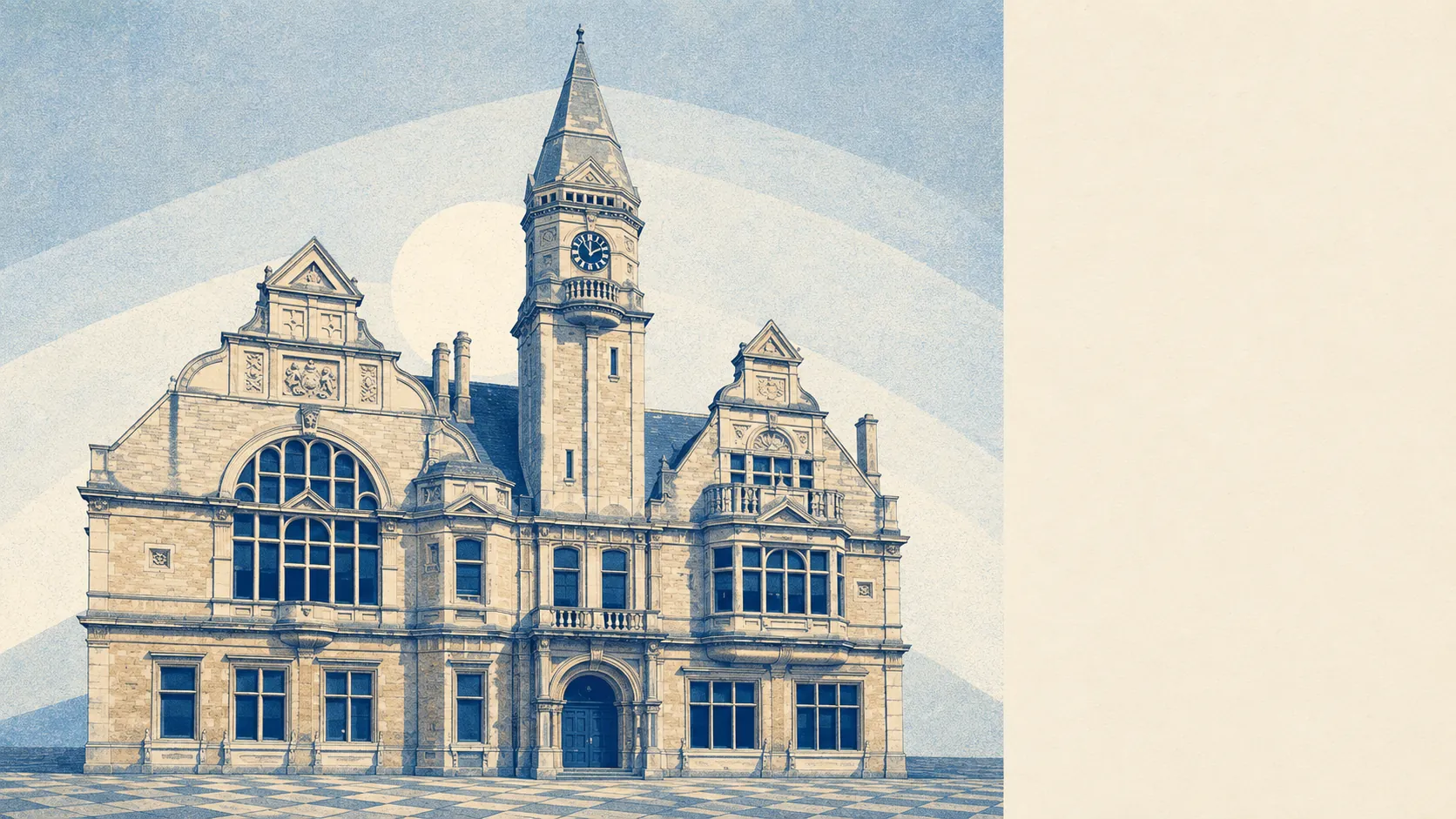
Mostly yes, and the answer turns on which side of an invisible line your house sits. The area carries 368 listed buildings. Four conservation areas sit across the town and Hilperton. Hundreds of applications go in every year regardless of any of that. Trowbridge is tightly held where it is old and largely left alone where it is not, and most of the town is not old.
Of those 368 listed buildings, 6 are grade one, 19 are grade two star and 343 are grade two. If you buy one, listed building consent applies to anything affecting its character, and that includes work inside the house as well as the bits the street can see. The common misunderstanding is that listing protects the frontage. It protects the building, which is why the plan to knock through into the back room becomes a two-stage process involving a heritage statement and someone with letters after their name.
The four conservation areas cover Trowbridge itself, New Town, Hilperton Road and Hilperton. Designation brings extra consent requirements over and above the ordinary rules, and it can strip out permitted development rights that apply freely elsewhere, which means a rear extension acceptable on one street needs a full application two streets away. The specific restrictions attach to each designation rather than to the town as a whole, so the only reliable version is the one for your address rather than the one the seller remembers.
One scheduled monument sits within the area. That is the strictest protection tier in the system and it matters mainly if you are buying land that adjoins it, in which case the constraint is on the ground rather than the building.
None of this stops people building. Between April 2024 and June 2026, 757 planning applications were submitted across the area, 323 of them in the last twelve months. Whatever the paperwork looks like from the outside, the residents of Trowbridge are clearly extending, converting and rearranging their houses at a healthy clip, and the ones who succeed are generally the ones who found out what applied to them before they paid an architect.
Ground conditions are worth a mention before the foundations are priced. The British Geological Survey puts the highest shrink-swell class present here at class three, with roughly 29% of the area reaching that level. Shrink-swell clay moves seasonally, which is a foundation-depth question rather than a reason to walk away, and it is the kind of thing a structural engineer settles in an afternoon and a builder discovers expensively in month three. Mature trees near a proposed extension make the question sharper.
One listed building in the area sits on Historic England's Heritage at Risk register. That describes a building in poor condition, where repair work may attract grant support and will certainly attract scrutiny. It is a fact about that building rather than a warning to anyone buying an ordinary house nearby.
Practically, the split is clean. Outside the designated areas, in the post-war and later stock that makes up most of the town, ordinary extensions and loft conversions follow the normal permitted development route and the process is unremarkable. Inside a conservation area, or in anything listed, assume you need consent and budget for the professional fees that go with it. The mistake that costs money is starting work on the assumption that a house looks ordinary enough to be treated as ordinary.
Freedom to alter your home here is more restricted than in most towns, and 368 listed buildings across four conservation areas is the reason. Buy outside the historic core and you will barely notice the constraint. Buy inside it and the character you paid for comes with a permanent third party attached to your plans.